Thursday, February 24, 2011

Twenty five years ago at EDSA

At EDSA in front of Camp Crame.
Twenty five years ago, in the midst of the peaceful revolution on Epifanio de los Santos Avenue (EDSA) in front of the gate of Camp Crame, somebody picked our pocket. Using today's spending econom, the contents were not much.  The wallet came back to us by mail some time during those euphoric days after Ferdinand Marcos, his family, and his trusted cronies were flown out from Malacanang Palace to Honolulu, Hawaii, contents all gone except for our residence certificate and company ID.  The sender, a Protestant minister, said he found it in a gutter on EDSA.

At EDSA fronting Camp Crame.
We were too busy with the camera, and with so many revolutionaries milling around during that bright, sunny 25th day of February and getting into multiple body contact every so often, we would not have noticed somebody's sticky fingers dipping into our back pocket.

Food and water for the soldiers.
One people.


It was not a heavy price though for the victory that came afterward. We soon forgot about it when word got around that Macoy has fled, and we were on board a fraternity brother's Volks Beetle honking down the avenue exchanging victory shouts with other sweat-drenched, exhausted yet ecstatic souls along the way.

One with the people.
The EDSA Revolution, People or People's Power Revolution, or Yellow Revolution remains to us first and foremost a military rebellion. If the mutineers did not get caught, and people did not heed the call of Cardinal Sin via Radio Veritas to go to Camp Aguinaldo then to Crame to shield Defense Secretary Juan Ponce-Enrile, Constabulary Chief Fidel Ramos and secessionist Reform the Armed Forces Movement (RAM) military elements, a truly civilian people's uprising could have taken longer to happen.  True, Corazon Aquino was going around the country for the disobedience campaign, but she could not have ignited a people's rebellion that rapidly even if her voters were seething in anger over the results of the fraudulent February 7 election, the 29 NAMFREL canvassers having walked out of their job, and the Batasang Pambansa declaring Marcos the president-elect.

"Laban!"
We are pleased to note that the role of the military in 1986 was recognized yesterday when the EDSA revolution museum at the defense department was inaugurated by President Benigno Aquino III with Senators Enrile and Honasan and former President Ramos were in attendance. After all, the military rebels were the ones who ignited EDSA.

It's really time to cast off the yellow magic spell. We should not forget why there were coup attempts during the yellow regime, or why brown-outs came about to ruin our economic agenda for many years.

The battle ground was as far as the eye could see.

The Bataan Nuclear Power Plant (BNPP) in Morong, Bataan was on its final pre-operational tests and the nuclear fuel was all set for loading into the core when Malacanang ordered that it be shut down for good. That exacted a heavy toll on the Filipino people; they continued paying the multi-million dollar loan for it through many more years.

Neighboorhood associations on the march.
That yellow dictum was particularly painful for people like us who trained very long--here and in the United States--to operate it safely. We look at the BNPP today as symbol of government folly--folly of those who ruled that it be mothballed--more so now that the nuclear option is again on the legislative agenda that includes, among others, the use of the Napot facility.


Even the handicapped were in the thick of the rebellion.
There was no immediate replacement of the nuclear plant, and the existing power generators became severely inadequate to meet increasing electricity demand.  Thus began those infuriating brown-out years, something that the romantics, we suppose, conveniently forget in their glowing recollection of the aftermath of the EDSA revolution.

Cardboard encampment for the EDSA rebels.

Democracy working equally for all such as in the access to education and health services; economic well-being and poverty alleviation; good governance and elimination of graft and corruption--we dreamed of these 25 years ago, and we still do today. 

Student activists doing their street theater act near ABS-CBN on Bohol Ave.
Did we fail the Revolution under four presidents--Corazon Aquino, Fidel Ramos, Joseph Estrada, and Gloria Macapagal-Arroyo?  Will we succeed under Benigno Aquino III?  The majority of our people voted for him because they thought he has the strong moral courage to lead it.

Sunday, February 20, 2011

Open letter of Irani filmmaker Jafar Panahi, condemned to 20 years of silence

Jahar Panahi (top left) and his internationally award-winning films.

"So from now on, and for the next twenty years, I’m forced to be silent. I’m forced not to be able to see, I’m forced not to be able to think, I’m forced not to be able to make films. I submit to the reality of the captivity and the captors. I will look for the manifestation of my dreams in your films, hoping to find in them what I have been deprived of. "

We were tracking the protest movements in the Middle East when we came across a reference to an open letter from Iranian filmmaker Jafar Panahi that Isabelle Rossellini read during the opening ceremony of the 61st Berlinale or the Berlin International Film Festival.

We jumped to the Berlinale webpage, and there it was, a video clip of the opening event showing his empty jury chair on the stage with a white board with his name on it, extracts from his movies, and Isabelle Rossellini reading his open letter.  After she was done, the audience gave Panahi a long standing ovation.

On December 20 last year, Jafar Panahi, 49, was convicted of colluding in gathering and making propaganda against the Iranian government, sentenced to six years of imprisonment, and banned for 20 years to make films, write scripts, travel abroad and give interviews to the media. His fellow filmmaker Muhammad Rasoulof was also sentenced to serve six years in jail.

Here is Jafar Panahi's open letter to the world, which can be downloaded from the Berlinale webpage in Farsi or English  --


"The world of a filmmaker is marked by the interplay between reality and dreams. The filmmaker uses reality as his inspiration, paints it with the color of his imagination, and creates a film that is a projection of his hopes and dreams.

"The reality is I have been kept from making films for the past five years and am now officially sentenced to be deprived of this right for another twenty years. But I know I will keep on turning my dreams into films in my imagination. I admit as a socially conscious filmmaker that I won’t be able to portray the daily problems and concerns of my people, but I won’t deny myself dreaming that after twenty years all the problems will be gone and I’ll be making films about the peace and prosperity in my country when I get a chance to do so again.

"The reality is they have deprived me of thinking and writing for twenty years, but they can not keep me from dreaming that in twenty years inquisition and intimidation will be replaced by freedom and free thinking.

"They have deprived me of seeing the world for twenty years. I hope that when I am free, I will be able to travel in a world without any geographic, ethnic, and ideological barriers, where people live together freely and peacefully regardless of their beliefs and convictions.

"They have condemned me to twenty years of silence. Yet in my dreams, I scream for a time when we can tolerate each other, respect each other’s opinions, and live for each other.

"Ultimately, the reality of my verdict is that I must spend six years in jail. I’ll live for the next six years hoping that my dreams will become reality. I wish my fellow filmmakers in every corner of the world would create such great films that by the time I leave the prison I will be inspired to continue to live in the world they have dreamed of in their films.

"So from now on, and for the next twenty years, I’m forced to be silent. I’m forced not to be able to see, I’m forced not to be able to think, I’m forced not to be able to make films.

"I submit to the reality of the captivity and the captors. I will look for the manifestation of my dreams in your films, hoping to find in them what I have been deprived of."

Panahi is a supporter of Iran's opposition green movement.  He was arrested in July 2009 for participating in the mourning of protesters killed in the aftermath of the disputed presidential election that year. He was released but was banned to leave the country. In February 2010, he was again arrested with his family and colleagues and taken to Tehran's Evin prison.

He is an internationally acclaimed filmmaker but his movies are banned in Iran.

His debut film, The White Balloon (1995), won the Camera d'Or at the Cannes Film Festival that year.  The New York Film Critics Circle declared it the Best Foreign Language Film in 1996.

His The Mirror (1997) garnered the Golden Leopard of the 1997 Locarno International Film Festival and the Golden Tulip of the 1998 Istanbul International Film Festival.

The National Board of Review of the USA gave his The Circle (2000), a movie about women struggle in the sexist society of Iran, its Freedom of Expression award that year.  It went to the 2000 Venice Film Festival and brought home five awards including the Golden Lion and the UNICEF awards.  In 2001, it was the FIPRESCI Film of the Year at the San Sebastian International Film Festival, and was, among others, the Best Film at the Uruguay International Film Festival.

His 2003 film, Crimson Gold, was not shown in Iranian cinemas because it was considered a "dark" movie by the government. Thus it could not be considered Iran's entry to the Best Foreign Film derby of the 2003 Oscars.   It's interesting to note that "the lead actor, playing a pizza delivery man, is, in real life, a pizza delivery man [who] is also a paranoid schizophrenic." (The hyperlink goes to a trailer of the film.) 

His movie Offside (2006) about a group of women trying to sneak into a stadium to watch a qualifying soccer game between Iran and Bahrain for the 2005 World Cup.  Women are forbidden to watch male sports events.  The film won the Silver Bear of the 2006 Berlinale. (The hyperlink goes to a trailer of the film.)

As Jafar Panahi said, he will make movies in his mind for the next 20 years. Hopefully,  international film festivals will give him every now and then some space and time for his freedom of expression through these films he has completed for the world to see.   


References:


Stone, Susan. (2011, Feb 19). Berlinale focuses on Iran. Los Angeles Times. Retrieved from  http://www.latimes.com/entertainment/news/la-et-0219-berlin-film-20110219,0,7637764.story

Dehghan, Saeed Kamali Dehghan, (2010, Dec 20).  Iran jails director Jafar Panahi and stops him making films for 20 years.  The Guardian Co. UK. Retrieved from http://www.guardian.co.uk/world/2010/dec/20/iran-jails-jafar-panahi-films

Hubschman, Daniel. (2010, Dec 20). Iranian Filmmaker Jafar Panahi sentenced to six years in jail.  Hollywood.com. Retrieved from http://www.hollywood.com/news/Iranian_Filmmaker_Jafar_Panahi_Sentenced_To_Six_Years_In_Jail/7743689

IMDb,com for materials regarding Jafar Panahi and his movies (hyperlinks in the above story).

Thursday, January 27, 2011

Postscript to the January Sto. Nino Festivals: Christianized Philippines is 446 years old!

The image of child Jesus was given by Magellan to the queen of Cebu in April 1521; it was recovered by Miguel Lopez de Legazpi in April 1565.
The colorful costumes and the tom-tom drums for the Ati-Atihan (Kalibo, Aklan), Sinulog (Cebu City) and Dinagyang (Iloilo City) festivals have now all been stored and yet ready for retrieval just in case invitations or opportunities to compete in forthcoming carnivals, religious or not, in neighboring places come the dancing troupes' way.  The Sto. Niño images used as props in the street dancing and other festival side-events like the beauty queen contests probably are back in the household altars unless these were given away to visiting relatives and friends or sold to local and foreign tourists.

Source:  The Manila Bulletin. 17 January 2011

It’s interesting to note that the Kalibo, Cebu and Iloilo carnivals revolve around the child Jesus with the original Sto. Niño image in residence at the Cebu cathedral while replicate copies are housed in the Kalibo and Iloilo churches, but the Ati-Atihan was the original street celebration centuries before Dinagyang and Sinulog festivals were organized as tourist attractions in 1967 and1981, respectively. Since Iloilo and Kalibo are in Panay Island, their carnivals have a historical add-on:  commemoration of the arrival of the Bornean datus there around three millenia earlier than the Spaniards and how they eventually converted their pagan dancing ritual into the Ati-Atihan.

Without the Sto. Niño, these  three Visayas festivals and the non-religious Binirayan of Antique, MassKara of Bacolod and the Panagbenga of Baguio would all be the same hot pandesal but of different brands.  Other derivative pandesals have since spawned like the Talong, Longganisa, and other product promotion carnivals throughout the archipelago.   We think that are too many of them in the Philippine tourist market. We may yet see a war among these pandesals with the hottest eventually emerging as the Philippine Mardi Gras like the international crowd-drawing hedonistic carnivals of Rio de Janeiro and New Orleans.

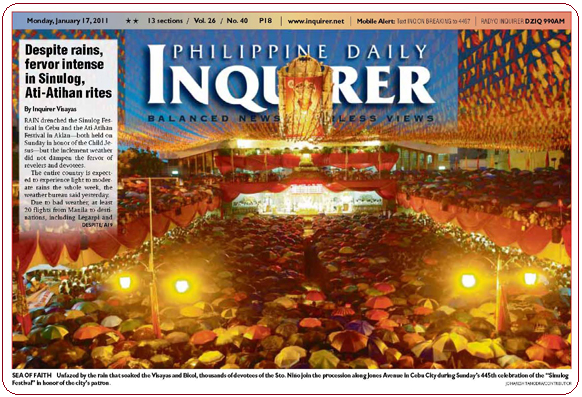
Setting that view aside, we were grateful that the multi-media coverage of the Sinulog highlighted as well the religious commemoration of the child Jesus and the folk catholic adoration of the historic Sto. Niño image on the eve of the street carnival.

Religious commemoration, Cebu City. (The Philippine Daily Inquirer, 17 Jan 2011).
The image reminds that Christianized Philippines will be 446 years old in April this year.  Sometime that month in 1565, the soldiers of Miguel Lopez de Legazpi recovered the image of the Sto. Niño left there by Ferdinand Magellan in 1521.   Legaspi had a church immediately constructed to house the image, and had it named [Santissimo] Nombre de Jesus. 

Pigafetta (c1525) wrote that after the queen of Cebu and her party of forty women were baptized, she was “shown an image of our Lady, a very beautiful wooden child Jesus, and a cross.”  The queen, named Johanna in her baptism, expressed interest to keep the child Jesus to replace her idols, and Magellan gave it to her on 14 April, 1521  (Blair & Robertson Resume of Documents, 1(2), 1906).

It is believed that this is the same image that soldier Juan Camuz found and showed to Esteban Rodriguez in one of the houses abandoned by the natives upon the arrival of Legazpi (B&R Resume) in Cebu “ on the twenty-seventh day of the month of April, day of the glorious martyr St. Vidal, in the year 1565 [which] happened to be also the feast of the resurrection (Medina, 1630).”

“Your excellency,” Legazpi (1565) wrote the king, “should should know that on the day when we entered this village one of the soldiers went into a large and well-built house of an Indian, where he found an image of the child Jesus (whose most holy name I pray may be universally worshiped). This was kept in its cradle, all gilded, just as it was brought from España; and only the little cross which is generally placed upon the globe in his hand was lacking. This image was well kept in that house, and many flowers were found before it, no one knows for what object or purpose. The soldier bowed before it with all reverence and wonder, and brought the image to the place where the other soldiers were. I pray the holy name of this image which we have found here, to help us and to grant us victory, in order that these lost people who are ignorant of the precious and rich treasure which was in their possession, may come to a knowledge of him. “

In a letter from Sevilla to Miguel Salvador of Valencia (1566), the writer spoke of the Mexican soldiers in the expedition who found  “in a poorly-built house … an image of the child Jesus, such as comes from Flanders, with his veil and the globe in his hand, and in as good condition as if just made.”

Sinulog 2011.  (Manila Bulletin & Phil. Daily Inquirer, 16 Jan 2011) 
The earliest account we’ve read on the veneration of the Sto. Niño comes from Chirino  (1604). He wrote that “the Indians …held the object [carved image of the holy child Jesus] in great veneration … and had recourse to it in all their necessities—making sacrifices to it after their custom, and anointing it with their oils, as they were accustomed to anoint their idols. … Each year it is borne in solemn procession from the church of St. Augustine to the spot in which it was found, where a chapel has since been erected. The procession takes place upon the same day when the discovery was made -- namely, on the twenty-ninth of April, the feast of the glorious martyr St. Vital, who is patron of the city, and as such that day is kept as a solemn feast in his honor. One of the regidors, appointed each year for this purpose, brings out the banner of the city; he is on that day clad in livery, and invites the public to the festivals. There are bull-fights and other public festivities and rejoicings, with many novel fireworks, such as wheels and sky-rockets, which the Sangleys make the night before; on this occasion they construct things well worth seeing, and which appear well-nigh supernatural.”

Miracles have been attributed to the Sto. Niño at childbirths and hence called El Partero, “man-midwife” (Chirino), during the ‘terrible drought of 1618’, ‘a number of great fires including the one in 1632 when the city would have been entirely destroyed if the flames had reached the Spanish powder house’, and the ‘cholera epidemic of 1752’ (Del Mar, 1935), among other testimonies of people through the years.

Hence, “most people come to fulfill vows made to the Santo Niño in seeking recovery from some serious illness, either for themselves or their loved ones. They place lighted candles before the image and kneel and pray, and sometimes perform a sort of dance known as the sinulog, literally "current", as of a stream” (Abellana, 1935), sinug to Bautista (1935) where performers “shout and dance and perform a sort of moro-moro or sham battle with wooden bolos and shield before the Senior Santo Niño …”

It would be very interesting to find when the dancing of the sinulog or sinug started.  But years before this morphed into the street dancing carnival in 1981, this was how it was – 

“The dance is performed either inside or in front of the old San Agustin Church and often lasts for hours, the dancers hoarsely shouting "Pit Senor!" an expression of no known meaning, and frenziedly fighting an imaginary enemy with their wooden weapons to the beat of one or more drums. Next to the great procession in honor of the image, this dancing is perhaps the most interesting feature of the Santo Nino festival.

“Old folk and children as well as young men and women whirl about and dance and shout, some of them weeping and beating their breasts with their fists. Most of them come from the distant barrios of the province in compliance with some vow or seeking a cure to ailments ranging from skin troubles and rheumatism to more serious illnesses. Often children only a few months old are carried into the dance on the shoulders of a parent or other relative.

“The dancing last several days but only until the gold-embroidered habiliments of the image, put on for the feast, are removed and replaced by the ordinary robes. Sometimes it is a week before the clothes are changed, apparently in order to give all of the thousands of people who flock to Cebu an opportunity to kiss the Holy Child in its regal dress.

“The sinug is begun on the afternoon of the procession by a group of small boys dressed up in belts and shoulder straps just before the main door of the Church is thrown open and Senor, borne on the silver-plated and lavishly adorned carro, emerges. As the procession progresses slowly down the principal streets of the city, the dancing boys, who are paid for this service, precede it. Sometimes one of them comically goes beyond what is required of him to the suppressed laughter of the onlookers, but he comes to grief if the maestro who is in charge of the boys detects him, for he does not choose a place to reprimand him, but does it on the spot--with a horsewhip.

“There are expert professional sinug dancers who are paid five or ten centavos by those who can not dance before the Senor personally. The hired dancers will shout "Pit Senor, kang Juan kini!" meaning, "Pit Senor, this is for Juan!". Such a dance lasts only a few minutes, particularly when business is brisk, and the drummer gets a share.  

“After the feast the friars in charge of the Church allow the dancing only in the patio, and it is said that the prior has counselled the people to refrain from the sinug and revere the Senor in a simpler way, but the practice appears to be ancient and is deeply rooted and the people have so far been unwilling to give it up. …” 

Give up the folk religious tradition?  Would the Church even dare now since this Sinulog and other religious festivals have become economic activities in the country?

Do these Christianized expressions of faith speak of the Christianity of the nation? Have we become truly Christian 446 years after we’ve replaced the ancient pagan idols with the Sto. Niño image and other icons of the Roman Catholic faith? 


Sources:

1.      Editorial. (1965 Apr). The Fourth Centennial of Christianity in the Philippines. The Journal of the American Chamber of Commerce of the Philippines.  41(4):157. Retrieved from http://name.umdl.umich.edu/aaj0523.1965.001 

2.       Pigafetta, Antonio. ( c1525).  First Voyage Around the World  [I Primo viaggio intorno al mondo]. Italian text with English translation found in The Philippine Islands, 1493-1803; 1(33):159,161,163. Blair, Emma Helen & Robertson, James Alexander,  Eds. Cleveland, Ohio: The A. H. Clark Company, 1903-09.  Retrieved from http://name.umdl.umich.edu/afk2830.0001.033 

3.       Resume of documents found in The Philippine Islands, 1493-1803; 1(2):119-121.  Blair, Emma Helen & Robertson, James Alexander,  Eds. Cleveland, Ohio: The A. H. Clark Company, 1903-09.  Retrieved from http://name.umdl.umich.edu/afk2830.0001.002 

4.      Legazpi, Miguel Lopez de. (1565). Relation of the voyage to the Philippines [Cebu] found in The Philippine Islands, 1493-1803; 1(2):215,216. Blair, Emma Helen & Robertson, James Alexander,  Eds. Cleveland, Ohio: The A. H. Clark Company, 1903-09.  Retrieved from http://name.umdl.umich.edu/afk2830.0001.002 

5.      Copy of a letter sent from Seuilla to Miguel Saluador of Valencia which narrates the fortunate discovery made by the Mexicans who sailed in the fleet which His Majesty ordered to be built in Mexico with other wonderful things of great advantage for all Christendom worthy of being seen and heard. Printed in Barcelona, By Pau Cortey, 1566 found in The Philippine Islands, 1493-1803; 1(2):225,227. Blair, Emma Helen & Robertson, James Alexander,  Eds. Cleveland, Ohio: The A. H. Clark Company, 1903-09.  Retrieved from http://name.umdl.umich.edu/afk2830.0001.002 

6.      Medina, Juan de, O.S.A. (1630; Manila, 1893). History of the Augustinian order in the Filipinas Islands (to be concluded) found in The Philippine Islands, 1493-1803; 1(23):158-159,167. Blair, Emma Helen & Robertson, James Alexander,  Eds. Cleveland, Ohio: The A. H. Clark Company, 1903-09.  Retrieved from http://name.umdl.umich.edu/afk2830.0001.002 

7.      Chirino, Pedro, S.J. (1604). Relacion de las Islas Filipinas (to be concluded) found in The Philippine Islands, 1493-1803; 1(12):179-182. Blair, Emma Helen & Robertson, James Alexander,  Eds. Cleveland, Ohio: The A. H. Clark Company, 1903-09.  Retrieved from http://name.umdl.umich.edu/afk2830.0001.012 

8.      Abellana, Martin. (1935 March). The “Santo Nino” Festival. Philippine Magazine. 32(3):127-128.  Retrieved from http://name.umdl.umich.edu/ACD5869.0032.001 

9.      Bautista, Rafael A. (1935 March). “Pit Senor”. Philippine Magazine. 32(3):127-128.  Retrieved from http://name.umdl.umich.edu/ACD5869.0032.001 

10.  Mar, Perla del. (1935 March). The Holy Child of Cebu. Philippine Magazine. 32(3):127.  Retrieved from http://name.umdl.umich.edu/ACD5869.0032.001


Wednesday, January 12, 2011

An enlightening encounter with a T'boli family in Lake Sebu

Our very kind and friendly T'boli hosts treated us like family.
The T'bolis are said to be the most hospitable people. We agree! This after a T'boli family in Lake Sebu town invited us into their household, brewed coffee for us, prepared nganga chewables for those who'd like to give it a try, played T'boli music from their bamboo 'guitar', and, over cup of coffee, regaled us with family and tribal stories--all in response to a simple request for permission to take pictures of their house.
  
Front view of the house:  stairs, door and living room window.
It's the T'boli house architecture that got us to stop over for photographs after ziplining and hiking to the seven waterfalls in Lake Sebu, surveying the rim of the remaining virgin forest in the area, and dipping in the clear waters of a river down there.

Support for the retractable windows (bedroom window, left).
We thought the architecture best fits a beach house. We own one in Zambales, and just in case someone is interested to put up another one beside ours, we'd strongly suggest to follow the T'boli house design.
 
A view of the virgin forest through the wide living room window.


Bed room window. No beds but mats. Storage racks above.
It's the windows that we found interesting. They are pulled down to rest on support posts during the day to let in the fresh air esp. in the summer, and pulled up at night or during rainy days. The wide windows provide an exhilarating view of the greenery all around.

T'boli family and guests sit comfortably on the floor.
The house has only two areas:  the bedroom and the living-dining-kitchen room.  There are no furniture, not even a dining table. Family and guests sit on mats or on the floor of bamboo slats. 

Common rocks stove, overhead storage rack and golden roof.
The kitchen is right there consisting of the usual trio of rocks to support the cooking pot, a storage rack above it where the dry corn are hang and woven bamboo bins are kept.  The roof above the living room has acquired a golden/copper patina after the smoking it got for a long time. 

Music making and pounding rice, T'boli way.
In this setting did our hosts entertain us. We sat around the living room sipping newly brewed coffee from tin cups while the T'boli Old Woman strummed her bamboo guitar, the T'boli Old Man prepared the betel nut chewable, answering our sundry questions on things T'boli .  

Later, the nursing woman narrated her love story when we asked who among the menfolk in the house is her child's father. She simply said, "I gave her away to the another woman from another tribe."  What did she mean? "I love him so much that I let him go and marry her ...  or he will be killed for raping that woman. That's our custom."

She sacrificed her love, she emphasized, so that his son would still have a father as he grows up. But for the man to be free and be spared the harsh punishment, tradition dictates that, first, he had to return his wife to her family with a fine of three horses; and second, he had to go through the same ritual as in his previous marriage--offer a dowry of five horses and seek approval of the other woman's family. 

Of course, the T'boli we met no longer wear their traditional dresses. Their elaborate beaded and colorful costumes  they now wear only during special occasions. The household we visited may not be rich since we did not see any of those brass decorative sculptures, which possibly are now being produced for the tourist market.

In the afternoon, we visited the T'boli museum and the souvenir shop for our fill of T'boli art, which can be seen in their tinalak of various dream weave patterns, brass sculptures, heavy and elaborate royalty belts, women blouses in black and embroidered with intricate patterns using colored beads, and of course, the necklaces and bracelets of stringed colored beads.

The museum and the shop were designed like the typical T'boli house--low and with retractable wide windows.

Friday, December 31, 2010

A New Year's eve story when it was dangerous to be a Pinoy in California

It happened on the eve of the new year 1926 in Stockton ...

Source:  The Philippine Republic (1926, January). 3(1):19. Washington DC. Retrieved from  http://name.umdl.umich.edu/ACC6198.1926.001

Thursday, December 30, 2010

Rizal Day USA during the campaign period for Philippine independence

Today, 30th of December 2010, promptly at 7 o'clock this morning, His Excellency Benigno Simeon Cojuanco Aquino III, presided over the Rizal Day ceremonies at Luneta Park to mark the 114th death anniversary of national hero, Dr Jose Rizal.  As tradition dictates, he hoisted the giant Philippine flag with the assistance of top civilian and military authorities, laid a wreath of flowers at the foot of the hero's monument, and delivered a memorial message to the Filipino people. 

It's not a holiday today however. PNoy moved it earlier to last Monday, 27th December, and we doubt if the citizenry even considered giving a pause for Rizalian reflection that day before they resumed their planned activities for the extended Christmas weekend.

Except for the Luneta rites, the only other Rizal Day celebration we know of is the city fiesta of Olongapo City.  It's always been called 'Rizal Day' although we doubt if there is anything commemorative of the hero's sacrificial death amidst the noise and fun in the auditorium and around the festive food tables of the city households. 

Rizal Day on December 30 was an eventful day among Filipinos here and abroad before the Americans restored our independence on the 4th of July in 1946.  Records show that they celebrated in grand fashion with parades, dinners and other commemorative programs. 

It could be that Rizal Day morphed into the 4th of July, later replaced by the 12th of June, independence day celebrations.  In the pre-World War II days (peacetime to the old generation), Filipinos had no big historical event to commemorate (did we win the war against the Spaniards? the Americans?) yet.  As residents of an American territory, they celebrated the holidays of their colonizers.

It was a lingering veneration of Jose Rizal, and a vintage decree issued by Emilio Aguinaldo of the short-lived Philippine Republic on 20th December 1898 that kept Filipinos observed Rizal Day with pomp and ceremony here and abroad during the first four decades of the 1900s.

The Philippine Republic, a magazine that was set up by Americans to help in the Philippine independence campaign, left us records of 'how Rizal Day was celebrated in the United States'.  From issues of 1925 to 1928, we read accounts of how Filipinos in various cities in the United States, in Japan, and even Argentina kept the memory of Jose Rizal alive.

Our survey of the Rizal Day programs during those years show the following common elements --

  • Recitation of "Mi Ultimo Adios"/"My Last Farewell", sometimes with a piano accompaniment;
  • Musical entertainment featuring Filipino bands, orchestras, jazz groups, string quartets;
  • Musical numbers from Filipino and guest American singers and instrumentalists (pianists, violinists, guitarists, etc) rendering classical and patriotic songs and compostions;
  • Orations and speeches from guest speakers (pro-Independence Americans, visiting dignitaries from the Philippines, notable members of the sponsoring Filipino association);
  • Recitation of Rizaliana (biography, poems and excerpts from his other literary works);
  • Formal attire--the barong has not come of age yet; 
  • Singing of two national anthems:  Star Spangled Banner and the Philippine National Anthem.
In some cities, there were Rizal Day Queens.  We also found a playlet of four scenes, the last a re-enactment of the execution in Bagumbayan, a table d'hote of dishes with Philippine names. 

There was a group of Filipino scholars there who called themselves The Philippines Collegians, probably because they were from the University of the Philippines doing graduate work in Harvard U.  Enrique Virata, Gregorio Zara, Juan Nakpil, and their colleagues--big names later in the Philippines--organized very formal Rizal Day programs.

Here are a few reminders of how Filipinos in America remembered national hero when they were there as pensionados or self-supporting students in the universities and colleges, World War 1 veterans who opted to stay and raise families there, adventurous Pinoys who came to work in the plantations of Hawaii and California and in the canneries in Alaska, and the first generation of Fil-Ams--US-born or innocent children yet when their parents migrated there. 
  • Brooklyn, New York City, 1924.

The Filipino masons of "Gran Oriente Filipino" led the annual Rizal Day celebrations in Brooklyn, New York City. In this 1924 event, violin prodigy Ernesto Vallejo was 14 years old.

  • Boston, Massachussetts, 1924.
In the Boston area, the Filipino World War 1 veterans were the leaders in the celebration of Rizal Day.
  •  Los Angeles, California, 1924.
The Filipino Association of Southern California called this a Rizal Day meeting, and from the program, it looked like it was a music concert.
  •  Washington DC, 1925.
In this Washington DC Rizal Day, Mrs Claro M Recto, soprano, a music student in Washington at that time rendered a vocal solo.
  • Detroit, Michigan, 1925.
What's remarkable in this celebration is the table d'hote consisting of, among others, Malolos Salad with Philippine Islands Dressing,  Biak-na-Bato Ice Cream, Balintawak Cakes and Bagumbayan Coffee.  The Philippine Revolution on the table, indeed!
  • San Diego, California, 1925.
This program tells us that the Filipinos in the United States Navy at that time were not only cooks and stewards but also musicians. 
  •   Salinas, California, 1925.
This 1925 Rizal event was a three-day celebration.  Other cities also had Rizal Day Queens.
    •  Seattle, Washington, 1925.
    The chairman of the executive board of the Filipino Council of Seattle in 1925, and the toastmaster for that year's Rizal Day celebration was Victorio C. Edades, who was working his way through fine arts schooling in the city.  Victorio Edades would become a National Artist of the Philippines.
    •  Crane College, Chicago, Illinois, 1926.
    Every year the Crane College Filipino Club was among several Chicago-based associations that organized Rizal Day activities.  The picture tells us that Philippine music was very much part of the commemorative program.


    Sources of pictures and information:
    •  The Philippine Republic ( 1925-1927 issues).  Retrieved from the University of Michigan Digital Library Collection, The United States and its Territories, 1870-1925: Age of Imperialism at http://quod.lib.umich.edu/p/philamer/


    Friday, December 17, 2010

    Westernization/Americanization of Philippine Christmas Gift-Giving

    In our previous post, we cited Alvaro Martinez's account that by the 1930s, the Filipino tradition of gift-giving at Christmas time had been westernized.  He said that only children used to be the recipients of  gifts from relatives and godparents.  Perhaps, this still lingers in the Filipino consciousness when we hear about Christmas being "para sa mga bata" (for children only) even if we all scour the malls and the tiangges for presents to adults as well.

    There were no shopping malls.  We can imagine mothers with their daughters trooping to Phil. Education Company to look at the dolls with names like Miss Kiss Me, Little Miss and Ma-ma.  Source:  Philippine Magazine (Nov 1929).
    Mary Macdonald's Suggestion for Christmas Shopping in her The Philippine Home corner in the December 1929 issue of Philippine Magazine confirms that the Americans clearly influenced the transformation of Philippine Christmas into what our generation (post-WW2) became accustomed to.  This includes the expensive presence of Santa Claus in the picture.  

    This store in Escolta had mostly sports items to suggest for the gift-giving to children and adults.  Source:  Philippine Magazine (Nov 1929).
    She was talking about gifts for children, mothers and fathers.  We may infer that she was addressing the American community, and the Filipino readers of the magazine, which comprised the educated and well-off, the new middle class and the old rich, at that time.  Thus when she said "children everywhere are talking about Christmas, and what they want Santa Claus to bring them", she could have been referring to the children of the privileged class.  
     
    Meralco suggested electrical appliances as Christmas gifts.  Source:  Philippine Magazine (Dec 1929).
     Let's remember that the democratized public school system started the osmosis of American culture and lifestyle into the Filipino mind. By the 1930s, Christmas was already party time for American business in the Philippines.  If we look at the advertisements at that time, the target market was the affluent class.  In due time, as we all see every year, the frenzy for buying (and expecting) gifts spread to all social classes. 

    No National Book Store then but PECO where you can pick up Hemingway's 'A Farewell to Arms', a novel set during the first world war, as a Christmas gift.  Source:  Philippine Magazine (Nov 1929).
     What Macdonald wrote then still rings true today:  "How many of us are doing our Christmas shopping early?  A great deal of confusion and money can be saved if we will take time to figure out how much money can be allowed for Christmas spending and apportion it out accordingly."  She went on to say that doing it early affords the shoppers "new, fresh stocks choose from" and spares them the fatigue from "jostling with the last-minute crowds."


    Jewelry for gifts. Source: Philippine Magazine (Nov 1929).
    She suggested these gifts for small boys--instructive building blocks instead of the cheap mechanical toy, and for the little girls--a pair of blunt scissors with a set of paper dolls to be cut out, and the bright-colored papers from which to cut dresses instead of more expensive things. The more expensive toys around that time could be "a pair of roller skates or a tricycle or those fascinating two-wheeled side-walk bicycles" for the boys, and lovely dolls for the girls.

    Today, of course, we get a variety of goods for young kids from the local franchise of Toys R Us and the distributors of Made In China playthings.

    "Books are most acceptable," she wrote.  This is a timeless suggestion. Today, there is a great body of children's literature written by Filipino authors around Philippine themes.

    Suggested gift items for the grown-up girls included "lovely brush and comb sets in colors to match her room, and the most fascinating organdie boudoir pillows for the dainty bed; a new dress; and a small rug for her room."  Obviously, the girl in Macdonald's mind was not a provincial girl living in a nipa hut.   

    Shoes.  Source:  Philippine Magazine (Nov 1929).
    And for boy entering his teens:  a book about pirates, a new Boy Scouts outfit, an inexpensive violin, or a new bicycle.  Not a farmer's son, this boy.

    Macdonald was not referring to our grandmother when she was looking at "beautiful pieces of pottery for the living room in colors to harmonize with the draperies ... attractive bedspreads and bolsters, or perhaps some extra pieces of silverware ."  Our grandma could have been happy if she got from our grandpa "beautiful hand-embroidered Philippine handkerchiefs."  But then, she could not have had everyday use for them.

    Our maternal grandpa was literate and he owned horses (all butchered during the second world war), but we don't know if he subscribed to the Philippine Magazine, Graphic or Philippines Free Press. If he did, he could have loved our grandma "renewing the subscription for his favorite magazine" as a gift.  He could have read El Filipino though because his best friend helped set up this short-lived news-magazine in the mid-1920s.  Could he have appreciated a  book on the first world war, as suggested by Macdonald?  Others could have wished to receive "a new tie-clasp, and socks and handkerchiefs." 

    Almost a century before the coming of digital cameras:  A choice of cameras from Kodak and Agfa. (Source: Philippine Magazine (Nov 1929).
     Spread out in this article are several advertisements for gift items in the 1930s.  Aside from these, there could have come others to the variety to choose from until the second world war possibly halted albeit temporarily the Americanization of Filipino Christmas.

    Something Filipiniana even then. Shellcraft still sells abroad today.  Source:  Philippine Magazine (Nov 1929).
    We know that there was no stopping the transformation of Philippine Christmas after the war with other foreign influences coming in. It's gone global too bearing gifts of bibingka, lechon and suman pascua (native delicacy among Zambales Ilokanos) and other regional delicacies to foreign hosts of Filipino communities.
    Christmas cards from PECO.  Source:  Philippine Magazine (Dec 1929).