Showing posts with label Manila Bay. Show all posts

Tuesday, June 17, 2014

Ferrying up and down Pasig River

NOTE.  This photo-essay appeared in the 13-19 June 2014 issue of the FilAm Star, a weekly published in San Francisco, CA "for the Filipinos in mainstream America."  This author/blogger is the Special News/Photo Correspondent of the paper here in the Philippines.

A trip between Pagbuhatan or Guadalupe and Escolta or Plaza Mexico passes by the Pandacan oil depots.

We cross over the Pasig River each time we take the metro/light railway transits on EDSA and Taft but we’ve never taken a cruise along its 26-kilometer stretch from Laguna de Bay to Manila Bay until last week when we took the ferry boats from the Guadalupe in Makati to three destinations:   Escolta and Plaza Mexico in Manila, and Pinagbuhatan in Pasig City.

At this time, only five ferry terminals from Pasig to Manila are operational in the Pasig River Ferry Service re-launched by Metropolitan Manila Development Authority (MMDA).  All the runs to Manila stop by the Polytechnic University of the Philippines (PUP) terminal in Sta. Mesa. The ferry service had its test-run with three bus-boats in March, and became fully operational on 28 April with free rides for one week.

The Philippine Postal Office at Plaza Lawton is an architectural landmark along the Pasig.

The ferry service is a joint project of the MMDA, the Department of Transportation and Communication (DOTC) and the Pasig River Rehabilitation Commission (PRRC).  MMDA looks at it as “an alternate mode of public transport for commuters who will be affected by traffic jams expected to be generated by the 15 major infrastructure projects across Metro Manila that will be completed by 2016” especially for residents near the river or for those whose work places are near the river.

The Escolta Ferry Terminal below the Jones Bridge.

This is not the first ferry service on the Pasig.

Magsaysay Lines had a brief operation from 1990 to 1991. Its Guadalupe-Escolta services closed down because of problems that arose from informal settlers along the river banks, garbage in the river and foul odor from the polluted water.

Starcraft Ferry also operated a service from Bambang, Pasig City to Escolta using 30-seater catamaran-type boats in 1996.  It folded up a year later due to the same problems that encumbered Magsaysay Lines.

In 2007, the government revived the ferry service. A private firm, SCC Nautical Transport Services, owned and operated six 150-seater air-conditioned boats serving the stretch from Intramuros to Pinagbuhatan. The service closed down in 2011 because of business losses.

The re-launch this year has a private company owning and operating the boats. A boat can accommodate 28 persons, running 12 knots at most, slowing down to 5 knots along the Malacañang area. From Guadalupe, it can run downstream to Plaza Mexico in about 40 minutes, and upstream to Pinagbuhatan in about the same time.

An old business building in Binondo from across the Plaza Mexico ferry terminal.

Passengers from Guadalupe pay Php 50 in going to any of three destination terminals: PUP, Escolta or Plaza Mexico.  The Guadalupe-Pinagbuhatan run costs Php 45.  The fare for the PUP-Escolta and Escolta-Plaza Mexico ride is Php 30. When we had our rides, the discounts for students, senior citizens, children and persons with disabilities were not in place yet.

When we took the ferry at Guadalupe, three giant billboards loomed over the river.  These feature a popular movie actress in her lingerie with a crown, and “Her Royal Beauty” is printed across two adjacent billboards.

The beautiful model reminds of the woman who appears at night during full moon, the Mutya ng Pasig of National Artist Nicanor Abelardo, which he composed in 1926.  At that time, Pasig must still have been the “lifeline” of Manila and other communities it ran through:  a clear flowing river teeming with fishes, clean for the bathing and the laundry washing on the river bank, the air cool and pleasant for the sailing from the lake to the bay.
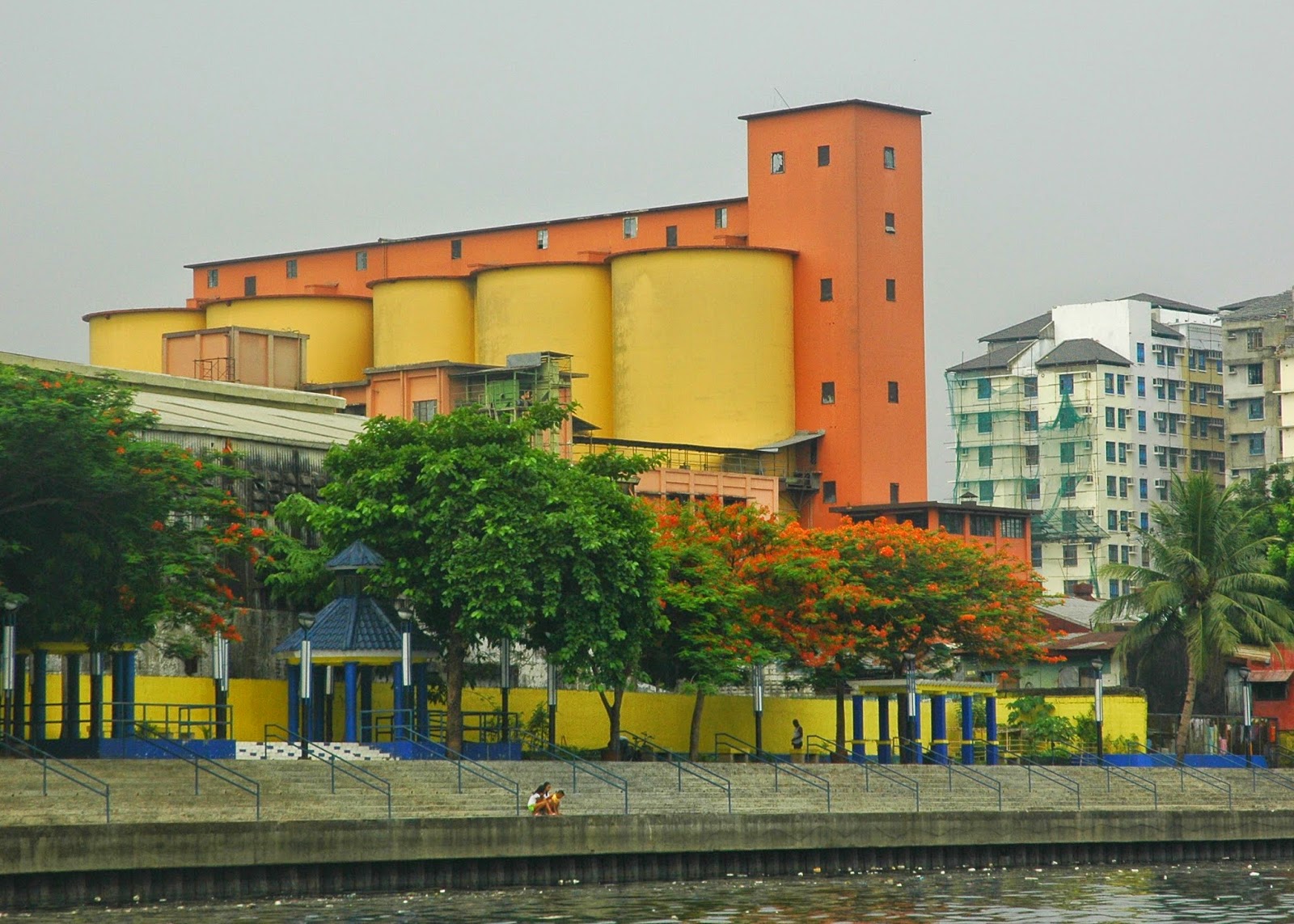
Linear park colors from silos, concrete fence and fire trees.
The PRRC gives us this timeline in the river’s transformation from being lifeline to becoming the “sewer” of the metropolis:  increasing river pollution and diminishing fish migration from Laguna de Bay (1930s), decline of bathing by the river (1950s), further decrease of people bathing, washing clothes and using river water for cleaning (1960s), emanation of foul odor and deterioration of water quality to Class C (1970s), total disappearance of any fishing activity (1980s) and declaration of its being biologically dead (1990s).

It’s still summer when we rode the ferry.  Overall, the river is murky.  There is no indication whatsoever of any life in the water in going downstream to Plaza Mexico.  Upstream though at the approach to Pinagbuhatan, we saw plenty of white birds flying low and peeking into the river, diving for fish fries, according to the helmsman.

The smell was initially a bit offensive but this disappeared during the cruise.  The boats are not air-conditioned. What assailed us were garbage accumulations in many parts especially along populated river banks, and the bits and pieces of thrash floating all around.

The banks were cleaner along the commercial properties like oil depots and manufacturing companies and along the linear parks of  Carmona, Valenzuela, Poblacion and Guadalupe, all in Makati; PUP, South Nagtahan, Intramuros and Plaza Mexico, all in Manila.

Colorful houses near the Guadalupe terminal.
We learned that PRRC has joined hands with local government units and other public and private agencies in the relocation of informal settlers along the river banks and esteros, and in the rehabilitation of esteros like Paco (2009), Sañtibanez and Aviles (both in 2013). Esteros are the flowing sources of garbage to the Pasig when the rains come.  Unless ecological solid waste management is effectively implemented in the cities and towns comprising the Pasig River basin, the 47 tributaries carry their garbage as well into the river. 

Despite the smell and the ugly sights at this time, we still enjoyed the photo opportunities we found during the rides, and the prospect of easier access to historical and touristic sites from the ferry terminals.

New riders would gain an insights on the physical linkages of the Metro Manila:  first,  the 14 bridges along the stretch from Pinagbuhatan to Plaza Mexico, and second, the bancas ferrying passengers between river banks, a commuter service that has been going on in the history of the Pasig River.  The commuter bancas cost a passenger Php 5 for the short distance across the river.

Terminal of bank-to-bank commuter boats.
The Guadalupe ferry terminal on JP Rizal St. is a short walk east of the bridge on EDSA.  Going to Pinagbuhatan, the ferry goes under C-5 or Pasig-Makati Bridge, the Bambang and Arsenio Jimenez (Kalawaan) Bridges.   Of interest is passing by the Napindan Flood Control Center where one sees the gates to control floodwaters from the lake.  The destination terminal is several meters away from the Pinagbuhatan Bridge.

Going downstream to Plaza Mexico, the ferry goes under three bridges in the Makati span: Guadalupe,  Estrella Pantaleon and Makati-Mandaluyong Boundary.  Estrella Pantaleon leads to the Rockwell Center. 

Lambingan Bridge connects Sta. Ana, Manila and Mandaluyong where the Pasig makes its U bend.  This is followed by the Pandacan or Padre Zamora Bridge, which spans into Sta. Mesa, and is clearly visible from the PUP ferry terminal.

Before approaching Mabini or Nagtahan Bridge, we were reminded of the no-photography (camera or mobile camphones) rule during the slow-down along Malacañang.  A Coast Guard man comes on board PUP to enforce the ban.  We’ve been figuring out the ‘why’ behind this ban when any tourist can have his photo taken on the avenue behind the White House.

Skyview & Makati-Mandaluyong Bridge.
After Nagtahan, veteran Manila visitors would readily recognize the foursome of Ayala, Quezon, MacArthur and Jones Bridges.  There’s a parallel bridge to Quezon bridge, the LRT-1 bridge connecting Central Terminal and Carriedo Stations.  One would not miss the island whose tip seems to touch Ayala Bridge: the Isla de Convalescencia where Hospicio de San Jose is located.

The Escolta ferry terminal is at the foot of Jones Bridge, right side, while the Plaza Mexico terminal is about 300 meters away on the left side.

Thus, our ferry travel log on the Pasig includes historical notes on the Isla de Convalescencia where the Hospicio de San Jose took permanent residence since 1810.  We caught sight of the spires of the National Shrine of Saint Michael and the Archangels on Malacañang grounds.  We read that this is popular among Roman Catholic betrothed couples because they can have their pre-wedding confirmation and baptism, if needed, here all in the same day. 

Commuter boat loading passengers going to opposite bank.
From the Escolta terminal, this ferry traveller took a memory stroll down Escolta St. before proceeding to Sta. Cruz.  We could have walked to Binondo/Chinatown too.

Intramuros is accessible from Plaza Mexico where stand the commemorative monuments to the fourth centennial of maritime trade between Mexico and the Philippines and the galleon trade. 
Plaza Roma is a short walk away for a visit to the Cathedral, Fort Santiago and other historical places inside the walls of Old Manila.

It may take some more time before ferry service on the Pasig becomes as popular and busy as that on Chao Prya in Thailand or the Star Ferry in Hongkong.   From fellow riders, we gathered that one issue is the fare, which is more expensive than public land or train transport to students and ordinary folks.  Then there’s the problem of garbage, and we noted that the ferries we rode on stopped a few times because of garbage obstruction.

In Junto al Pasig (Along the Pasig), the national hero JP Rizal wrote of boys who, after a quarrel, decided to prepare for the procession of the Virgin of Antipolo along the river.  In this play, Rizal composed a chorus for the boys, which, according to the historian Wenceslao Retana, was last sung by the Ateneo de Manila students in 1904 when the fluvial procession passed by the banks at San Pedro Makati. 

It may take years before the river becomes a lifeline again, when everyone can sing Rizal’s chorus of “pretty Pasig, pretty river” in seeking “beauty, peace of heart and mind” and “happiness for the soul beset with duty.”

Another commuter boat terminal.

Wednesday, August 10, 2011

Amigo 113: The Presidio of San Francisco and the Filipino

'The Ordonez Gun – “War Prize” from the Philippines

'The Presidio’s Ordonez gun was originally mounted in a Spanish coastal fort at Subic Bay in the Philippines.  Undamaged during the Spanish-American War, the gun was captured by Filipino nationalists, who were known as “Insurrectos” by the occupying Americans.

'In September 1899, a combined U.S. Army-Navy force attacked Filipino positions at Subic Bay. This gun was reported to have been destroyed by shellfire from American cruiser USS Charleston.  Some historians suggest that the damage was caused by the explosion of a shell within the gun.' -- From the Presidio Marker

The Presidio is not as popular a tourist destination as the Golden Gate Bridge and Palace of Fine Arts even if all three are in the same neighborhood.  One can take the free Presidio shuttle bus to reach the Bridge, or walk from its Lombard Gate to the Palace. It is a favorite of hikers and bikers; there's a green for golfers, outlook points for nature lovers, and places of interest for history researchers.  Crowd-drawing relocators may soon follow the Walt Disney Museum that's now housed in one of the restored military barracks there.

This was the military outpost of the Spanish empire in North America since 1776, then of the Mexicans for 24 years before the U.S. Army took over in 1846 (California became the 31st state in 1850).

On 13 August 1898, Manila was captured by the US Army under General Wesley Merritt with the support of the naval fleet under Admiral George Dewey. Spanish power in the Philippines ended.  This coming Saturday will be the 113rd anniversary of the fall of Manila.

Thus, the 113 in our title.  The Amigo (friend, Sp.) derives from John Sayle's movie of the same name about a barrio chief torn by conflicting alliances during the Philippine war for independence (1898-1902), a facet of Fil-Am history that Americans and Filipinos know so little about.  The movie is scheduled for theatrical showings in major American cities starting this month.

The Lombard Gate.  Inset are war trophies (cannons, left and right) and decorative detail at the right gate post.  The trophies are bronze cannons "probably from the harbor fortifications of Manila ... cast in Seville in 1783 [and] engraved with the monogram CR III for Carlos de Borbon, King of Spain from 1759 to 1788. (War & Dissent Exhibition Brochure)."
So, what has the Presidio got to do with the Filipino amigo then and now - the tourist from Manila, or the Fil-Am living in the [San Francisco] Bay Area or visiting from other states?

We recall that George Dewey crushed the Spanish navy in Manila Bay on 01 May 1898.  There was no way he could capture Manila.  He could only set up a blockade, and because the Spaniards did not allow him to use the cable lines, he cut them on 02 May.  From Hong Kong, he wired Washington DC on 07 May:  "I have taken possession of the naval station at Cavite, Philippine Islands, and destroyed its fortifications. Have destroyed fortifications bay entrance, paroling garrison. Have cut cable to main land. I control bay completely and can take city at any time, but I have not sufficient men to hold..."

"Unaware of Dewey’s success," a marker in the Presidio reads, "President McKinley authorized troops to mount a campaign against the capital of Manila. The military base best suited as a staging point was the Presidio of San Francisco. "

Thus, a military expedition was organized with Major-General Wesley Merrritt in command.  These comprised thousands of men from the regular army and volunteers in the regiments from the western states so that the rail travel to San Francisco, the port of mobilization, would be shorter.

The troops were all encamped in the Presidio; from 1898 through 1900, 18,000 soldiers passed through this post to the Philippines.

The first transports came on board the City of Peking, City of Sydney and  Australia under the convoy of the Charleston and reached Manila Bay on 30 June, 1898.  These were the four companies of the 14th infantry of the regular army and the 1st California and 1st Oregon regiments of volunteers under the command of General Thomas M. Anderson of the US Army.

The next troopships arrived in July--those under General Frank V. Greene on the 17th; General Merritt's on the 25th; and those of General Arthur MacArthur on the 30th.

It's important to recall that General Emilio Aguinaldo left Hongkong on 17 May on board the USS McCulloch, arrived in Cavite on the 19th, and issued three proclamations on the 24th.  In the third, he invoked that "The great American nation, a lover of true liberty, and therefore desirous of liberating our country from tyranny and despotism to which it has been subjected by its rulers, has decided to give us disinterested protection, considering us sufficiently able and civilized to govern ourselves."

Within a week, Aguinaldo had mobilized his army to resume the revolution against the Spaniards eventually liberating Cavite. On 12 June, he proclaimed the country's independence from the window of their house in Kawit.

"[U]ntil the arrival of the first detachment of United States troops on the 30th of June," Stickney (1899) wrote, "Aguinaldo maintained his headquarters in Cavite, but his troops were continually pressing the Spaniards back upon Manila.  ... It was not long before they reached the fort near the beach at Malate ... and continued their movement for investing the city to the east and north."

When his large troops landed, General Anderson asked Aguinaldo to evacuate Cavite for them.  Aguinaldo obliged and moved his troops to Bacoor where he organized a provisional government.

In July, the Spaniards in Manila were already on the defensive against the Filipino forces.  The US troops had advanced to Parañaque, and the Americans were preparing to compel the Spaniards to surrender Manila to General Merritt.

In August, while the Filipinos were pressing forward to Manila, the Americans and the Spaniards were negotiating the battle plans and the terms of surrender.  

On 13 August, the Anderson and MacArthur troops pinched Manila from two sides; the Olympia, Charleston, Raleigh and the Petrel pummeled the Malate fortifications and Fort San Antonio while the Spanish guns from Intramuros remained mute; and the California volunteers ordered the Filipino troops to hold their fire and leave them alone and in no way should they advance ahead of them.

Thus, the fall of Manila to the Presidio boys. Part 1 of America's first foreign war, a conventional one--the Spanish-American--ended;  Part 2, the Philippine-American, a guerilla type, had began.


References:

  • Stickney, Joseph L.  (1899).  War in the Philippines and Life and Glorious Deeds of Admiral Dewey. A Thrilling Account of our Conflicts with the Spaniards and Filipinos in the Orient including the Glorious Deeds of the Great Commander and The Complete Story of the Philippine Islands, Historical and Descriptive. Chicago: Imperial Publishing Company. 
  • White, Douglas. (1899, May).  The Surrender of Manila.  Frank Leslie's Popular Monthly.  48(1):38-48.