Showing posts with label Magellan. Show all posts

Monday, April 6, 2015

Into the Indie-genous World of Kidlat Tahimik

Note: This photo-essay in a slightly different version appeared in the 27 Mar - 02 Apr 2015 issue of FilAm Star, 'the newspaper for the Filipinos in mainstream America' published in San Francisco, CA. This author/blogger is the Manila-based Special News/Photo Correspondent of the weekly paper.

Kidlat in cap and gown (he graduated from UP and Pennsylvania's Wharton School and
bahag (he embraces the indigenous culture of the Cordilleras to this day, having grown up in Baguio City).
 

Indie-genous from indie and indigenous:  for his being the “Father of Philippine Independent Cinema”, a title given Kidlat Tahimik by his fellow film makers,  and second, for making Filipino cultural threads shine through his unique, playful  and humorous film narratives.

I had two occasions to meet indie genius Kidlat (formally Eric de Guia, 72, of Baguio City): at the screening of Balikbayan #1 Memories of Overdevelopment Redux III on 23 March, and at a forum with film students at the UP College of Mass Communications the next day.

In August last year, during the 10th Cinemalaya Film Festival, Kidlat received the Cinemalaya Gawad Balanghai from the Cultural Center of the Philippines and the Cinemalaya Foundation for his outstanding contribution to Philippine independent cinema.  This was in recognition for giving the “[indie cinema] movement impetus through his pioneering efforts.”

Kidlat turned over Cimemalaya
Balanghai award to Yason Banal of
UP Film Institute for safekeeping.
But before the film showing, Kidlat, “the silent lightning”, struck at the Cinemalaya Foundation. He expressed a strong protest against the new policy of scrapping the New Breed category in the next Cinemalaya film festival, which would mean that new film makers will compete with the veteran directors.  Kidlat symbolically returned the Balanghai award: he gave it to the UP Film Center for keeps, and he will take it back if Cinemalaya rescinds the new policy. 

Balikbayan #1 took 35 years to finish.  Kidlat narrated that it all began in 1979 when his oldest son Kidlat was five years old, Kawayan was three, and Kabunyan was not born yet.  The busy years were from 1981 to 1985.  He said that he came to realize in 1988 that he wanted to be barkada to his sons who were growing up. He decided “to be father first rather than a film maker.”  He wanted focus in his role in family bonding.  Thus, he “hang” his 16 mm camera, so to speak.

He resumed shooting again in 2013. The 16mm technology was out already, and digital was very much in. He felt it was a cosmic chance to finish the film after seeing his son Kawayan with a thick mane and fully bearded, perfect as the new Magellan. He had just come back from the retrospective shows of his films in the United States.

“Magellan was just a prop in the film,” Kidlat stressed. It is Enrique de Malacca’s story: “umikot sa mundo [si Enrique] at umuwi sa kanyang bayan ...he was the first OFW, the first balikbayan.” The film narrative, he jested, was “according to the gospel of Kidlat Tahimik.”

Home to the reincarnated Enrique became an Ifugao village in 2013. Here he is a wood-carver where old customs and values are very much alive.

In good humor, Kidlat said that Enrique made the complete circumnavigation. In his fiction, Enrique was an Ifugao lad who flew to Cebu using his native blanket.  He could have been captured and brought to Malacca by pirates, where Magellan purchased him from a Chinese trader, brought to Portugal and Spain. Of course, he was part of the expedition in search of Spice Islands, and it was his duty to give Magellan a bath!. According to Kidlat’s gospel, Lapu-Lapu, a babaylan, not a tough guy, killed Magellan.  The poor Ferdinand did not complete the round-the-world trip back to Sevilla.

Balikbayan #1 is also about the power of language. Enrique was into translating his native language for Portuguese and Spanish ears. After the long sea voyage, they landed in Limasawa.  Enrique could not understand the Warays there but he understood the rattle of Bisaya words of his tribe mates when they got to Cebu/Mactan.  Language was the key that opened the islands to the Spanish empire. The aside is, of course, the post-1898 experience tells that it was through language that Pinoy culture got Americanized.

The film is a family movie. “The family is in the film,” Kidlat said, “for practicality. The cheapest actors are my sons.”  Kidlat himself portrayed Enrique de Malacca. Son Kawayan played the new Magellan, the other sons Kidlat, Jr. and Kabunyan did cameo roles. His wife Katrin was the original Queen Isabella.  And they were all involved in the production.  Kabunyan did the poster design five days before Berlin.

Kidlat talking about his approach to art.

The musical theme is something familiar to Pinoys:  Yoyoy Villame song of the discovery of the Philippines by Magellan.  Villame, according to Kidlat, in good humor, is the “best teacher of Philippine history” because of this signature song.

At the student forum, he told the students of his indie path: how he made films when his ‘duwende’ wanted him to tell a story.

He said that he had no scripts, no theoretical base, all “kapa-kapa” and “pakiramdaman”. He cites the crazy architecture of his Oh My Gulay restaurant in Baguio, “walang eskuwalado”, and where the Jose Rizal statue has a “bahag” underneath the overcoat.  “Don’t be a square!,” he humored the film students.  “Don’t be a Mother Lily!” in his swipe of Pinoy formula movies; “Don’t be Hollywood!,” a caution on sex-plus-violence to ensure box-office hits.  The indie path, he said, does not lead to PST (patok sa patilya).

Kidlat looks forward to the day when he can teach again. He has proposed to what he calls the “creative colleges” of the University of the Philippines (Fine Arts, Architecture, Mass Communications, Music) to offer a required elective that he will handle, a collective course defined along Sikolohiyang Pilipino or the Pinoy “Kapwa” psychology, where the students will be encouraged to find old core values in defining their methodologies for producing creative works.

Year 2021 will be the 500th anniversary of the arrival of Ferdinand Magellan in Limasawa and his death in Mactan.  Will there be official celebrations to mark the quincentennial of the “discovery” of the Philippines?

Who will remember Enrique de Malacca, the first Pinoy who made the first around-the-world journey across the Pacific and Atlantic oceans 500 years ago?

Probably, Kidlat Tahimik will expand or make another Balikbayan film for Enrique!

Kidlat with the image of the propagandist Marcelo del Pilar. He received
the Gawad Plaridel from UP CMC a fewyears ago,


Thursday, January 27, 2011

Postscript to the January Sto. Nino Festivals: Christianized Philippines is 446 years old!

The image of child Jesus was given by Magellan to the queen of Cebu in April 1521; it was recovered by Miguel Lopez de Legazpi in April 1565.
The colorful costumes and the tom-tom drums for the Ati-Atihan (Kalibo, Aklan), Sinulog (Cebu City) and Dinagyang (Iloilo City) festivals have now all been stored and yet ready for retrieval just in case invitations or opportunities to compete in forthcoming carnivals, religious or not, in neighboring places come the dancing troupes' way.  The Sto. Niño images used as props in the street dancing and other festival side-events like the beauty queen contests probably are back in the household altars unless these were given away to visiting relatives and friends or sold to local and foreign tourists.

Source:  The Manila Bulletin. 17 January 2011

It’s interesting to note that the Kalibo, Cebu and Iloilo carnivals revolve around the child Jesus with the original Sto. Niño image in residence at the Cebu cathedral while replicate copies are housed in the Kalibo and Iloilo churches, but the Ati-Atihan was the original street celebration centuries before Dinagyang and Sinulog festivals were organized as tourist attractions in 1967 and1981, respectively. Since Iloilo and Kalibo are in Panay Island, their carnivals have a historical add-on:  commemoration of the arrival of the Bornean datus there around three millenia earlier than the Spaniards and how they eventually converted their pagan dancing ritual into the Ati-Atihan.

Without the Sto. Niño, these  three Visayas festivals and the non-religious Binirayan of Antique, MassKara of Bacolod and the Panagbenga of Baguio would all be the same hot pandesal but of different brands.  Other derivative pandesals have since spawned like the Talong, Longganisa, and other product promotion carnivals throughout the archipelago.   We think that are too many of them in the Philippine tourist market. We may yet see a war among these pandesals with the hottest eventually emerging as the Philippine Mardi Gras like the international crowd-drawing hedonistic carnivals of Rio de Janeiro and New Orleans.

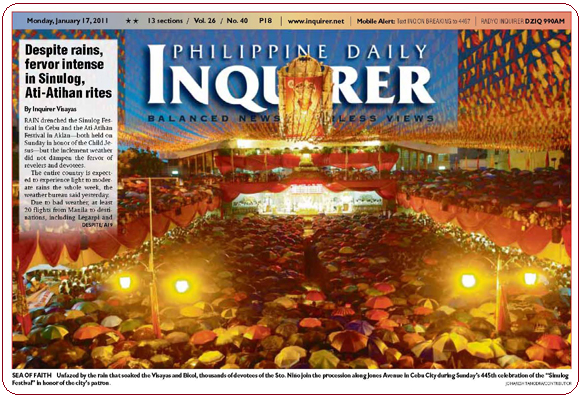
Setting that view aside, we were grateful that the multi-media coverage of the Sinulog highlighted as well the religious commemoration of the child Jesus and the folk catholic adoration of the historic Sto. Niño image on the eve of the street carnival.

Religious commemoration, Cebu City. (The Philippine Daily Inquirer, 17 Jan 2011).
The image reminds that Christianized Philippines will be 446 years old in April this year.  Sometime that month in 1565, the soldiers of Miguel Lopez de Legazpi recovered the image of the Sto. Niño left there by Ferdinand Magellan in 1521.   Legaspi had a church immediately constructed to house the image, and had it named [Santissimo] Nombre de Jesus

Pigafetta (c1525) wrote that after the queen of Cebu and her party of forty women were baptized, she was “shown an image of our Lady, a very beautiful wooden child Jesus, and a cross.”  The queen, named Johanna in her baptism, expressed interest to keep the child Jesus to replace her idols, and Magellan gave it to her on 14 April, 1521  (Blair & Robertson Resume of Documents, 1(2), 1906).

It is believed that this is the same image that soldier Juan Camuz found and showed to Esteban Rodriguez in one of the houses abandoned by the natives upon the arrival of Legazpi (B&R Resume) in Cebu “ on the twenty-seventh day of the month of April, day of the glorious martyr St. Vidal, in the year 1565 [which] happened to be also the feast of the resurrection (Medina, 1630).”

“Your excellency,” Legazpi (1565) wrote the king, “should should know that on the day when we entered this village one of the soldiers went into a large and well-built house of an Indian, where he found an image of the child Jesus (whose most holy name I pray may be universally worshiped). This was kept in its cradle, all gilded, just as it was brought from España; and only the little cross which is generally placed upon the globe in his hand was lacking. This image was well kept in that house, and many flowers were found before it, no one knows for what object or purpose. The soldier bowed before it with all reverence and wonder, and brought the image to the place where the other soldiers were. I pray the holy name of this image which we have found here, to help us and to grant us victory, in order that these lost people who are ignorant of the precious and rich treasure which was in their possession, may come to a knowledge of him. “

In a letter from Sevilla to Miguel Salvador of Valencia (1566), the writer spoke of the Mexican soldiers in the expedition who found  “in a poorly-built house … an image of the child Jesus, such as comes from Flanders, with his veil and the globe in his hand, and in as good condition as if just made.”

Sinulog 2011.  (Manila Bulletin & Phil. Daily Inquirer, 16 Jan 2011) 
The earliest account we’ve read on the veneration of the Sto. Niño comes from Chirino  (1604). He wrote that “the Indians …held the object [carved image of the holy child Jesus] in great veneration … and had recourse to it in all their necessities—making sacrifices to it after their custom, and anointing it with their oils, as they were accustomed to anoint their idols. … Each year it is borne in solemn procession from the church of St. Augustine to the spot in which it was found, where a chapel has since been erected. The procession takes place upon the same day when the discovery was made -- namely, on the twenty-ninth of April, the feast of the glorious martyr St. Vital, who is patron of the city, and as such that day is kept as a solemn feast in his honor. One of the regidors, appointed each year for this purpose, brings out the banner of the city; he is on that day clad in livery, and invites the public to the festivals. There are bull-fights and other public festivities and rejoicings, with many novel fireworks, such as wheels and sky-rockets, which the Sangleys make the night before; on this occasion they construct things well worth seeing, and which appear well-nigh supernatural.”

Miracles have been attributed to the Sto. Niño at childbirths and hence called El Partero, “man-midwife” (Chirino), during the ‘terrible drought of 1618’, ‘a number of great fires including the one in 1632 when the city would have been entirely destroyed if the flames had reached the Spanish powder house’, and the ‘cholera epidemic of 1752’ (Del Mar, 1935), among other testimonies of people through the years.

Hence, “most people come to fulfill vows made to the Santo Niño in seeking recovery from some serious illness, either for themselves or their loved ones. They place lighted candles before the image and kneel and pray, and sometimes perform a sort of dance known as the sinulog, literally "current", as of a stream” (Abellana, 1935), sinug to Bautista (1935) where performers “shout and dance and perform a sort of moro-moro or sham battle with wooden bolos and shield before the Senior Santo Niño …”

It would be very interesting to find when the dancing of the sinulog or sinug started.  But years before this morphed into the street dancing carnival in 1981, this was how it was – 

“The dance is performed either inside or in front of the old San Agustin Church and often lasts for hours, the dancers hoarsely shouting "Pit Senor!" an expression of no known meaning, and frenziedly fighting an imaginary enemy with their wooden weapons to the beat of one or more drums. Next to the great procession in honor of the image, this dancing is perhaps the most interesting feature of the Santo Nino festival.

“Old folk and children as well as young men and women whirl about and dance and shout, some of them weeping and beating their breasts with their fists. Most of them come from the distant barrios of the province in compliance with some vow or seeking a cure to ailments ranging from skin troubles and rheumatism to more serious illnesses. Often children only a few months old are carried into the dance on the shoulders of a parent or other relative.

“The dancing last several days but only until the gold-embroidered habiliments of the image, put on for the feast, are removed and replaced by the ordinary robes. Sometimes it is a week before the clothes are changed, apparently in order to give all of the thousands of people who flock to Cebu an opportunity to kiss the Holy Child in its regal dress.

“The sinug is begun on the afternoon of the procession by a group of small boys dressed up in belts and shoulder straps just before the main door of the Church is thrown open and Senor, borne on the silver-plated and lavishly adorned carro, emerges. As the procession progresses slowly down the principal streets of the city, the dancing boys, who are paid for this service, precede it. Sometimes one of them comically goes beyond what is required of him to the suppressed laughter of the onlookers, but he comes to grief if the maestro who is in charge of the boys detects him, for he does not choose a place to reprimand him, but does it on the spot--with a horsewhip.

“There are expert professional sinug dancers who are paid five or ten centavos by those who can not dance before the Senor personally. The hired dancers will shout "Pit Senor, kang Juan kini!" meaning, "Pit Senor, this is for Juan!". Such a dance lasts only a few minutes, particularly when business is brisk, and the drummer gets a share.  

“After the feast the friars in charge of the Church allow the dancing only in the patio, and it is said that the prior has counselled the people to refrain from the sinug and revere the Senor in a simpler way, but the practice appears to be ancient and is deeply rooted and the people have so far been unwilling to give it up. …” 

Give up the folk religious tradition?  Would the Church even dare now since this Sinulog and other religious festivals have become economic activities in the country?

Do these Christianized expressions of faith speak of the Christianity of the nation? Have we become truly Christian 446 years after we’ve replaced the ancient pagan idols with the Sto. Niño image and other icons of the Roman Catholic faith? 


Sources:

1.      Editorial. (1965 Apr). The Fourth Centennial of Christianity in the Philippines. The Journal of the American Chamber of Commerce of the Philippines.  41(4):157. Retrieved from http://name.umdl.umich.edu/aaj0523.1965.001 

2.       Pigafetta, Antonio. ( c1525).  First Voyage Around the World  [I Primo viaggio intorno al mondo]. Italian text with English translation found in The Philippine Islands, 1493-1803; 1(33):159,161,163. Blair, Emma Helen & Robertson, James Alexander,  Eds. Cleveland, Ohio: The A. H. Clark Company, 1903-09.  Retrieved from http://name.umdl.umich.edu/afk2830.0001.033 

3.       Resume of documents found in The Philippine Islands, 1493-1803; 1(2):119-121.  Blair, Emma Helen & Robertson, James Alexander,  Eds. Cleveland, Ohio: The A. H. Clark Company, 1903-09.  Retrieved from http://name.umdl.umich.edu/afk2830.0001.002 

4.      Legazpi, Miguel Lopez de. (1565). Relation of the voyage to the Philippines [Cebu] found in The Philippine Islands, 1493-1803; 1(2):215,216. Blair, Emma Helen & Robertson, James Alexander,  Eds. Cleveland, Ohio: The A. H. Clark Company, 1903-09.  Retrieved from http://name.umdl.umich.edu/afk2830.0001.002 

5.      Copy of a letter sent from Seuilla to Miguel Saluador of Valencia which narrates the fortunate discovery made by the Mexicans who sailed in the fleet which His Majesty ordered to be built in Mexico with other wonderful things of great advantage for all Christendom worthy of being seen and heard. Printed in Barcelona, By Pau Cortey, 1566 found in The Philippine Islands, 1493-1803; 1(2):225,227. Blair, Emma Helen & Robertson, James Alexander,  Eds. Cleveland, Ohio: The A. H. Clark Company, 1903-09.  Retrieved from http://name.umdl.umich.edu/afk2830.0001.002 

6.      Medina, Juan de, O.S.A. (1630; Manila, 1893). History of the Augustinian order in the Filipinas Islands (to be concluded) found in The Philippine Islands, 1493-1803; 1(23):158-159,167. Blair, Emma Helen & Robertson, James Alexander,  Eds. Cleveland, Ohio: The A. H. Clark Company, 1903-09.  Retrieved from http://name.umdl.umich.edu/afk2830.0001.002 

7.      Chirino, Pedro, S.J. (1604). Relacion de las Islas Filipinas (to be concluded) found in The Philippine Islands, 1493-1803; 1(12):179-182. Blair, Emma Helen & Robertson, James Alexander,  Eds. Cleveland, Ohio: The A. H. Clark Company, 1903-09.  Retrieved from http://name.umdl.umich.edu/afk2830.0001.012 

8.      Abellana, Martin. (1935 March). The “Santo Nino” Festival. Philippine Magazine. 32(3):127-128.  Retrieved from http://name.umdl.umich.edu/ACD5869.0032.001 

9.      Bautista, Rafael A. (1935 March). “Pit Senor”. Philippine Magazine. 32(3):127-128.  Retrieved from http://name.umdl.umich.edu/ACD5869.0032.001 

10.  Mar, Perla del. (1935 March). The Holy Child of Cebu. Philippine Magazine. 32(3):127.  Retrieved from http://name.umdl.umich.edu/ACD5869.0032.001