Monday, June 30, 2014

Celebrating 116 years of Philippine independence

Note:  This photo-essay appeared in slightly different version in the 20-26 June 2014 issue of the weekly FilAm Star, "the newspaper for Filipinos in mainstream America."  The author/blogger is the special news/photo correspondent of the paper in the Philippines.

There were no grand fireworks to watch on the Twelfth of June in the home country unlike in the US of A where ‘Filipinos in mainstream America’ wait for the pyrotechnics to burst and brighten the skies on the night of the Fourth of July.

There was no parade at the Luneta either just like in the old days.  The last one we remember watching was that of the centennial celebration in 1998.

Like in the past, government agencies set up booths at the Burnham Green of the Rizal Park to show their flagship projects and community services (Mga Pampamahalaang Programa at Serbisyo).  The Department of Health, for example, provided free medical, dental and optical services.  Tree seedlings and packets of vegetable seeds were distributed at the Dept. of Agriculture booth. 

The booths of the Armed Forces of the Philippines were a big hit because it allowed visitors to carry high-powered weapons on display (without bullets, of course!).  Many had their selfies with real soldiers with camouflage paints on their faces. Marching bands from various military services like the Philippine Air Force also provided entertainment at the Luneta Grandstand, and silent drills by units from the Philippine Coast Guard and Philippine Marines awed spectators there too.

For those who stayed up to the early evening, they could have enjoyed for free the 30-minute “Martyrdom of Dr. Jose Rizal: Light and Sound Presentation”, which dramatizes the national hero’s final hours using eight sculptural clusters. This presentation is the collective work of National Artists Leandro Locsin, Lamberto Avellana, Lucio San Pedro and Rolando Tinio.  The holiday crowd could also have enjoyed listening to various musical artists in the Harana sa Rizal Park at different performance areas around the park.

The Metro and Light Railway Transits provided free rides 7 to 9 in the morning and 5-7 in the evening for people who wanted to enjoy their holiday in various places in Metro Manila.  The Pasig River Ferry Service also offered free cruises from 6 AM to 6 PM between its operating terminals: Plaza Mexico, PUP, Guadalupe and Pinagbuhatan.

These were some of the events in this year’s 116th commemoration of the proclamation of Philippine Independence, which carried the theme “Pagsunod sa Yapak ng mga Dakilang Pilipino, Tungo sa Malawakan at Permanenteng Pagbabago.”

Early in the day at eight o’clock in the morning, flag-raising and wreath-laying ceremonies were held simultaneously in seven historical sites all over the country led by high government officials:  Plaza Quince Martires in Naga City; Rizal National Monument at the Luneta, General Emilio Aguinaldo Shrine in Kawit, Cavite; Mausoleo delos Veteranos dela Revolucion at the Manila North Cemetery; Barasoain Church Historical Landmark in Malolos, Bulacan; Pinaglabanan Memorial Shrine in San Juan City; Bonifacio National Monument in Caloocan City and Pamintuan Mansion in Angeles City.

These rites were replicated in every town and city in the archipelago.  In my hometown San Narciso in Zambales, for example, the flag rite in front of the municipal building was followed by the laying of floral wreaths at the monuments of  Jose Rizal, Ramon Magsaysay, the Doce Martires (12 members of the town principalia who were executed in April 1898) and the Defenders of Bataan and Corregidor.

President Benigno Aquino III, guest of honor at Plaza Quince Martires rites, extolled the heroism of the fifteen Bicolano martyrs who were suspected of involvement in the Katipunan.  Eleven of them were executed in Bagumbayan in January 1897 barely a week after the martyrdom of Jose Rizal, while four died in exile.

According to reports, some students from the Ateneo de Naga heckled Aquino while he was talking about the pork barrel scam.  “Patalsikin ang Pork Barrel King! Walang pagbabago sa Pilipinas!,’ were apparently heard from the students who deemed that the president failed to fulfil his promise of ending corruption and bringing change to the country.  One of them, Emmanuel Pio Mijares, was arrested.

Aquino challenged Filipino voters to“[c]hoose candidates who fight for the interests of the each and every citizen in the face of any challenge. We do not need a leader who can read a script, dance well or sing well.”  Obviously, he was referring to Sen. Bong Revilla whose privilege speech included a song number.

At the Rizal National Monument, Vice President Jejomar Binay reportedly called for a “timeout” from politics, reminding Filipinos to remember the patriotism and bravery of those who fought for our independence. 

Chief Justice Maria Lourdes Sereno also touched on the pork barrel scam cases when she spokeat the General Emilio Aguinaldo Shrine.  According to reports, she assured that there will be no shortcuts in resolving these cases, and that the judiciary will always be guided by the Constitution and the Rules of Court in their resolution.

At the Barasoain Church, where the first Philippine Republic was inaugurated on 23 September 1898, the guest of honor was MMDA Sec. Francis Tolentino.  He reportedly emphasized the importance of Malolos Constitution, and also spoke of the threats to our rightful ownership of some islands in the West Philippine Sea.

Senate President Franklin Drilon led the Independence Day rites at the historic Pinaglabanan Shrine, a memorial to the first battle of the Katipunan that started on 29 August 1898.  According to reports, he appealed to the people to keep their faith in their democratic institutions despite the pork barrel scam controversies.

We witnessed the commemoration program at the Bonifacio National Monument.  It was the Caloocan City Mayor who delivered the keynote speech. Theatrical, dance and musical presentations were performed by government employees and public school teachers.

It is presumed that similar flag-raising and wreath-laying ceremonies were conducted at the Pamintuan Mansion and the Mausoleo de los Veteranos de la Revolucion.

 For historical appreciation, Aguinaldo moved the seat of the government from Kawit, Cavite to Pampanga during the war against the Americans. He waved the Philippine flag from the second-floor balcony of the Pamintuan Mansion on 12 June 1899, the first anniversary of Philippine independence.  On the other hand, the Mausoleo was built by the Veteranos de la Revolucion headed by Aguinaldo and inaugurated on 30 May 1920 as a pantheon of the heroes of the revolution against Spain. 

The noise of the 116th anniversary celebration of our independence came from the rallies not only in Metro  Manila but also in some cities in the country, a continuing reverberation of the Million People March to Scrap Pork Barrel on 26 August last year.

The festive colors came from the protest streamers and banners, and from the props such as masks and papier mache pigs of various configurations like the big one with a crown.

One reporter observed that “[a] funny thing happened to marchers protesting against the pork barrel in all forms. Their target turned out to be President Aquino.”  This is evident in the ‘Pork Barrel King’ title given to him.

We were at the Kartilya ng Katipunan Shrine (or Bonifacio Shrine) near the Manila City Hall for the 6.12.14 Protest Against Corruption in the afternoon.  This was put together by 6.12.14 Protest Coalition of various organizations comprising the Scrap Pork Network, Kilusang KonTRAPOrk, and Freedom from Debt Coalition.  Hashtags used for social media communications were #OUCHPinoy, #ScrapPork and #JailALL.

Various sectoral representatives were given the chance to denounce the plunder of government funds through the PDAF or the popular pork barrel.  There was a collective call for the Aquino administration to prosecute the people behind the pork barrel scam, those linked to the controversies including the allies of the president.  “All those involved should be prosecuted and not just a few,” Auxiliary Bishop Broderick Pabillo emphasized.

Entertainment numbers were provided by popular singers like veteran activist Heber Bartolome and Jograd de la Torre with their nationalistic and protest songs, and rocker Eli Buendia of Eraserheads fame.

At Liwasang Bonifacio, a “Rally for Accountability” was led by the #Abolishpork Movement. This was joined by militant, civil and religious groups like the Volunteers Against Crime and Corruption (VACC),  Artista Kontra Korapsyon (AKSYON), University of the Philippines (UP) Faculty versus Pork, Youth ACT Now!, Babae Laban sa Katiwalian (BABALA), and Bagong Alyansang Makabayan (BAYAN). 

Reports in the social media showed that this was preceded by a march to the US Embassy in Manila and a program at Kalaw Avenue where some protesters dressed up like Katipuneros and Katipuneras and carried make-believe bolos and rifles.

Later in the afternoon, the protesters marched to Mendiola with torches.

Present at both the Kartilya and Liwasang Bonifacio rallies was Mae Paner, more popularly known as Juana Change, who had porky faces adorning the front of her kimona and all around the hem of her saya.


The cheer up chants were variations on the theme of accountability.  At the Kartilya Shrine:  Sumagot, Managot, Kundi Lagot! Ouch PiNoy!  At Liwasang Bonifacio-Mendiola:  “Lahat ng Sangkot, Dapat Managot”


Tuesday, June 17, 2014

Ferrying up and down Pasig River

NOTE.  This photo-essay appeared in the 13-19 June 2014 issue of the FilAm Star, a weekly published in San Francisco, CA "for the Filipinos in mainstream America."  This author/blogger is the Special News/Photo Correspondent of the paper here in the Philippines.

A trip between Pagbuhatan or Guadalupe and Escolta or Plaza Mexico passes by the Pandacan oil depots.

We cross over the Pasig River each time we take the metro/light railway transits on EDSA and Taft but we’ve never taken a cruise along its 26-kilometer stretch from Laguna de Bay to Manila Bay until last week when we took the ferry boats from the Guadalupe in Makati to three destinations:   Escolta and Plaza Mexico in Manila, and Pinagbuhatan in Pasig City.

At this time, only five ferry terminals from Pasig to Manila are operational in the Pasig River Ferry Service re-launched by Metropolitan Manila Development Authority (MMDA).  All the runs to Manila stop by the Polytechnic University of the Philippines (PUP) terminal in Sta. Mesa. The ferry service had its test-run with three bus-boats in March, and became fully operational on 28 April with free rides for one week.

The Philippine Postal Office at Plaza Lawton is an architectural landmark along the Pasig.

The ferry service is a joint project of the MMDA, the Department of Transportation and Communication (DOTC) and the Pasig River Rehabilitation Commission (PRRC).  MMDA looks at it as “an alternate mode of public transport for commuters who will be affected by traffic jams expected to be generated by the 15 major infrastructure projects across Metro Manila that will be completed by 2016” especially for residents near the river or for those whose work places are near the river.

The Escolta Ferry Terminal below the Jones Bridge.

This is not the first ferry service on the Pasig.

Magsaysay Lines had a brief operation from 1990 to 1991. Its Guadalupe-Escolta services closed down because of problems that arose from informal settlers along the river banks, garbage in the river and foul odor from the polluted water.

Starcraft Ferry also operated a service from Bambang, Pasig City to Escolta using 30-seater catamaran-type boats in 1996.  It folded up a year later due to the same problems that encumbered Magsaysay Lines.

In 2007, the government revived the ferry service. A private firm, SCC Nautical Transport Services, owned and operated six 150-seater air-conditioned boats serving the stretch from Intramuros to Pinagbuhatan. The service closed down in 2011 because of business losses.

The re-launch this year has a private company owning and operating the boats. A boat can accommodate 28 persons, running 12 knots at most, slowing down to 5 knots along the Malacañang area. From Guadalupe, it can run downstream to Plaza Mexico in about 40 minutes, and upstream to Pinagbuhatan in about the same time.

An old business building in Binondo from across the Plaza Mexico ferry terminal.

Passengers from Guadalupe pay Php 50 in going to any of three destination terminals: PUP, Escolta or Plaza Mexico.  The Guadalupe-Pinagbuhatan run costs Php 45.  The fare for the PUP-Escolta and Escolta-Plaza Mexico ride is Php 30. When we had our rides, the discounts for students, senior citizens, children and persons with disabilities were not in place yet.

When we took the ferry at Guadalupe, three giant billboards loomed over the river.  These feature a popular movie actress in her lingerie with a crown, and “Her Royal Beauty” is printed across two adjacent billboards.

The beautiful model reminds of the woman who appears at night during full moon, the Mutya ng Pasig of National Artist Nicanor Abelardo, which he composed in 1926.  At that time, Pasig must still have been the “lifeline” of Manila and other communities it ran through:  a clear flowing river teeming with fishes, clean for the bathing and the laundry washing on the river bank, the air cool and pleasant for the sailing from the lake to the bay.

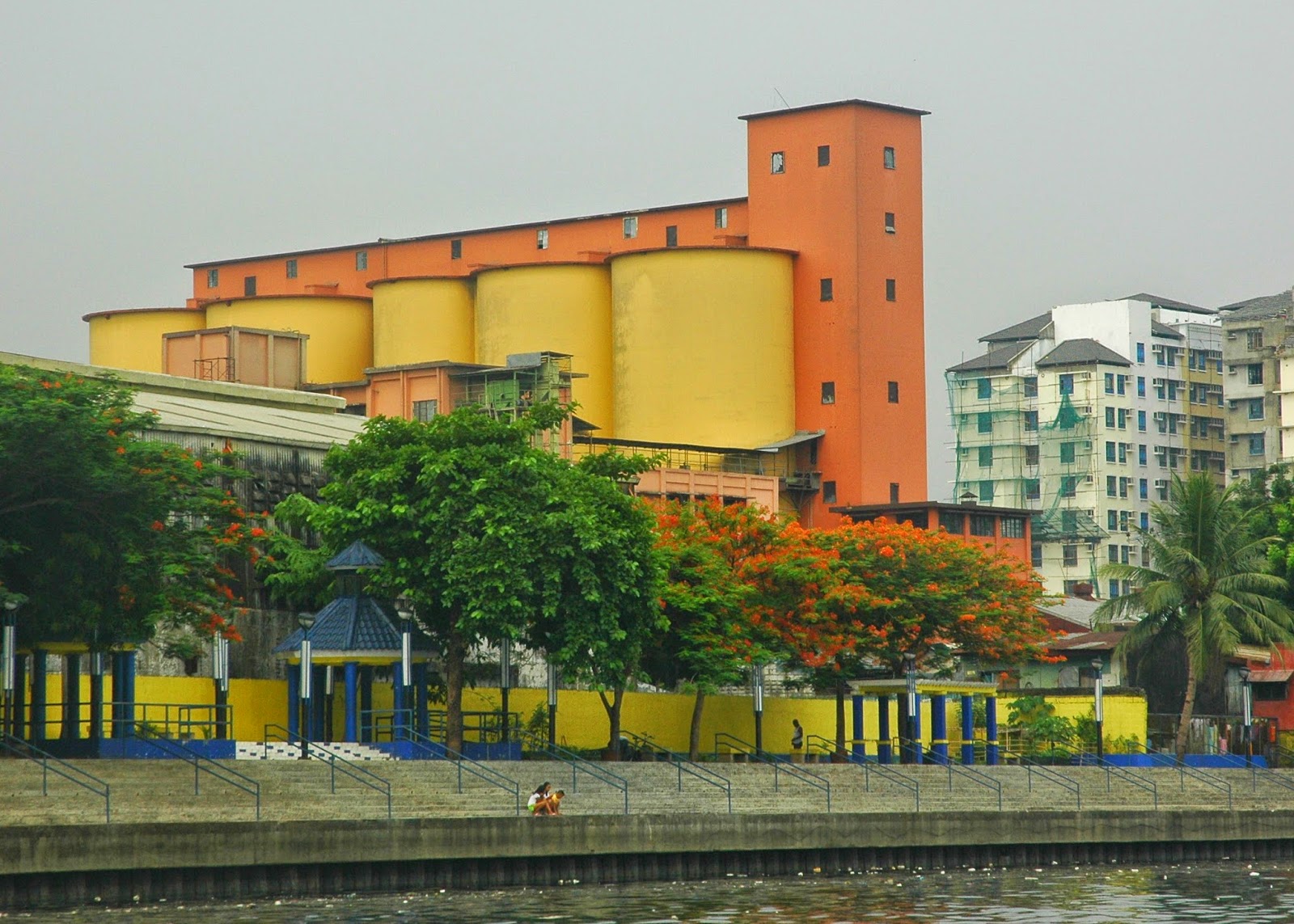
Linear park colors from silos, concrete fence and fire trees.
The PRRC gives us this timeline in the river’s transformation from being lifeline to becoming the “sewer” of the metropolis:  increasing river pollution and diminishing fish migration from Laguna de Bay (1930s), decline of bathing by the river (1950s), further decrease of people bathing, washing clothes and using river water for cleaning (1960s), emanation of foul odor and deterioration of water quality to Class C (1970s), total disappearance of any fishing activity (1980s) and declaration of its being biologically dead (1990s).

It’s still summer when we rode the ferry.  Overall, the river is murky.  There is no indication whatsoever of any life in the water in going downstream to Plaza Mexico.  Upstream though at the approach to Pinagbuhatan, we saw plenty of white birds flying low and peeking into the river, diving for fish fries, according to the helmsman.

The smell was initially a bit offensive but this disappeared during the cruise.  The boats are not air-conditioned. What assailed us were garbage accumulations in many parts especially along populated river banks, and the bits and pieces of thrash floating all around.

The banks were cleaner along the commercial properties like oil depots and manufacturing companies and along the linear parks of  Carmona, Valenzuela, Poblacion and Guadalupe, all in Makati; PUP, South Nagtahan, Intramuros and Plaza Mexico, all in Manila.

Colorful houses near the Guadalupe terminal.
We learned that PRRC has joined hands with local government units and other public and private agencies in the relocation of informal settlers along the river banks and esteros, and in the rehabilitation of esteros like Paco (2009), Sañtibanez and Aviles (both in 2013). Esteros are the flowing sources of garbage to the Pasig when the rains come.  Unless ecological solid waste management is effectively implemented in the cities and towns comprising the Pasig River basin, the 47 tributaries carry their garbage as well into the river. 

Despite the smell and the ugly sights at this time, we still enjoyed the photo opportunities we found during the rides, and the prospect of easier access to historical and touristic sites from the ferry terminals.

New riders would gain an insights on the physical linkages of the Metro Manila:  first,  the 14 bridges along the stretch from Pinagbuhatan to Plaza Mexico, and second, the bancas ferrying passengers between river banks, a commuter service that has been going on in the history of the Pasig River.  The commuter bancas cost a passenger Php 5 for the short distance across the river.

Terminal of bank-to-bank commuter boats.
The Guadalupe ferry terminal on JP Rizal St. is a short walk east of the bridge on EDSA.  Going to Pinagbuhatan, the ferry goes under C-5 or Pasig-Makati Bridge, the Bambang and Arsenio Jimenez (Kalawaan) Bridges.   Of interest is passing by the Napindan Flood Control Center where one sees the gates to control floodwaters from the lake.  The destination terminal is several meters away from the Pinagbuhatan Bridge.

Going downstream to Plaza Mexico, the ferry goes under three bridges in the Makati span: Guadalupe,  Estrella Pantaleon and Makati-Mandaluyong Boundary.  Estrella Pantaleon leads to the Rockwell Center. 

Lambingan Bridge connects Sta. Ana, Manila and Mandaluyong where the Pasig makes its U bend.  This is followed by the Pandacan or Padre Zamora Bridge, which spans into Sta. Mesa, and is clearly visible from the PUP ferry terminal.

Before approaching Mabini or Nagtahan Bridge, we were reminded of the no-photography (camera or mobile camphones) rule during the slow-down along Malacañang.  A Coast Guard man comes on board PUP to enforce the ban.  We’ve been figuring out the ‘why’ behind this ban when any tourist can have his photo taken on the avenue behind the White House.

Skyview & Makati-Mandaluyong Bridge.
After Nagtahan, veteran Manila visitors would readily recognize the foursome of Ayala, Quezon, MacArthur and Jones Bridges.  There’s a parallel bridge to Quezon bridge, the LRT-1 bridge connecting Central Terminal and Carriedo Stations.  One would not miss the island whose tip seems to touch Ayala Bridge: the Isla de Convalescencia where Hospicio de San Jose is located.

The Escolta ferry terminal is at the foot of Jones Bridge, right side, while the Plaza Mexico terminal is about 300 meters away on the left side.

Thus, our ferry travel log on the Pasig includes historical notes on the Isla de Convalescencia where the Hospicio de San Jose took permanent residence since 1810.  We caught sight of the spires of the National Shrine of Saint Michael and the Archangels on Malacañang grounds.  We read that this is popular among Roman Catholic betrothed couples because they can have their pre-wedding confirmation and baptism, if needed, here all in the same day. 

Commuter boat loading passengers going to opposite bank.
From the Escolta terminal, this ferry traveller took a memory stroll down Escolta St. before proceeding to Sta. Cruz.  We could have walked to Binondo/Chinatown too.

Intramuros is accessible from Plaza Mexico where stand the commemorative monuments to the fourth centennial of maritime trade between Mexico and the Philippines and the galleon trade. 
Plaza Roma is a short walk away for a visit to the Cathedral, Fort Santiago and other historical places inside the walls of Old Manila.

It may take some more time before ferry service on the Pasig becomes as popular and busy as that on Chao Prya in Thailand or the Star Ferry in Hongkong.   From fellow riders, we gathered that one issue is the fare, which is more expensive than public land or train transport to students and ordinary folks.  Then there’s the problem of garbage, and we noted that the ferries we rode on stopped a few times because of garbage obstruction.

In Junto al Pasig (Along the Pasig), the national hero JP Rizal wrote of boys who, after a quarrel, decided to prepare for the procession of the Virgin of Antipolo along the river.  In this play, Rizal composed a chorus for the boys, which, according to the historian Wenceslao Retana, was last sung by the Ateneo de Manila students in 1904 when the fluvial procession passed by the banks at San Pedro Makati. 

It may take years before the river becomes a lifeline again, when everyone can sing Rizal’s chorus of “pretty Pasig, pretty river” in seeking “beauty, peace of heart and mind” and “happiness for the soul beset with duty.”

Another commuter boat terminal.

Wednesday, June 11, 2014

Express trip under the shadow of Mayon & Bulusan volcanoes

Note:  This photo-essay appeared in the 06-12 Jun issue of the FilAm Star, 'the newspaper for Filipinos in mainstream America,' published weekly in San Francisco, CA,  This author/blogger is the paper's Special News/Photo Correspondent in the Philippines.

Mount Mayon from the left side of the Daraga Church. Woman figure shows her carrying red sili, said to be the Bicolano's favorite spice.

Our first option was to take the Bicol Express to Legazpi City, Albay, and the return trip on board one of the deluxe sleeper buses that ply the Maharlika Highway non-stop to Manila.

We did not know that the Philippine National Railways had cancelled all train services “due to ongoing repairs” and, as they implored, for us to bear with them until the Mayon Limited and the Bicol Express get running again.  For now, it’s only their Metro Commuter that keeps their choo-choo of “a storied past, a challenging present, and connections to the future” chugging along the rails from Tutuban to Laguna.  PNR, in fact, has not deleted their press release about resuming their Bicol runs “starting March 16, 2012.”

Thus, we flew to Legazpi, taking advantage of the budget promo of one local airline company. Our destination actually was barangay Tongdol of Irosin, Sorsogon to represent the family in a civil wedding. This would formalize a union that has already borne the marrying couple two young sons. The thirtyish groom was our personal driver more than a decade ago.

Bulusan Volcano from the wedding venue in Tongdol, Irosin, Sorsogon.

A very dear fraternity brother working in the city was off for the weekend with his family in Pio Duran.  He lent us his service vehicle and his driver for our Bicol sojourn.  He also gave us the key to his house in Daraga where we had a good sleep before the long haul to Irosin in the morning.

The driver knows the Bicol road system like the back of his palm, which made zipping through the Albay and Sorsogon towns under the shadow Mayon and Bulusan volcanoes, respectively, hassle-free and very relaxing .  He cued us on the interesting places we should see along the way, and he’d ask every now and then if we’d like to stop at what he thinks are beautiful sights to capture with our camera.  

We departed Daraga after the Sunday morning mass at the antique town church.  We took the national highway up to Sorsogon City.  Since we would be stopping by Bulusan Lake, he went another way, the coastal road that strings the town of Bacon, Prieto Diaz, Gubat, Barcelona, and Bulusan, from where we veered toward Irosin, the only inland town of Sorsogon, after cooling off at Bulusan Lake. All in all, we traversed around 160 kms of paved roads, some parts gravelly, with thick, lush green plants on our right, and the blue of Albay Gulf and the Pacific Ocean on the left.  There were portions where we drove under the canopy of branches of trees planted on both sides of the road. There was one instance when we stopped by the beach to chat with children enjoying the ankle-deep ocean waters at low tide.

Transporting pamaypay to the market (left). Pamaypay in various colors (right).

Fans, hats and sleeping mats.  Before hitting Sorsogon, we passed through barangay Bascaran of Daraga, where many hauling trucks were waiting to load, or were being loaded with Bicol region’s iconic handicraft products: pamaypay (fans), kalo (hats) and banig (sleeping mats). 

Bicol is endowed with indigenous flora for the raw materials of handicraft makers: karagumoy (Pandanus simplex) for hats, bags and mats; anahaw (Livistonia rotundifolia) for fans; and buri (Corypha) for hats.

What caught our fancy were the fans painted in several colors. We talked to one seller who actually collects from the weavers their unpainted products, which he then paints following the orders of the bulk buyers.  We learned from him that the demand could go as high as 10,000 pieces during the peak season.  

Nature tripping.  Rising 7,500 feet above sea level, Mayon Volcano was a looming presence during our tour of the Legazpi City and nearby Albay towns. It was the picturesque greeting card we saw from the window as the airplane descended for landing.  The sky was cloudless when we arrived; it was truly magayon (the Bicol word for beautiful) and passengers couldn’t help but pause for a selfie with the nearly perfect cone as background.

Bulusan Lake.

We noted that Bulusan is a hot subject these days. The volcano is not about to rumble and blow its top. The grumbling is from the anti-geothermal groups in the neigboring communities. We noted opposition to tap geothermal steam in the area for electric power.

 Bulusan volcano is not as high and majestic as Mayon but it sits in the heart of the national park named after it, a forest land teeming with flora of many different species.  

The park’s main attraction is Bulusan Lake, around 2 kilometers in circumference and 335 meters above sea level (masl).  We had our lunch break here surrounded by forest trees, shrubs and ferns, the green waters of the lake in view, and cicadas chirping all around.  Actually, the park management is tempting visitors to conquer all three lakes in the park: Bulusan, Aguingay, higher at 940 masl, and Blackbird’s, highest at 1,565 masl.

Young Bicolanos on their way to their favorite fishing sports by the bank of Bulusan Lake.

We could have gone trekking around the lake using the pathway of concrete slabs flanked by thick green foliage from various flora, which the guides said would not take an hour to complete. Kayaking on the placid green waters was another cool option.

We trekked part of the way though by joining a group of young men with fishing rods on their way to their favorite fishing spots.  We found some men on small boats casting their fishing nets a short distance away from the bank. 

Fisherman paddles his boat to a spot where he will cast his net.

While waiting for the young men to boast of a squirming catch on their lines, we spent some time with a honey collector nearby as he extracted sweet syrup from beehive fragments.  He said that this is one of the things he does for a living: roaming around the forest to smoke out beehives for the sweet honey.

Historical and spiritual detours.   Our quick Bicol trip gave us throwbacks to history starting with our departure point: the Church of the Nuestra Señora de Porteria (Our Lady of the Gate) on top of a hilltop in Daraga.  This church is more than 200 years old, and it was declared a Cultural Treasure by the National Museum in 2007 and a Historical Landmark by the National Commission on Culture and the Arts (NCAA) the following year.

Cagsaua ruins. Early this year, Albay province held Dos Siglo to commemorate the second centennial of the destructive Mayon eruption in 1814.

It has been painted with lime coating to protect the exterior side from further erosion.  The church facade and bell tower are rich in sculptured ornamentations like saints and other religious symbols, which are properly identified in the documentation of the preservation project.

This antique church reminded us of the ruins at Cagsaua, result of the violent eruption of Mayon on 01 February 1814.  As told by the historical marker on the ruins, the people of Cagsaua opted in July of that year to incorporate themselves with Daraga.  Hence, Cagsaua today remains a part of Daraga.  Early this year, Albay celebrated Dos Siglo to commemorate the destructive volcanic eruption two centuries ago.
Another candidate for declaration as heritage site is the church of Barcelona, Sorsogon, which  was built in 1874.  Across from it on the other side of the road are two ruins of stone buildings--the presidencia and the school—that date back to the Spanish colonial times.   According to popular stories,  Spaniards of yore gave the town that name to keep alive their memory of their city of origin.

The centuries old Daraga Church, a National Cultural Treasure.

When we returned from Sorsogon, we revisited Guinobatan, Albay to look for food items. In the search, two monuments caught our special photographic attention:  the Rizal Monument at the town plaza park and the Christus Regnat (Christ the King) monument facing the Church of the Assumption. 

We found the design of the pedestals closely similar.  The four women figures at the base of the monuments gave us the thought that these two works could have been designed and built by the same artist or group of artists.

Because of similarities in structure esp. with the four women figures, the Christ the King and Rizal monuments in Guinobatan appear to have been designed by the same artist or group of artists.

The standing allegorical women at the Christ monument are named after the cardinal virtues of Justicia (justice), Fortaleza (courage), Prudencia (prudence) and Templanza moderation. On the the hand, the four Rizal women are seated. The three that we were able to discern symbolize the arts, education and justice.

Culinary treats.  The theme of the welcome arch of Sorsogon province is seafoods symbolized by the crab, shrimp and mussel sculptures there.  A big crab is also atop the rest area building at Pepita Park, Sorsogon City.  Sad to say, there were no seafood meals during our dash through the province.

A giant white rooster along the road in Irosin. Across the street is the San Pedro barangay hall with a statue of the saint in front of it.

There was also nothing spicy in the wedding/fiesta menu, none of the traditional regional fare of laing and the so-called Bicol Express. 

The groom had a 100-kg pig butchered for the occasion, which an all-male cooking brigade headed by the popular village chef transformed into several dishes at the temporary kitchen in the backyard.  There was chicken and ubod cooked in coconut milk but this was not an entree in the menu.  It was served for dinner, and this was our first taste of this Sorsogon dish.

We watched closely the tutongan, where a live charcoal was embedded in the platter of grated coconut to produce smoke from the burning portion.  The set up was covered for some time so that the grated coconut would acquire the smoky smell and flavour.

The grates were then mixed with the pig’s blood, filtered out and pressed to extract the coconut oil. The diced pork meat was not sautéed but went directly into the mix of blood and coconut oil for the cooking.  Tutongan sa dinuguan was truly a culinary delight, and we had several helpings of it during the dinner.

Back in Albay, we had to hie off to Guinobatan for the thumb-size longanisas of garlicky or spicy red flavours.  Several packets of both flavours plus the pili nuts, sweetened and salted, made up our limited airplane baggage for the customary pasalubong for the family back home in Manila.

Town signage under construction.


Saturday, May 31, 2014

Three days of dancing at the Obando Pintakasi

Note:  This photo-esssay in slightly different version was featured in the 30 May - 05 Jun 2014 issue of FilAm Star, 'the newspaper for Filipinos in mainstream America, published weekly in San Francisco, CA. The author/blogger is the paper's special photo/news correspondent in the Philippines.


Rafaela Evangelista, the popular Ka Pelang of Obando, is almost 80, and she may be the last of her generation who graced the procession of March 18, the feast day of St. Clare of Assisi (the Santa Clarang Pinung-pino of local folks). It seems she doesn’t have any more favors to ask.  After all, she bore 13 children: 10 sons followed by three daughters, which she attributes to the patroness saint.  The beautiful woman had been dancing most of her life.

I had the chance to talk to Ka Pelang before the start of the procession. She was with the group of relatives and friends who were all wearing her old Filipiniana costumes of various colors and designs. She said that she cannot dance anymore but she would walk in thanksgiving for all the blessings she has received. Her daughter-in-law Julie is four months pregnant. She has three daughters already but she came dressed up in one of Ka Pelang’s antique garments to dance for a son.

Santa Clara is one of the trinity of patron saints of Obando. According to the history of the parish, the Franciscans introduced the veneration of the saint to the village people in the 17th century when Catangalan (old name of Obando) was still a part of Polo (now Venezuela).  San Pascual Baylon/Bailon joined Santa Clara as another patron in the 18th century when Obando was already a town of its own, and the church was being built. The coming of the Virgin of Salambao to Obando also in the 18th century is the subject of folklore about the image of the Immaculate Conception being caught in the net (salambao) of two fisherman brothers.   

Popular town histories trace the evolution of the folk Catholic dancing tradition to the pre-Spanish rituals called kasilonawan presided by high priestesses, usually nine days of eating, drinking, singing and dancing at the residence of the village chief. The religious orders adapted these pagan rites as tools in their evangelization mission.  In the case of Catangalan, the ancient house gods before whom women did fertility dancing was replaced by the image of Santa Clara.

That may explain how San Pascual Baylon, patron saint of Eucharistic congresses and associations, was absorbed into the town’s fertility dancing tradition.  There’s a basis though for the married folks to include the Virgin of Salambao in their prayer dance for children, she is after all the image of the Immaculate Conception. The town has a term for this dancing: bayluhan, derived from the Spanish baile (dance) or from the Baylon or Bailon name of the patron saint.


The church history marker clearly delineates that the Obando fiesta of 17, 18 and 19 May honors the trinity of saints with dancing: San Pascual for child bearing, Santa Clara, patroness of the conceiving mother, Virgin of Salambao, patroness of fishermen and farmers.  Throwbacks culled from literature though tell us that the bayluhan was done in various ways and covered other requests for saintly intercessions.

Throwback late 1800s.  Jose Montero y Vidal (Cuentos Filipinos,1883) wrote that the “indios and mestizos” danced before the image of San Pascual for the healing of every kind of illness and for protection from other misfortunes. During fiesta days, men, women and children went to Obando “fancifully dressed, head adorned with feathers and provided with tambourines, guitarillas they call cinco-cinco and other instruments ... cheerfully dancing, not allowing a moment of rest, despite the fire of the sun falling on their heads.”

At the sight of the image of San Pascual during the procession, he wrote, “people of all classes, ages and conditions, jiggle, jump and dance incessantly to implore the holy healing of their ailments, pointing out the diseased part of the body; they swarm in all directions, pray, sing and never stop dancing, even in the church after the conclusion of the procession.”

One throwback is an aside, fictional, from Jose Rizal’s Noli me Tangere (1887) about Capitan Tiago who enshrined several images of saints including San Pascual Baylon in the small chapel in his house.  He and his wife had long wished to have a child. Their pilgrimage to the shrines of the Virgin in Taal and Pakil had all been in vain.  She danced for a son in Obando during the feast day of San Pascual Baylon; she bore a daughter instead who was given the name Maria Clara in honor of the Virgin of Salambao and Santa Clara.

Joseph Earle Stevens, an American, wrote in his ‘Yesterdays in the Philippines’ (1894) about taking the train to attend the three-day fiesta. He noted that many pilgrims went there on foot, and “[e]verybody seemed to think it his duty to dance, and men, women, old men and children, mothers with babies and papas with kids, shouted, jumped around, danced, joggled each other, and rumpussed about until they were blue in the face, dripping with heat, and covered with dust. Then they would stop and another crowd take up the play.”  Apparently the frenzied activity lasted until sunset with tired groups sleeping under the shades around the church while other groups took over the dancing and shouting.

Throwback Peacetime. The accounts come from issues of the American Chamber of Commerce of Manila (AmCham) Journals several years before the Japanese invasion, when Obando was a short railway or motor vehicle ride away from Manila.

A 1932 account described that most of the pilgrims came from the lower classes who fastened to their clothing or hats pieces of colored paper cut in fanciful shapes. It appears that the focus of their devotion was San Pascual, and they went to pray for a child, for healing, or for protection.

There’s something incredible in the story: pilgrims dancing from “Tinajeros cemetery on the Manila North Road [later named MacArthur Highway]” all the way to the Obando Church.  My research tells me that Tinajeros is in Malabon, but there was no cemetery there of that name. Malabon had a cemetery near the San Bartolome Church and one in Tugatog.  The distance from any of them to Obando Church would be around seven kilometers!  Still, the pilgrims “who still [had] sufficient strength [kept] on dancing and leaping until they [sunk] to the ground in exhaustion.”


Throwback 1940 describes the three-day fiesta as “characterized by dancing by couples [who may also merely be betrothed] whose prayers are that their union will be blessed with children.”  The patron of devotion was San Pascual Bailon. The dance also named after this saint was one of the many religious dances in the country, wrote Lydia Villanueva-Arguilla, “consisting mainly of jogging and skipping, funny to the spectator but performed in all earnestness by the dancers.”

The Obando fiesta was disrupted by the second world war, and the centuries old images of the patron saints enshrined in the church were all destroyed by the bombs of 1945.

There was no fertility dancing after the war.  The church abolished it because of its pagan origins. The tradition however was revived in 1972.

Back to the present.  During the last pintakasi, I gathered that different groups of Obando folks from different barangays dance during the procession of the images of the three saints.  There are groups dedicated only to one feast day or to one patron saint.  The men and women wore different sets of Filipiniana costumes of different cuts and colors to distinguish their groupings. The group of Ka Pelang wore her antique garments for Santa Clara.

Yes, there were still pilgrims from other places who attended mass and may have joined the dancing inside the church after the service. It’s possible they were in the procession too and may have swayed with the crowd from the church down the main street and back to the same tune played over and over by the musikong bumbong and several brass bands: the ever popular Santa Clarang Pinung-Pino, although I did not hear anyone singing the song:
 Santa Clara Pinung-Pino.  I did not hear anyone singing though these popular lyrics: Santa Clarang pinung-pino, / Ang pangako ko ay ganito / Pagdating ko po sa Ubando, / Magsasayaw ng pandango. / Aruray, Araruray, Ang pangako’y tutuparin, / Aruray, Araruray, Ang pangako’y tutuparin. 

[Santa Clara, Thou blessed one, / Solemn promise I have made to thee, / When I reach your shrine at Obando, / I will pray, then dance the Fandango. / Aruray, Araruray, Oh, Santa Clara, hear my vow. / Aruray, Araruray, Oh, Santa Clara, hear my vow. – Translation in the 1914 music book for primary grades]


Saturday, May 24, 2014

Eight Pinoy high school students had fun at the Intel ISEF 2014 in Los Angeles

This photo-essay appeared in slightly different form in the 23-29 May 2014 issue of FilAm Star, 'the newspaper for Filipinos in mainstream America,' published weekly in San Francisco.  The author/blogger is the Special News/Photo Correspondent-Philippines of the paper.

On the giant screen during the Opening Program: Poster and Team Philippines 2014 members who did the Shout Out. (Photo from Joseph Roni Jacob).

More than 1,700 students from close to 80 countries, regions and territories converged at the Los Angeles Convention Center last week, May 11 to 16 during the Intel International Science and Engineering Fair (Intel ISEF), the world’s largest research competition for students in grades 9–12, a program of the Society for Science and the Public (SSP).

This year had the highest number of finalists so far in the 64-year history of the international competition.


The Top Three Winners, left to right:  Intel Foundation Young Scientists Awardees Shannon Xinjing Lee and Lennart Kleinwort, and the Gordon E. Moore awardee Nathan Han. (Photo from Society for Science & the Public).

15-year old Nathan Han of Boston was declared the “best of the best,” and he received the Gordon E. Moore Award, a US$75,000 prize named in honor of the Intel co-founder and fellow scientist.  Han used data from publicly available databases to develop a machine learning software tool in studying mutations of a gene linked to breast cancer. 

Two other top winners each received the Intel Foundation Young Scientist Awards of US$50,000: Lennart Kleinwort, 15, of Germany, and Shannon Xinjing Lee, 17, of Singapore.

Kleinwort’s prize-winning project is described as “a new mathematical tool for smartphones ... [the] app allows users to hand draw curves, lines and geometric figures on the touch screen and watch the system render them into shapes and equations that can then be manipulated at will.’

Lee developed a novel electrocatalyst entirely from carbonized Chinese eggplant, which may be used for batteries in the future. She found out that her carbon catalyst “greatly out-performed a more sophisticated commercial catalyst in stability and longevity tests and will be environmentally friendly and inexpensive to produce.”


Photos from Joseph Roni Jacob.
Our Team Philippines 2014 of eight students and the other young scientists from around the world (Kenya, Oman, and Qatar participated for the first time this year) were all at the Intel ISEF vying for awards and scholarships. 

They brought to Los Angeles projects competing in 17 categories covering various fields like Animal Sciences, Behavioral/Social Sciences, Mathematics, Cellular/Molecular Biology, Computer Science, Earth/Planetary Science, Engineering, Environmental Management/Sciences, Energy/Transportation and Plant Sciences.  Each of the 17 “Best of Category” winners received US$5,000, with a US$1,000 grant from Intel Foundation going to their respective schools and to their affiliated fairs.  The top three winners came from these “bests”.

Other finalists in each category received Grand Awards:  First (US$3,000), Second (US$1,500), Third (US$1,000) and Fourth (US$500).  As in the past ISEFs, there were many who received fourth to second Grand Awards.  Aside from these, there were Special Awards from about 70 organizations on the eve of closing day.

Competing in three categories were the hopeful eight bright students from the Philippines:  two individual researchers, Michael Angelo Zafra from Taguig Science High School and Angelo Gabriel  Urag from Fr. Saturnino Urios University (High School Department), Butuan City; and two research teams -- Lea Sibay, Nicole Cejas and Magenta May Orozco from Agusan del Sur National High School, San Francisco, Agusan del Sur; and Michael Angelo De Chavez, Danise Chan and John Steven Ablong from Victorino Mapa High School, Manila. 

Except for Urag who was a sophomore, all the rest were high school seniors during the last school year and are going to college this coming June, or August for those enrolling in the University of the Philippines.  Their projects passed through three levels of competition: division, regional and the national science and technology fairs, spread out in the Department of Education calendar from August 2013 to February 2014.

Michael Angelo Zafra’s research competed in the Energy and Transportation category.  In his study, he isolated thermophilic bacteria (those that can work at high temperatures) from compost, and determined if these can hydrolyze cellulose. He was able to identify a strain of bacillus that has the potential for use in large-scale conversion of biomass into fermentable sugars in bioethanol production.

Angelo Gabriel Urag explored the surface structure and the chemical composition of the wings of male and female Neurothemis terminata, a dragonfly species commonly found in the country, to explain their hydrophobic or anti-wetting characteristics.  Interestingly, he found the male wings more hydrophobic than the female.  He said that the nanostructures of the wings could be reverse engineered for future applications to repel water and dirt on surfaces for easy-cleaning.  His project competed in the Engineering (Materials and Bioengineering) category.

Also in the same engineering category was the study of the Victorino Mapa High School team. They explored the potential use of chitin from crab shells for thin film solar cell applications. They were able to characterize and produce chitin nanowires, nitrogen- and manganese-doped carbon nanomaterials through the Horizontal Vapor Phase Growth Technique at the De La Salle University. 

The team from Agusan del Sur National High School were able to isolate five bacteria strains from palm oil sludge that can break down the Polycyclic Aromatic Hydrocarbon (PAH) and Total Petroleum Hydrocarbon (TPH) components of diesel oil.  They found out that these strains, rod-shaped like bacilli, are effective in the bioremediation of oil-contaminated soil that they used for planting mangroves and associated plants.  The research project was in the Environmental Management competition.

In national costumes to the judging interviews, 
and thrilla' at Universal immediately after.
(Photos from Joseph Rino Jacob)
More than 500 finalists brought home awards and prizes for their innovative research.  A number of students received experiential awards from the Intel Foundation including an 11-day trip to China for them to attend the country’s largest national science competition, speak with researchers at Intel’s lab in Shanghai, and visit the Panda Research Base in Chengdu.

Three finalists were awarded an all-expense trip to the Stockholm International Youth Science Seminar (SIYSS), which includes attendance at the Nobel Prize ceremonies.  Others were selected to attend the European Union Contest for Young Scientists in Warsaw, Poland, and the London International Youth Science Forum.  For the second time this year, finalists won the Innovation Exploration Award for a chance to visit the Jet Propulsion Laboratory in Pasadena, California, and Caltech to learn about the latest in space exploration.

What is most interesting to first and second grand award winners is that their names are submitted to the International Astronomical Union (IAU) for once in a lifetime naming after them of minor planets in Ceres Connection.  All these minor planets were discovered by the Lincoln Near Earth Asteroid Research (LINEAR) program, operated by Massachusetts Institute of Technology-Lincoln Laboratory. This naming is connection with the partnership of MIT-Lincoln, SSP and Intel ISEF to promote science education.

Apparently this lifetime naming started way back in 2002 when all the Intel ISEF awardees were invited to submit an essay on 'why would you like a planet named after you.'  The Filipino prize winners, except one, submitted an essay, hence, teammates Jeric Valles Macalintal and Allan Noriel Estrella, and individual researcher Prem Vilas Fortran Moso Rara had planetary bodies named after them. This was also the year that Dr. Josette Biyo, currently Executive Director of the Philippine Science High School System, had a minor planet between Mars and Jupiter named after her when she received the “Intel Excellence Award in Teaching." In 2011, Miguel Arnold Reyes of Philippine Science High School-Main had a minor planet named after him for winning a second grand award for his materials and bioengineering project. 

The Philippines had been participating in the Intel ISEF since 1998.  For the past 15 years, our finalists brought back home special and grand awards to show off. 

Team Philippines 2014 may not have fared equally as well as previous teams, but it was certainly a week of fun and inspirational encounters for all of them at the Intel ISEF in Los Angeles.


National costumes, different nationalities at the world's biggest annual research competition;
(Photos from Team Philippines 2014)

They would recall how they faced the highly qualified judges in their national costumes during their whole day of interviews with them in front of their project displays at the exhibition hall. They forgot the stress of judging day because what followed immediately were thrilling rides at the Universal Studios Hollywood all for free during the Intel ISEF Night there.

There is more than research competition in the ISEF.  There are fun events too like the pin exchange, the customary icebreaker on the eve of opening day with the finalists trading pins and thereby meeting new friends from around the world.  

For sure they also enjoyed their encounter with Nobel laureates comprising the "Excellence in Science and Technology Discussion Panel".  They threw questions to Frances Arnold (Draper Prize, 2011), J. Michael Bishop (Physiology or Medicine, 1989), Martin Chalfie (Chemistry, 2008), H. Robert Horvitz (Chemistry, 2002), Sir Harold Kroto (Chemistry, 1996) and John Mather (Phyics, 2006). They also grabbed photo-ops with anyone of them after the Q&A session.

We have been involved in the national science and technology fair in the Philippines since year 2000, the Intel ISEF-affiliated fair initially with the Department of Science &Technology, and now under the Department of Education. We’ve been part of scientific review committees that pre-qualify projects in the national competition among regular and science high schools, and of panels that judge projects in the physical sciences category, and select the research projects to be sent to the Intel ISEF.  Through these review and judging tasks, we have seen the passion for scientific inquiry among many high school students from the different regions of the country. 

The winning projects in the national fair that are selected for the Intel ISEF are truly owned by the young researchers.  Their work fall within the perspectives defined by Rick Bates, interim CEO and chief advancement officer of Society for Science & the Public, and Wendy Hawkins, executive director of the Intel Foundation.

“In congratulating [the top three winners], we join with Intel in seeing great hope in their research, and that of all of our Intel ISEF finalists,” Bates said. “Not only are they working to discover solutions for society’s challenges, they importantly serve as an inspiration for younger students and encourage them to become involved in the amazing world of hands-on science and engineering.”

Hawkins added, “The world needs more scientists, makers and entrepreneurs to create jobs, drive economic growth and solve pressing global challenges. Intel believes that young people are the key to innovation, and we hope that these winners inspire more students to get involved in science, technology, engineering and math, the foundation for creativity.”