Monday, October 24, 2016

Juan Luna, cover boy of Ilustracion Artistica


Three days before his 27th birthday, Juan Luna was cover boy of the 20 October 1884 issue of La Ilustracion Artistica, a weekly newspaper on literature, arts and science published in Barcelona, The cover story gave a brief biography of the artist and dwelt lenghtily on the Spoliarium, his large painting that won the 'primer premio' (gold medal) in the Exposición de Bellas Artes (Exhibition of Fine Arts) in Madrid.

The story described Luna as a 17-year old boy who received the title of Piloto de Altos Mares (Pilot of the High Seas) from the Escuela de Nautica de Manila in 1874. He boarded a ship shortly after graduation, starting his career as a beardless boy, according to the story, and sailed for thirty months. His shipmates called him el marino atrevido, the daring sailor.

During those thirty months, he had as much time to study the sky, according to the story, and probably to think about new ideas of securing a bright future. Here's how Ilustracion depicted Luna's predicament out there at sea  --

"Who knows ... Maybe in the imposing solitude of the sea, in one of those times when there is no way to avoid nostalgia, in which one yearns for something unknown and the heart struggles to get out of the chest as the prisoner struggles to leave the prison, as the bird struggles to get out of the cage, our young man was fixed on a star; and the wind that rippled the surface of the waters whispered in his ear unexpected revelations, mysterious words that no one pronounces and yet distinctly resonate in the soul of the preordained. Those words are also like those heard by Saul on the road to Damascus and Augustine on African soil; inspiration from on high that puts the powerful genius to go in reverse what he begun on the journey of life."

All it wanted to say was that Luna changed his mind about his career. For as soon as he had landed, and he was turning twenty years old, he entered the Academia de Bellas Artes in Manila 'with the intent of studying drawing.'  He was, according to the story, tested soon. He got affected by the dismissal of one of the directors, who was deemed inept or not fully qualified by the rest of the school directors.

Luna transferred to another school, and as Ilustracion said:

"Who was daring at sea should not, on the ground, easily give up a pawn: D. Lorenzo Guerrero, a professor as modest and as intelligent, admitted Luna to his Academia India, and discovering in this already big student truly exceptional qualities, he advised his parents to send him to Madrid, where he met the renowned painter D. Alejo Vera, a skilled teacher and a friend, more than a friend, almost a father. It is not therefore surprising that when Vera transferred to Rome, he took with him his fond disciple. This was in 1878; a year before he begun in the first rudiments of drawing; three years later. he won the second medal in the Madrid Exposition of 1881, with the painting "Muerte de Cleopatra." The new artist started his career rather late, but as if to make up for the lost time, he had to catch up. In three years, he had leveled with good painters; in another three (1884), he has taken place among the great masters.".

The Spoliarium was a supplement, a two-page spread, in the La Ilustracion Artistica
.
That same issue had for its supplement a two-page spread of the painting of fallen gladiators being hauled away after the bloody sports competition in the Roman arena.

Five months earlier, the cover of  the 30 May 1884 issue of La Ilustracion Espanola y Americana, a weekly newspaper published in Madrid, also showed the Spoliarium: how it was displayed at a Exposicion gallery with a small crowd of viewers, who could have been discussing about its merits and rating it among the other competing entries.
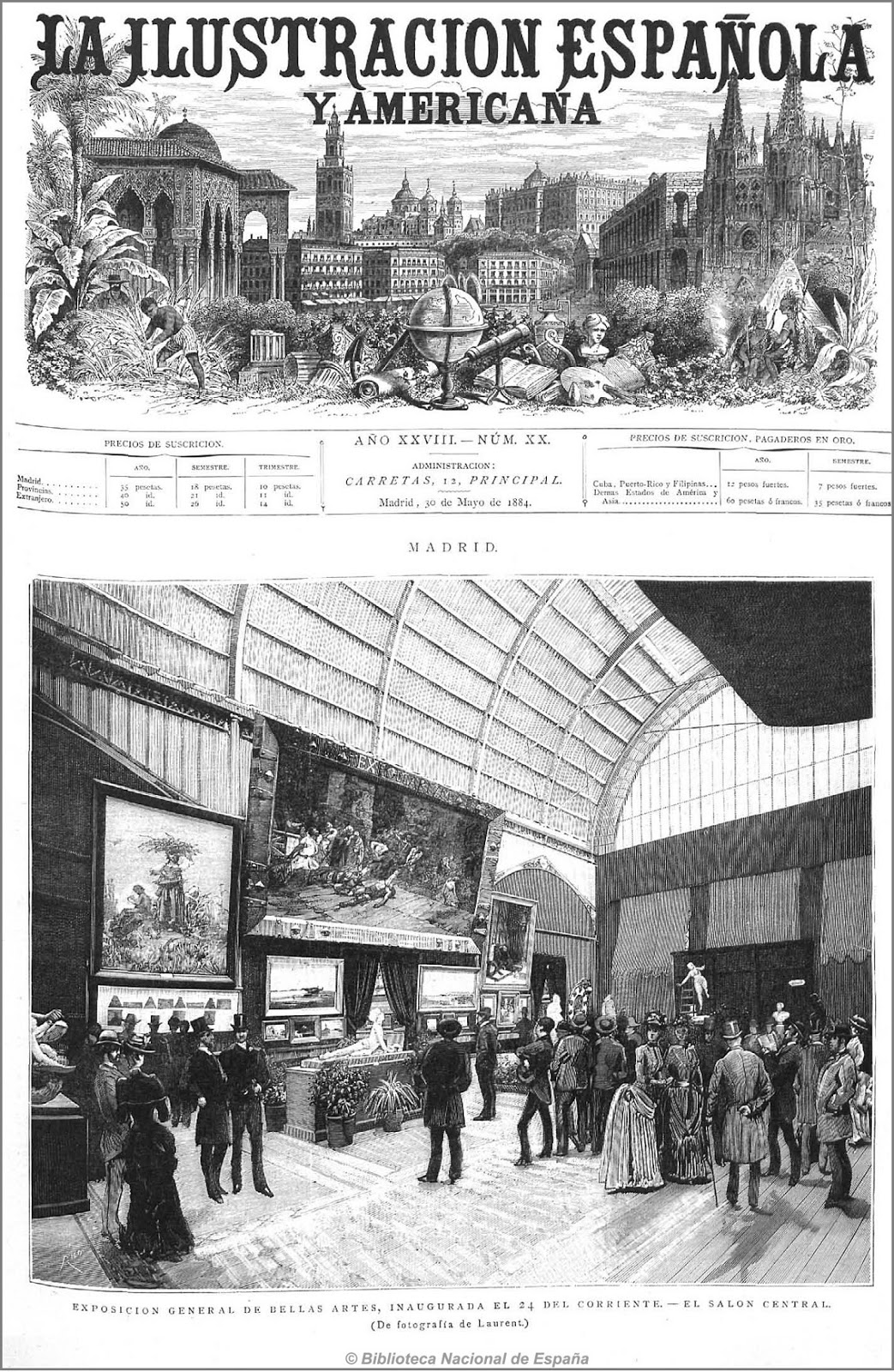
Spoliarium at the Exposition

Luna's works actually started getting the attention of these two weekly newspapers as early as 1881. La Ilustracion Espanola y Americana featured a one-page spread of his Muerte de Cleopatra, which he entered in the Exposicion de Bellas Artes in Madrid in 1881. The reporter on the exhibits noted that with better composition and careful drawing, Luna, without doubt, would shine in Spanish contemporary art.

In our latest survey, the last appearance of a Luna painting was in the 27 January 1896 issue of La Ilustracion Artistica: the painting titled El Trapero [The Ragman or Ragpicker].  The write-up said that "this simple composition has enough elements to show the characteristic qualities of  the painter's works, among which undoubtedly stands out the vigor of his drawing and brushwork, revealing a fiery temperament and a lively imagination." 


El Trapero.

In that span of fifteen years, several of Luna's work were played up in both Ilustracion newspapers. Except that of the masterpiece Spoliarium, a short write-up accompanied each featured painting.

Pictures of the following Luna paintings appeared in La Illustracion Artistica of Barcelona:

1.  Mujeres Romanas was the supplement (two-page spread) in the 25 February1884 issue; 

2. La Belleza Feliz y La Esclava Ciega occupied one whole page in the 14 March 1887 issue; 

3. El Babieca was on the cover of the 02 April1888 issue; 

El Babieca.

4.  La Mestiza, which won a diploma of honor in the 1887 Exposition in Madrid, was in the 28 May 1888 issue; 

5. Ensuenos de Amor, his entry to the Universal Exposition of 1888 in Paris, appeared in the 25 June 1888 issue; and  


Pueblos y Reyes

6.  Pueblos y Reyes was fearured in the 21 May 1894 issue.  The accompanying short article said that this was a controversial piece in the 1892 Exposicion Nacional but it deserved the applause accorded to it and the painter. It was described as a "large canvas [that] can be appreciated as a great sketch pictorially; but the conception, movement and action of the figures, the whole ensemble energetically portrays a moment, a violent and brutal deed, the orgy of a popular uprising." 

The popular painting España Guiando a Las Islas Filipinas por el Camino del Progreso was featured in the 08 January 1889 issue of  La Ilustracion Española y Americana of Madrid.  A version of this can be viewed at the Lopez Museum and Library.

Spain guiding the Philippines

Luna killed his wife and mother-in-law in September 1892. We have yet to see if a French newspaper had a story about this incident and his acquittal later. It appears that this did not affect the appreciation of the culturati of Spain of Juan Luna's masterful paintings. His works still got publicity after 1892.


x-x-x-x


Note:

All images in this blog are from the digital collection of the Biblioteca Nacional de Espana. The Ilustacion newspapers can be accessed from the Search box of the Biblioteca webpage: http://www.bne.es/es/Catalogos/BibliotecaDigitalHispanica/Inicio/index.html

Wednesday, October 12, 2016

Human art forms in MANILART 2016

Retablo with ostrich eggs bearing carved religious icons.

Opening night. We were first drawn to a retablo reminiscent of preserved/conserved altars of Philippine churches that date back to the Spanish colonial times. The artist though filled the niches up with ostrich eggs, lamps to our mind with carvings of religious images such as the Sto, Nino and the Mother of Perpetual Help, instead of the the traditional statuettes of saints and martyrs, the Virgin Mary and the crucifix.

That re-invention of a cultural artifact is a counterpoint to the predominance of bulols, ancient deities in the Cordilleras, in the Shambala Living Museum exhibits of indigenous handicrafts including a couple of low wooden chairs with phallic handles.

Ancient gods at the Shambala Living Museum exhibits.

Later did we think that the retablo and the ancient gods provided some kind of religious context to sculpted human forms: whole bodies, torsos, heads, done in the conventional or modern manner, that convey various artistic expressions such as -

Traditional values ...


Harmonious relationships such as between mother and daughter ...


Re-interpretation of Jose Rizal ...


Abstracted realities ...


Harsh reality of the current drug war: the victim of EJK (extrajudicial killing)  ...


Note: MANILART 2016 was held at SMX Convention Center, SM Aura, Bonifacio Global City on 06-09 October 2016.


Sunday, October 2, 2016

Mary in the stained-glass windows of Santo Domingo Church

It's October in Quezon City! It used to be 'October in Manila!' in the fond memories of the late National Artist Nick Joaquin of the fiesta of the La Naval in Intramuros, the old Manila. 

The Santo Domingo Church rose again after the bombs of the so-called American liberation forces razed it to the ground, but not any more in Intramuros but in Quezon City. The new church was inaugurated in October 1954, and the La Naval was brought there in 1957.

The church has been declared a national cultural treasure in 2011 because it possesses a rich trove of religious, historical and cultural materials.

It is surrounded, for example, by large beautiful stained-glass windows designed by Galo Ocampo after returning from Rome. The Archbishop of Manila sent him there to design the windows for Santo Domingo and the Manila Cathedral. 

Among his designs were the fifteen windows depicting the old joyful, sorrowful and glorious mysteries of the rosary. Other windows are portraits of the leading saints of the Dominicans like those of St. Vicente Liem de la Paz and other martyrs in Indo-China, Japan and China.

We heard mass on the third day of the feast week of the La Naval (29 September to 09 October 2016), and our attention was focused on her image on the altar. After the mass, we focused on the stained-glass windows that feature Mary in white and blue. The triptych on the right side depicts the victory of the allied Christian forces against the Turks at Lepanto in 1571 (right side of the panel), and of the Spanish naval forces against the Dutch invaders in Philippines waters in 1652 (left side of the panel), both of which were attributed to Our Lady of the Rosary. 

The middle panel could be a rendition of the image of Our Lady in the side chapel of the Santo Domingo Church in Intramuros before the battle of Manila in 1945. A historical account says it had Saint Dominic and Saint Catalina de Siena kneeling before her image, and the former receiving a rosary. 

The names of the donors can be discerned at the bottom of the panels: Andres Soriano and family (battle of La Naval de Manila), [Asosacion?] de Honor de Maria (central panel), and Don Manuel [Elizalde?, name not very legible] (battle of Lepanto).

Large panel at the right side depicting the battles of La Naval de Manila and Lepanto.

Mary is featured in other windows: all of the five depictions of the joyful mysteries, two in the sorrowful, and three in the glorious mysteries.

 
As installed. the mysteries are in reverse sequence following one's movement from the entrance to the altar. Here, left to right, are (1) the Annunciation, (2) the Visitation, (3) the Nativity, (4) the Presentation of the Christ Child in the Temple, and (5) the Finding of the Child Jesus in the Temple.


We were not able to discern the donors of the Annunciation and Nativity windows. The Visitation was donated by the UST Medica Association and MEDSCA, the Presentation of the Christ Child in the Temple was from the family of a 'vda. de Cacho' (first name not discernible), and the Finding of the Child Jesus came from Dr. and Mrs, Constantino P. Manahan,

Mary can be seen in the Carrying of the Cross and the Crucifixion in the Sorrowful Mysteries windows. The donors' names however were partly hidden and could not be discerned.


Mary in the Sorrowful Mysteries windows: the Carrying of the Cross and the Crucifixion.

The Glorious Mysteries are depicted in two individual windows (the Resurrection and the Ascension) and one large triptych comprising the Descent of the Holy Spirit, the Assumption of the Blessed Virgin Mary, and the Coronation of the Blessed Mother.

Mary figures in these three mysteries:

Mary witnesses the ascension of Jesus Christ to heaven.
The Ascension is on one side of the choir loft (right side if one is facing the main door), while the triptych is the back of the loft.

Mary in the Descent of Holy Spirit (right panel); her Coronation (left pane;), and her Assumption (center). 

One discerns the following as donors of the large window: Mr. and Mrs. Luz T. Engalla (coronation), the Vicente Madrigal family (assumption) and the Quezon family (descent of the Holy Spirit).

Facing this glorious window on the opposite side is the triptych depicting the martyrs of the Dominican order. In the chancel are six windows, three on each side of the altar, saints and martyrs honored by the Dominicans,


Tuesday, September 20, 2016

First learning encounter with sculptor Auguste Rodin

We viewed the special exhibit 'Rodin: Transforming Sculpture' at the Essex Peabody Museum in Salem, Massachusetts the day before we flew to San Francisco simply because we just wanted to see the iconic The Thinker and The Kiss sculptures of Auguste Rodin. We did not know much else about him and his works; hence, this museum visit became Rodin 101 appreciation course for us.

Big white drapes were hang from the ceiling and along the walls of the six exhibition galleries to give the feel of roaming around his studio. There were some 175 pieces on display, big and small, in clay, plaster, marble, patinated plaster, and bronze.

The first gallery had configurations of hands, small statuettes, and up in the wall was The Gates of Hell, the bronze doors that were inspired by Dante's Inferno. We later learned that some of Rodin's major works were originally planned for The Gates, and some figures there were transformed into independent pieces.

One of them is The Three Shades, or the souls of the damned in Dante's Divine Comedy. This trio of nude male in exaggerated twisted pose can also be found at the top of the said The Gates. 


The Three Shades.

In the Christ and Mary Magdalene, which shows a dying man nailed to a rock with a naked mourning woman kneeling in front of him, the Magdalene is said to have been derived from one of the condemned figures in The Gates. 


Christ and Mary Magdalene.

Rodin also called this Prometheus and the Oceanid and The Genius and Pity, thus giving his art piece religious, mythical and secular undertones. On the whole though, we were looking at polished surfaces of naked bodies esp. that of the contorted female against the rough marble on which these are mounted.

While we were looking for the iconic The Kiss, we encountered variations of the kissing theme such as the Eternal Spring. Literature on Rodin's artworks tell us that the latter piece was originally modeled while he was planning The Gates of Hell.

Eternal Spring.

The Kiss.

There were indeed many other naked bodies in this Rodin exhibition like the famous The Thinker both in bronze and patinated plaster; St. John the Baptist in plaster, which we think has resemblance with The Awakening Man in bronze; Adam in bronze and Eve in patinated plaster.

The crooked finger of Adam pointing downward reminded us of Adam's finger in Michaelangelo's mural of the creation in the Sistine Chapel. On the other hand, the brawny contortions in the body of Rodin's Adam contrasts strongly though with the polished structure of Michaelangelo's David. Nevertheless, we found traces of Michaelangelo's influence in the Rodins.


The Thinker.

Adam and Eve.

In contrast to the nudes were the fully robed Monument to Balzac and the three clothed Burghers of Calais, all in bronze.  It was interesting to read that this robed Balzac was controversial, and it took years for Rodin to make several studies before he finally came out with this distillation of the persona of the French novelist and playwright as being alone but with head aloft.

Other Rodin's studies of Honore de Balzac on exhibit were his head in bronze, and his full naked figure in plaster.

Monument to Balzac (top left); bust (top right) and full figure (bottom).

Only three of the six Burghers of Calais were part of the exhibit. These draped figures represent the burghers who chose to sacrifice their lives to save their city during the Hundred Years War,  According to literature on this commissioned work, the figures are arranged in a circle, thus not one of them is the focal point. Rodin created two versions. The Burghers in the memorial in Calais are mounted on a pedestal, and the others at the Musee Rodin in Paris were on the ground so that viewers can go around them.

Three of the six Burghers of Calais. 

The special exhibit was on view from 14 May to 05 September 2016. As expected, the do-not-touch rule was enforced but the organizers provided us slabs of the media (clay, plaster, marble) to feel in lieu of the polished or rough body surfaces of the artworks. We're thankful though that photography was allowed.


Sunday, September 11, 2016

9/11/16: Remembering the Twin Towers

The first thing we had in mind when we got to New York recently was visit the National September 11 Memorial & Museum (9/11 Memorial in short), which opened on the anniversary day five years ago, 

The Memorial consists of twin pools, each about an acre in size, surrounded by bronze parapets where names of the people killed in the attacks of 11 September 2001 and 26 February 1993 are inscribed.  The north and south pools are set within the footprints of the original Twin Towers, which were known then as One and Two World Trade Center (WTC), also as North and South Towers, respectively. 

The Twin Towers and The Sphere at the 9/11 Museum. Photo by the author.

The first item we saw upon entry to the Museum was a blow-up picture of the Twin Towers with the large metallic sculpture called The Sphere in the foreground. And as we gazed at it, memories of more than 30 years ago came flooding in.

In 1982, for six months, we commuted from upper west Manhattan via the A Express subway train to Cortlandt to get to the World Trade Center. We would get into the the express elevator to the 78th floor sky lobby where we'd transfer to the local elevator to get to our cubicle at the 89th floor. We were in training in health physics with Ebasco Services, the largest tenant then of Two WTC (South Tower), occupying 16 floors between the 77th and 93rd. 

Up and down these elevators became quite routine for the lunch breaks either at the ground floor or around the neighborhood, and for the rush to the PATH or to the subway stations nearby for those heading home to New Jersey or elsewhere in New York, respectively,

We were originally facing the windows through which we could see the canyon of buildings on Broadway. One time as we were looking at the view of buildings from our desk, we suddenly realized that the tower was swaying: the vertical frames of the windows were moving vis-a-vis the skyscraper in the distance.  That made us turn the table around, and henceforth, had our back to the windows as we pored through our training materials.

We remembered taking a picture of the Twin Towers before we left New York for a job training in Tennessee. There had also been other pictures that we took at the lobby where the giant tapestry of Joan Miro hang, and those at the top, where, on clear, sunny days, we could see the city and New Jersey as far as our eyes could reach.

The Twin Towers, Oct 1982. Photo by the author.
                                    
Our picture of the towers reminded us that on the day before 9/11, we were at the Austin J. Tobin Plaza, near The Sphere, and we had fun looking at two young Frenchmen trying to get a souvenir photo of themselves with the top of the towers as background. One of them had to lie down with a camera so that he can get the other one framed by the towers as he stood on the parapet around The Sphere. 

This sculptural piece, badly damaged, is installed at the Battery Park, We learned that it would be relocated within the 9/11 Memorial. 

The damaged The Sphere at Battery Park. Photo by the author.

On 9/11, we were preparing to leave our friend's house in Queens for the WTC because we wanted to buy a discounted ticket for a Broadway musical. I think it was The Producer, at a TKTs booth there to avoid the long queues at Times Square. We were having coffee and watching TV. When the first plane struck one of the towers, we thought an accident had just happened. We were all glued to the breaking news still unaware that these were terrorist attacks. When the towers came down, the young man in the house was almost in panic, deeply worried of  his friends who were working within the WTC complex. 

Subway trains to lower Manhattan were suspended that day. Some lines were opened the next day and we could get to the Penn Station on 34th Street. The Amtrak trains were running, and we decided to leave for Boston.

The train was full, and everybody it seemed had a newspaper to read. The headlines were all about the terror that hit the United States on 9/11: the attacks on the towers and the Pentagon, and an aborted one due to the heroic act of the passengers.

Relics from the towers at the 9/11 Museum. Photo by the author.

We felt the terrorist scare when we were approaching Providence, Rhode Island. Suddenly, without explanation, the train stopped on the tracks. The wait for it to resume running became stressful and tense. The mobile phones of passengers calling their friends or families provided the logical answer to our predicament. Our train was stopped because authorities were searching another train on the other track for suspected terrorists.

The parapet around the 9/11 Memorial pools. Photo by the author.

9/11 wrought a drastic change in the airport departure protocols. We were among the first to taste stricter security procedures from Boston to San Francisco on our way home to Manila a week after. We remember that our check-in baggage were selected for inspection in Boston, and we had a good laugh with the inspector regarding the large quantity of chocolate candies we were bringing home. They were very alert for pointed objects.  In San Francisco, a good friend who was on the same flight with us had a micro screw driver in his carry-on. He argued that it's something not easy to find in Manila, hence, as an accommodation, it was wrapped, tagged, and checked in, in a way, with the flight crew.

9/11 reverberates in every airport around the world. One can not even get a bottle of water past security. 


Wednesday, September 7, 2016

Did Jose Rizal leave his heart in San Francisco?

Many Filipinos entering the United States for the first time through San Francisco may be surprised to know that national hero Jose Rizal preceded them here more than a century ago.

From Tokyo, he wrote his parents and siblings that "[o]n the 13th of [April 1888] I leave for America on the steamship Belgic of the Oriental and Occidental Company. I intend to stay in America some weeks and afterward depart for London where I should be toward the end of May."

The steamer sailed from Yokohama, and based on the data from the 'Marine Ships in Port' of 'The Maritime Heritage Project - San Francisco 1846-1899', a voyage of the Belgic in 1890 took 15 days 13 hours and 44 minutes before it dropped anchor at the port in San Francisco.

The Port of San Francisco, 1849. (Source: The Maritime Heritage Project.)

On Saturday, 28 April, Rizal wrote in his diary: "We arrived in the morning at San Francisco, We docked, They say that we shall be quarantined, The little customs launch came to visit us. They have unloaded the silk cargo: Each bale costs about $700. They are not afraid of the silk and of the lunch."

The next day, Sunday, he noted: "The second day of the quarantine, We are bored. I no longer know how to amuse myself."  And he wrote to his parents: "Here we are in sight of America since yesterday without being able to disembark, placed in quarantine on account of the 642 Chinese that we have on board coming from Hong Kong where they say smallpox prevails. But the true reason is that, as America is against Chinese immigration and now they are campaigning for the elections, the government, in order to get the vote of the people, must appear to be strict with the Chinese, and we suffer. On board there is not one sick person."

On the third day: "The quarantine continues. I read in the newspapers a statement of the health inspector against the quarantine."  He wrote to his friend Dr. Ferdinand Blumentritt: "We are anchored in this port under quarantine. We don't know how long it will last, although there are no sick passengers aboard and the ship did not come from a filthy port. The reason for this is that we have 643 Chinese passengers and, as elections are approaching, the government wants to be in the good graces of the people. We protest, but it is useless for, as the Spaniards say, it is like exercising the right to kick."

On 01 May, Rizal said they signed a protest against the quarantine and the Englishmen wrote to their consul. After six days of quarantine, in the afternoon of 4 May, they, the first class passengers finally stepped on American soil.  The Japanese and Chinese remained on board.

At that time, the disembarkation point was not the postcard Port of San Francisco we see today. So where did the Belgic docked?  Gary Kamiya provided the most probable answer in his book Cool Gray City of Love: "The thousands of Chinese immigrants that poured into the city disembarked at the Pacific Mail Steamship pier, near what is now First and Brannan."

Marker on the wall of the Palace at the Montgomery St-
Market St. corner.

From there, Rizal could have taken a coach to the first class Palace Hotel on New Montgomery Street, where he lodged at "$4.00 a day with bath and everything included"  Based on the historical data of 1887, he stayed in a sunny outside room with southern exposure that cost '$4.00 per day and upward.'  It was more expensive by a dollar if he stayed in an outside room 'with facing street.' The cheapest were for outside rooms facing open courts: '$2.50, $3.00 and upward.'

There was not much in his diary from which to deduce how Rizal spent his short time in the city,

He simply wrote: "...Stockton St. 312. I saw the Golden Gate ... (one illegible word). The customs-house. A letter of recommendation. On Sunday the stores are closed. The best street in San Francisco is Market Street. Stroll. -- Stanford, the rich man. -- A street near Chinatown."

We must note that Rizal might have been referring to the Golden Gate Strait, the entrance to San Francisco Bay, because the iconic bridge was built in the 1930s. Or, he could have gone to the Golden Gate Park but he could not have walked to this large public park as it was too far from the hotel. He did not mention taking the streetcar that was already running to this place in 1887.

When he stepped out for a walk, the first thing that he could have noticed were the cable cars that had been running along Market Street since 1883. These cars replaced horse-drawn rails. He might have preferred to walk rather than take the cable car; hence, his remark that Market was the best street of the city.

When he strolled on Market, he could have noted at the corner of Geary and Kearny, a short distance from the hotel, Lotta's Fountain: a cast iron sculpture painted in bronze with lion's heads and other ornaments. Historical accounts say that this fountain was presented to the citizens of San Francisco in 1875 by the famous Lotta Crabtree, who started her career as a vaudeville performer in the city during the Gold Rush days.

The Lotta's Fountain in 1901 when Pres. McKinley visited the Palace Hotel.  (Source: Wikipedia)

The Lotta's Fountain today near the Palace Hotel. Photo by the author.

Except for the other buildings and street scenes, the vintage and recent photographs of Palace Hotel with Lotta's Fountain are quite similar except that the original hotel, where Rizal stayed, was gutted by fire in the aftermath of the 1906 earthquake. The reconstructed one was opened in 1909.

'Stanford, the rich man.'  Rizal was referring to Leland Stanford, one of the 'Big Four Millionaires' from the Gold Rush and was also dubbed a robber baron. His farm spawned the Stanford University. Did Rizal hear about his anti-Chinese attitude when he was governor of California? He lobbied for the restriction of Chinese immigration during his term.

'A street near China town,' he wrote. Did he go there? The scene could have been similar to Binondo of his student days in Manila.

He was in San Francisco for two days and two nights, and left for Oakland in the late afternoon of 06 May 1888 on a ferry boat. From there, he would board the train that eventually took him on a coast-to-coast journey to New York City.

From London, Rizal would relate his overall impression of America to his friend Mariano Ponce in his letter of 27 July 1888: "I visited the largest cities of America with their big buildings, electric lights, and magnificent conceptions. Undoubtedly America is a great country, but it still has many defects. There is no real civil liberty. In some states the Negro cannot marry a white woman, nor a Negress a white man. Because of the hatred of the Chinese, other Asiatics, like the Japanese, being confused with them, are likewise disliked by the ignorant Americans. The customs is excessively strict. However, as they say rightly, America offers a home to the poor who like to work."

He cited his sad experience in San Francisco: "There was moreover much arbitrariness; for example, when we were in quarantine. They placed us under quarantine, in spite of the clearance given by the American consul, of having been at sea for about one month, of not having a single case of illness aboard, and of the telegram of the governor of Hong Kong declaring that port free from epidemic. We were quarantined because there were on board 800 Chinese and, as elections were being held in San Francisco, the government wanted to boast that is was taking strict measures against the Chinese to win votes and the people's sympathy. We were informed of the quarantine verbally, without specifying its duration. However, on the same day of our arrival, they unloaded 700 bales of silk without fumigating them; the ship's doctor went ashore; many customs employees and an American doctor from the hospital for cholera victims ate on board. Thus we were for about thirteen days. Afterwards only the passengers of the first class were allowed to land, the Japanese and Chinese of the 2nd and 3rd classes remaining in quarantine for an indefinite period. It is said that in that way they got rid of about 300 Chinese, letting them gradually die on board. I don't know if this is true."

In November that year, the Americans were going to elect their president. The incumbent was Grover Cleveland (Democrat). In California, they voted for the Republican challenger Benjamin Harrison.

The Chinese issue of Rizal's time resonates in the present debates on immigration policy between the Republican Donald Trump and the Democrat Hillary Clinton. Trump had swiped at illegal immigrants particularly the Mexicans, but he also clawed at people coming from what he deemed terrorist nations, and tagged the Philippines as one of them. "We're dealing with animals," he trumped.


Note:  
Rizal's diary entries and letters were taken from the book Jose Rizal Reminiscences & Travels published by the National Historical Commission of the Philippines in 2011.

Recommended reading on the historical and current views of San Francisco:
Kamiya, Gary. 2013. Cool Gray City of Love: 49 Views of San Francisco. Berryville, VA: Berryville Graphics, Inc,


Wednesday, August 31, 2016

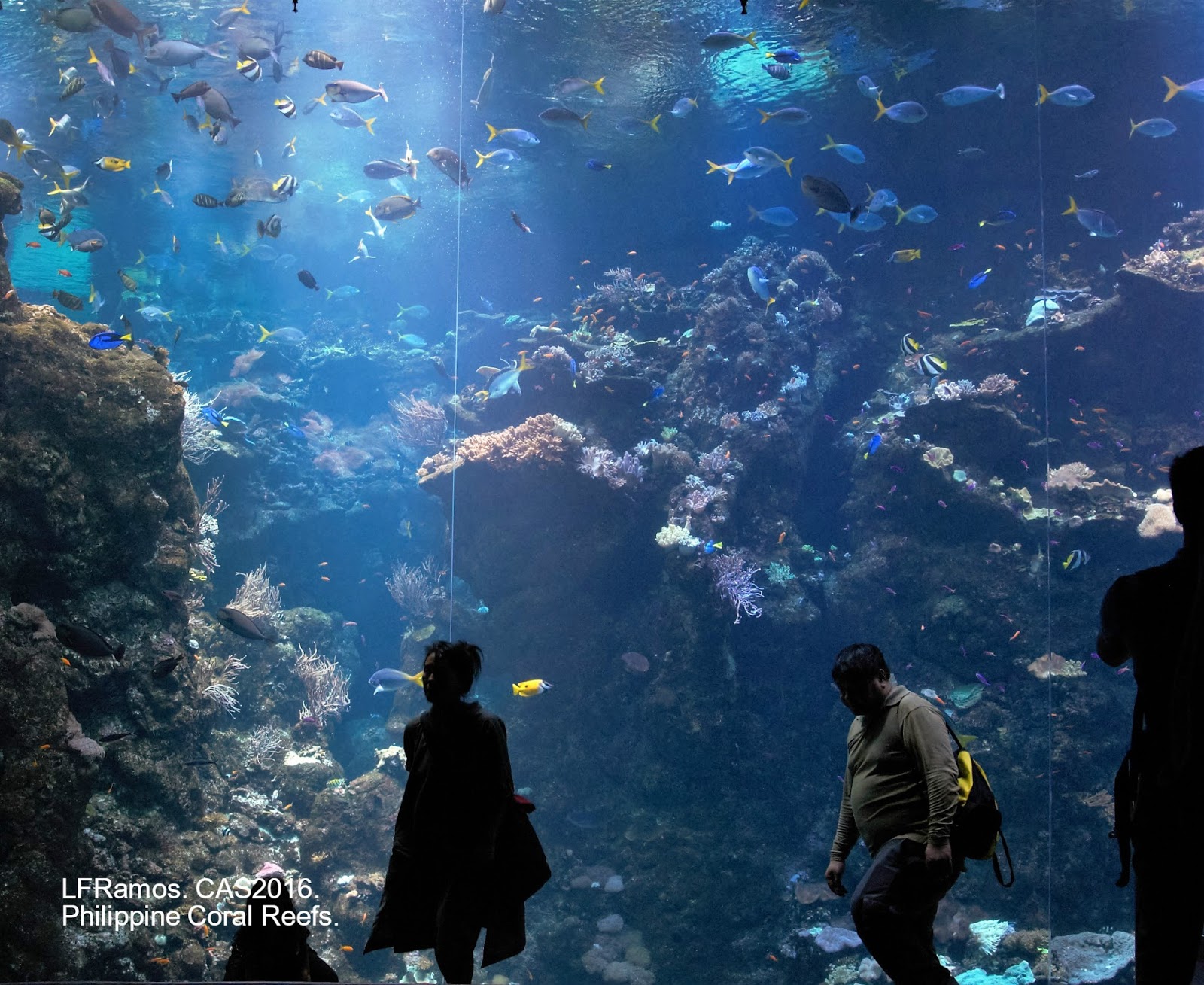
Philippine coral reefs at the California Academy of Sciences

We had to be in San Francisco, CA for a close look at marine life in Philippine coral reefs without donning a diving suit and a breathing apparatus. For the record, we had a camera whose shutter speed and aperture opening we had to adjust to the available light under the Philippine sea in an American setting.

Our 'diving site' was a 212,000-gallon aquarium of the California Academy of Sciences (CAS), which replicates some of the diversity found in our coral reefs.  

The coral reefs, says CAS, 'are among the world's most diverse ecosystems. Home to more than 500 coral species and 3,000 fish species of fish, they support entire ocean ecosystems and the people rely on reefs for food, income, and protection from storms.'

The Academy has been doing research in our country for more than a century, and the latest one was the 2014 Philippine Biodiversity Expedition that focused on marine habitats near the apex of the Coral Triangle. It surveyed the Triangle's 'twilight zone', a habitat 40 to 150 meters deep, where no humans had entered before.

The Triangle refers to the triangular area of the marine waters of Indonesia, Malaysia, Papua New Guinea, Philippines, Solomon Islands and Timor-Leste. The Philippines is near its apex.


Hundreds of species have been discovered through the joint efforts of Academy and Filipino scientists but they estimate that 'fewer than half of all reef species have been identified.'  During the cited expedition, at least 300 new species were discovered' such as the deep-water coral Philippine sea fan (Solenocaulon sp.) and the spiny, globular Philippine pencil urchin (Phyllacanthus imperialis), whose specimens are on display at the CAS.

The Academy noted that pollution, coastal development, global climate change, and non-sustainable fishing practices pose severe threats to Philippine diversity. It has 'developed a practice of rapidly translating data collected in the field into effective marine conservation actions.'


'The 2011 Philippine Expedition,' the Academy reported in its webpage, 'resulted in recommendations for better regulation of existing Marine Protected Areas, as well as the establishment of new MPAs. Today, that work—in conjunction with community-based conversation projects—has recently begun to yield reversed degradation in coral reefs. While the threats still far outweigh any recovery, these comprehensive policies and practices have begun to slow the loss of biodiversity in the Philippines. Here [in California], our work in the Philippines enriches and informs Academy exhibits, where it continues to reach millions of visitors, teachers, and students each year.'


Part of the exhibit is a video presentation of 'Filipino Voices' which shows Filipinos 'who are championing marine sanctuaries, changing fishing practices, protecting precious reefs for future generations.'

In its caption on the Philippine pencil urchin, the Academy cited the villagers living near Batalang Bato, a popular dive spot.  'After decades of unsustainable practices,' CAS said, '[they] established one of the first community-initiated marine sanctuaries. Academy researchers worked closely with the community leaders and after six years of protection, a once depleted reef now teems with life that will repopulate other nearby reefs.'


This community action resonates with the marine turtles conservation project of volunteer fisher folks in our coastal village La Paz in the San Narciso town of Zambales province. For the past four years, they have been operating a hatchery during the nesting season to ensure the survival of the endangered Olive ridley turtles for future generations. They know that these creatures feed on sea grass and in so doing, they maintain the balance in the ecosystems in the reefs, the breeding ground of fishes. Fishing is the primary source of livelihood of these volunteers.