Showing posts with label San Francisco. Show all posts

Wednesday, September 7, 2016

Did Jose Rizal leave his heart in San Francisco?

Many Filipinos entering the United States for the first time through San Francisco may be surprised to know that national hero Jose Rizal preceded them here more than a century ago.

From Tokyo, he wrote his parents and siblings that "[o]n the 13th of [April 1888] I leave for America on the steamship Belgic of the Oriental and Occidental Company. I intend to stay in America some weeks and afterward depart for London where I should be toward the end of May."

The steamer sailed from Yokohama, and based on the data from the 'Marine Ships in Port' of 'The Maritime Heritage Project - San Francisco 1846-1899', a voyage of the Belgic in 1890 took 15 days 13 hours and 44 minutes before it dropped anchor at the port in San Francisco.

The Port of San Francisco, 1849. (Source: The Maritime Heritage Project.)

On Saturday, 28 April, Rizal wrote in his diary: "We arrived in the morning at San Francisco, We docked, They say that we shall be quarantined, The little customs launch came to visit us. They have unloaded the silk cargo: Each bale costs about $700. They are not afraid of the silk and of the lunch."

The next day, Sunday, he noted: "The second day of the quarantine, We are bored. I no longer know how to amuse myself."  And he wrote to his parents: "Here we are in sight of America since yesterday without being able to disembark, placed in quarantine on account of the 642 Chinese that we have on board coming from Hong Kong where they say smallpox prevails. But the true reason is that, as America is against Chinese immigration and now they are campaigning for the elections, the government, in order to get the vote of the people, must appear to be strict with the Chinese, and we suffer. On board there is not one sick person."

On the third day: "The quarantine continues. I read in the newspapers a statement of the health inspector against the quarantine."  He wrote to his friend Dr. Ferdinand Blumentritt: "We are anchored in this port under quarantine. We don't know how long it will last, although there are no sick passengers aboard and the ship did not come from a filthy port. The reason for this is that we have 643 Chinese passengers and, as elections are approaching, the government wants to be in the good graces of the people. We protest, but it is useless for, as the Spaniards say, it is like exercising the right to kick."

On 01 May, Rizal said they signed a protest against the quarantine and the Englishmen wrote to their consul. After six days of quarantine, in the afternoon of 4 May, they, the first class passengers finally stepped on American soil.  The Japanese and Chinese remained on board.

At that time, the disembarkation point was not the postcard Port of San Francisco we see today. So where did the Belgic docked?  Gary Kamiya provided the most probable answer in his book Cool Gray City of Love: "The thousands of Chinese immigrants that poured into the city disembarked at the Pacific Mail Steamship pier, near what is now First and Brannan."

Marker on the wall of the Palace at the Montgomery St-
Market St. corner.

From there, Rizal could have taken a coach to the first class Palace Hotel on New Montgomery Street, where he lodged at "$4.00 a day with bath and everything included"  Based on the historical data of 1887, he stayed in a sunny outside room with southern exposure that cost '$4.00 per day and upward.'  It was more expensive by a dollar if he stayed in an outside room 'with facing street.' The cheapest were for outside rooms facing open courts: '$2.50, $3.00 and upward.'

There was not much in his diary from which to deduce how Rizal spent his short time in the city,

He simply wrote: "...Stockton St. 312. I saw the Golden Gate ... (one illegible word). The customs-house. A letter of recommendation. On Sunday the stores are closed. The best street in San Francisco is Market Street. Stroll. -- Stanford, the rich man. -- A street near Chinatown."

We must note that Rizal might have been referring to the Golden Gate Strait, the entrance to San Francisco Bay, because the iconic bridge was built in the 1930s. Or, he could have gone to the Golden Gate Park but he could not have walked to this large public park as it was too far from the hotel. He did not mention taking the streetcar that was already running to this place in 1887.

When he stepped out for a walk, the first thing that he could have noticed were the cable cars that had been running along Market Street since 1883. These cars replaced horse-drawn rails. He might have preferred to walk rather than take the cable car; hence, his remark that Market was the best street of the city.

When he strolled on Market, he could have noted at the corner of Geary and Kearny, a short distance from the hotel, Lotta's Fountain: a cast iron sculpture painted in bronze with lion's heads and other ornaments. Historical accounts say that this fountain was presented to the citizens of San Francisco in 1875 by the famous Lotta Crabtree, who started her career as a vaudeville performer in the city during the Gold Rush days.

The Lotta's Fountain in 1901 when Pres. McKinley visited the Palace Hotel.  (Source: Wikipedia)

The Lotta's Fountain today near the Palace Hotel. Photo by the author.

Except for the other buildings and street scenes, the vintage and recent photographs of Palace Hotel with Lotta's Fountain are quite similar except that the original hotel, where Rizal stayed, was gutted by fire in the aftermath of the 1906 earthquake. The reconstructed one was opened in 1909.

'Stanford, the rich man.'  Rizal was referring to Leland Stanford, one of the 'Big Four Millionaires' from the Gold Rush and was also dubbed a robber baron. His farm spawned the Stanford University. Did Rizal hear about his anti-Chinese attitude when he was governor of California? He lobbied for the restriction of Chinese immigration during his term.

'A street near China town,' he wrote. Did he go there? The scene could have been similar to Binondo of his student days in Manila.

He was in San Francisco for two days and two nights, and left for Oakland in the late afternoon of 06 May 1888 on a ferry boat. From there, he would board the train that eventually took him on a coast-to-coast journey to New York City.

From London, Rizal would relate his overall impression of America to his friend Mariano Ponce in his letter of 27 July 1888: "I visited the largest cities of America with their big buildings, electric lights, and magnificent conceptions. Undoubtedly America is a great country, but it still has many defects. There is no real civil liberty. In some states the Negro cannot marry a white woman, nor a Negress a white man. Because of the hatred of the Chinese, other Asiatics, like the Japanese, being confused with them, are likewise disliked by the ignorant Americans. The customs is excessively strict. However, as they say rightly, America offers a home to the poor who like to work."

He cited his sad experience in San Francisco: "There was moreover much arbitrariness; for example, when we were in quarantine. They placed us under quarantine, in spite of the clearance given by the American consul, of having been at sea for about one month, of not having a single case of illness aboard, and of the telegram of the governor of Hong Kong declaring that port free from epidemic. We were quarantined because there were on board 800 Chinese and, as elections were being held in San Francisco, the government wanted to boast that is was taking strict measures against the Chinese to win votes and the people's sympathy. We were informed of the quarantine verbally, without specifying its duration. However, on the same day of our arrival, they unloaded 700 bales of silk without fumigating them; the ship's doctor went ashore; many customs employees and an American doctor from the hospital for cholera victims ate on board. Thus we were for about thirteen days. Afterwards only the passengers of the first class were allowed to land, the Japanese and Chinese of the 2nd and 3rd classes remaining in quarantine for an indefinite period. It is said that in that way they got rid of about 300 Chinese, letting them gradually die on board. I don't know if this is true."

In November that year, the Americans were going to elect their president. The incumbent was Grover Cleveland (Democrat). In California, they voted for the Republican challenger Benjamin Harrison.

The Chinese issue of Rizal's time resonates in the present debates on immigration policy between the Republican Donald Trump and the Democrat Hillary Clinton. Trump had swiped at illegal immigrants particularly the Mexicans, but he also clawed at people coming from what he deemed terrorist nations, and tagged the Philippines as one of them. "We're dealing with animals," he trumped.


Note:  
Rizal's diary entries and letters were taken from the book Jose Rizal Reminiscences & Travels published by the National Historical Commission of the Philippines in 2011.

Recommended reading on the historical and current views of San Francisco:
Kamiya, Gary. 2013. Cool Gray City of Love: 49 Views of San Francisco. Berryville, VA: Berryville Graphics, Inc,


Wednesday, August 31, 2016

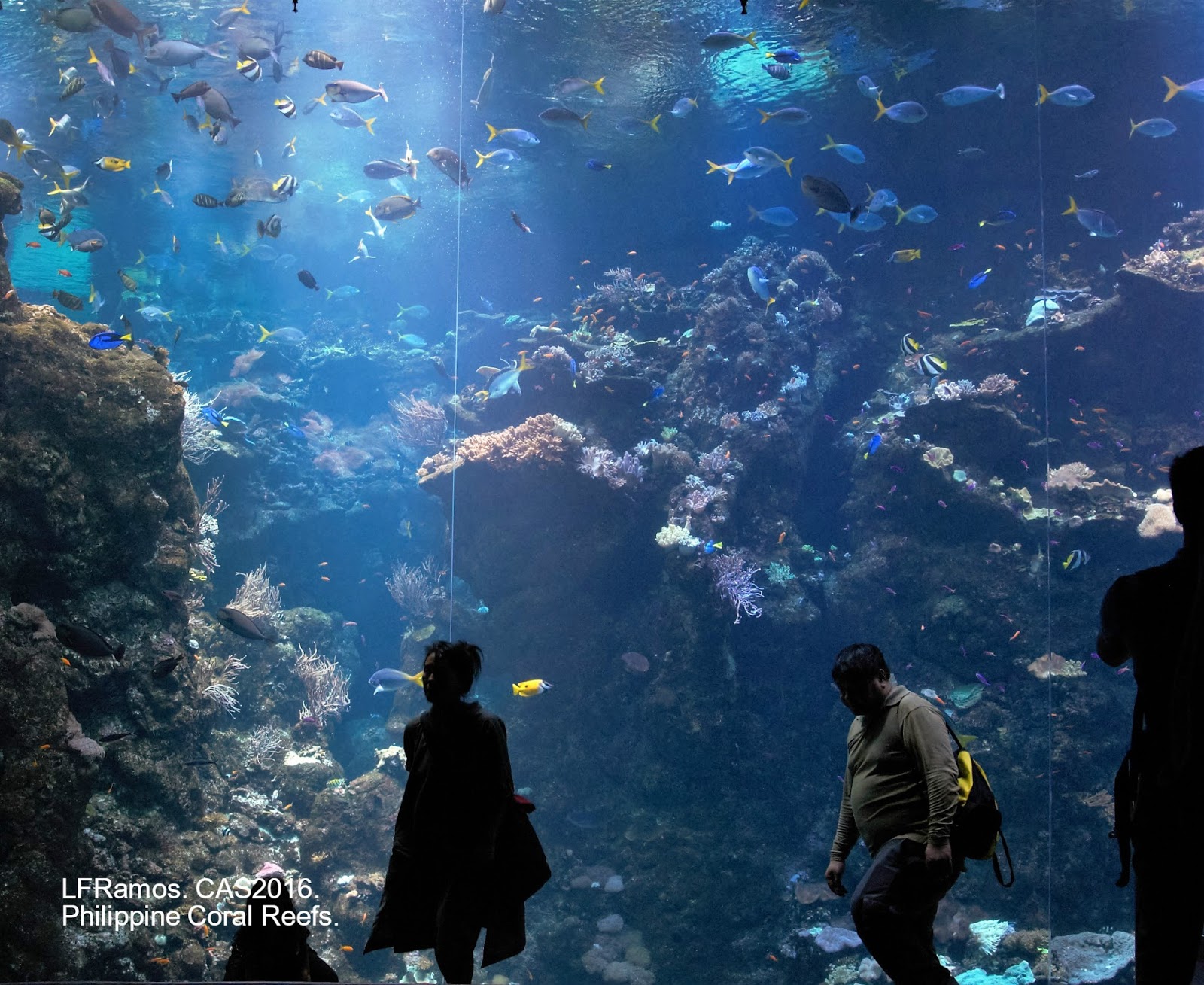
Philippine coral reefs at the California Academy of Sciences

We had to be in San Francisco, CA for a close look at marine life in Philippine coral reefs without donning a diving suit and a breathing apparatus. For the record, we had a camera whose shutter speed and aperture opening we had to adjust to the available light under the Philippine sea in an American setting.

Our 'diving site' was a 212,000-gallon aquarium of the California Academy of Sciences (CAS), which replicates some of the diversity found in our coral reefs.  

The coral reefs, says CAS, 'are among the world's most diverse ecosystems. Home to more than 500 coral species and 3,000 fish species of fish, they support entire ocean ecosystems and the people rely on reefs for food, income, and protection from storms.'

The Academy has been doing research in our country for more than a century, and the latest one was the 2014 Philippine Biodiversity Expedition that focused on marine habitats near the apex of the Coral Triangle. It surveyed the Triangle's 'twilight zone', a habitat 40 to 150 meters deep, where no humans had entered before.

The Triangle refers to the triangular area of the marine waters of Indonesia, Malaysia, Papua New Guinea, Philippines, Solomon Islands and Timor-Leste. The Philippines is near its apex.


Hundreds of species have been discovered through the joint efforts of Academy and Filipino scientists but they estimate that 'fewer than half of all reef species have been identified.'  During the cited expedition, at least 300 new species were discovered' such as the deep-water coral Philippine sea fan (Solenocaulon sp.) and the spiny, globular Philippine pencil urchin (Phyllacanthus imperialis), whose specimens are on display at the CAS.

The Academy noted that pollution, coastal development, global climate change, and non-sustainable fishing practices pose severe threats to Philippine diversity. It has 'developed a practice of rapidly translating data collected in the field into effective marine conservation actions.'


'The 2011 Philippine Expedition,' the Academy reported in its webpage, 'resulted in recommendations for better regulation of existing Marine Protected Areas, as well as the establishment of new MPAs. Today, that work—in conjunction with community-based conversation projects—has recently begun to yield reversed degradation in coral reefs. While the threats still far outweigh any recovery, these comprehensive policies and practices have begun to slow the loss of biodiversity in the Philippines. Here [in California], our work in the Philippines enriches and informs Academy exhibits, where it continues to reach millions of visitors, teachers, and students each year.'


Part of the exhibit is a video presentation of 'Filipino Voices' which shows Filipinos 'who are championing marine sanctuaries, changing fishing practices, protecting precious reefs for future generations.'

In its caption on the Philippine pencil urchin, the Academy cited the villagers living near Batalang Bato, a popular dive spot.  'After decades of unsustainable practices,' CAS said, '[they] established one of the first community-initiated marine sanctuaries. Academy researchers worked closely with the community leaders and after six years of protection, a once depleted reef now teems with life that will repopulate other nearby reefs.'


This community action resonates with the marine turtles conservation project of volunteer fisher folks in our coastal village La Paz in the San Narciso town of Zambales province. For the past four years, they have been operating a hatchery during the nesting season to ensure the survival of the endangered Olive ridley turtles for future generations. They know that these creatures feed on sea grass and in so doing, they maintain the balance in the ecosystems in the reefs, the breeding ground of fishes. Fishing is the primary source of livelihood of these volunteers.


Friday, August 12, 2011

Amigo 113: The American Volunteers in the fall of Manila on 13 August, 1898

 Inscription on the granite pedestal:  "ERECTED BY /THE CITIZENS OF SAN FRANCISCO  IN HONOR /OF THE / CALIFORNIA VOLUNTEERS / SPANISH-AMERICAN WAR / 1898 / FIRST TO THE FRONT. [Photo by the author.]


It's interesting to note that the California Volunteers Monument featuring the goddess of war Belladona mounted on Pegasus, and two soldiers, one fallen and the other bravely prepared to face the enemy, is the first to catch attention as one gets off the outbound Muni train at the Castro, San Francisco's gay district.  We suppose that the bronze statues merit at least a passing glance from first-timers there.  An extra effort to check what the monument represents seems highly unlikely.

Douglas Tilden did the sculptures in 1904 to commemorate the Californians--many of them from San Francisco--who were in the first three steamships of volunteers and regular U.S. Army contingents of the Philippine Expeditionary Force dispatched from San Francisco to the Philippines. 

"First to the Front" was something the 1st California Volunteer Infantry shared with the 2nd Oregon Volunteer Volunteer Infantry because both were in the first expedition to leave on 25 May.  They were on board the City of Sidney, City of Pekin (Peking) and Australia under the command of General Thomas M. Anderson. 

The Charleston convoyed them from Honolulu, Hawaii to Manila. Its commanding officer received instructions through the Peking from the Secretary of the Navy "to stop at the Spanish Island of Guam ... use such force as may be necessary to capture the port of Guam, making prisoners of the governor and other officials and any armed force that may be there ... also destroy any fortifications on said island and any Spanish naval vessels that may be there, or in the immediate vicinity", all to be done in a day or two.

On 20 June, Guam surrendered peacefully. The troopships arrived in the Philippines on 30 June with the Sidney carrying their prisoners of war - the Guam Spanish officials, soldiers and their families.

This first batch of regular soldiers and volunteers comprised such a large troop that General Thomas M. Anderson had to ask Aguinaldo, when they have landed in Cavite, to transfer his army so that they can move in.  Aquino moved to Bacoor where he would set up the provisional government.


"Transports Australia, City of Sydney and City of Peking departing San Francisco with troops and supplies, en route to Manila, 25 May 1898. Reproduction of an artwork by P.N. Boeringer, 1898" -  Photograph from the U.S. Naval Historical Center Website.
The second expedition came on board the transport ships China, Colon and Zeelandia (Zealandia). It was under the command of General Felix V. Greene, and included the 1st Colorado Volunteer Infantry, the Utah Volunteer Light Artillery and the 10th Pennsylvania Volunteer Infantry. They left port on 15 June, and reached Manila on 17 July. 

The third expedition were carried by the transports Senator, Morgan City, City of Para, Indiana, Ohio, Valencia and Newport.  The contingents included the 13th Minnesota Volunteer Infantry, the North Dakota Volunteer Infantry, the 1st Idaho Volunteer Infantry, and the 1st Nebraska Volunteer Infantry.  They were under the command of General Arthur MacArthur. 

On board the Newport was General Wesley Merritt, head of the Philippine Expeditionary Force who would command all the U.S. troops in the Philippines. Their group left San Francisco on earlier on 27 June and landed in Cavite on 25 July.  The rest of the expedition arrived later at the end of the month.  
“General Merritt arrived at Cavite in the Newport on the afternoon of July 25," wrote Greene (1899), "and after examining the ground the following day, promptly decided two points:  first, that the attack would be made along the shore; and second, that it was necessary to get the insurgents off to one side, so as to give us the right of way." 

Following that, Merritt had two battalions of the 1st California, two battalions of the 10th Pennsylvania and one company of the 3rd Regular Artillery relieving each other in building the trenches fronting Fort San Antonio de Abad in Malate, a far more advance position than that of the Aguinaldo forces. Of course, the Spaniards wanted to drive their enemies out of the trenches, and so on midnight of 31Jul-01Aug, the Americans had their first taste of Spanish fire (Greene).

The "First to the Front" could also have been attributed to the fact that the 1st California was the one sent forward in this incident, one battalion to the trenches, the second in reserve behind them, and the third at the rear of the second, out of range of Spanish fire.

Before 13 August, we all know that the Merritt and Dewey put their heads together to map out the battle plans just in case they can not convince the Spanish authorities to surrender Manila peacefully.  But we also know that the Spaniards acceded only on condition that there should be a semblance of battle.   

The American battle plan divided the Army into two brigades.  

General Greene's 2nd brigade would be strung along the extreme right extending to the beach with the Utah light artillery, the 1st Colorado and a battalion of the 3rd artillery in the advance fighting line. Behind them would be the support of the 2nd battalion of the 1st California, 1st Pennsylvania, 1st Nebraska, the 18th US Infantry and a battalion of engineers (Stickney, 1899).   

General MacArthur's 1st brigade would be farther inland distributed similarly as Greene's with firing lines and reserves.  At the front would be the Astor battery, the 13th Minnesota and 23rd Infantry; battalions from the 1st North Dakota, 1st Idaho, 1st Infantry and the 1st Wyoming would provide the reserves and support.

General Greene was to attack the entrenchments and Fort San Antonio in Malate (the strongest strongholds), and General MacArthur would take care of Blockhouse No. 14 and the fortified English cemetery. 

We know what happened during the mock battle of/for Manila.  The Spaniards did not fire their guns at the US ships providing support for the US soldiers and volunteers in their assault of Manila.  


"First U.S. flag is hoisted over the fort, which had been bombarded by U.S. warships, including USS Olympia, and captured by troops of the U.S. Army First Colorado Volunteer Regiment. Note extensive damage from shellfire. Donation of Rear Admiral Ammen C. Farenholt, USN(MC)." -- Photograph from the U.S. Naval Historical Center Website.

At ten minutes after eleven that day, the men of the 1st Colorado raised Old Glory on Fort San Antonio (White, 1899). The defeat of the Spaniards at the trenches and the capture of the fort was said to be the ‘most brilliant and spectacular’ (Stickney).   

“By twelve o’clock, therefore," wrote Greene, "the entire Spanish line from Fort San Antonio to blockhouse No. 13 [14?] had been carried, and the navy, of course, had ceased firing some time before.  The First Colorado, and the First California, which had followed rapidly up the beach, were in the houses and gardens at the southern end of the Malate suburb ... The houses in Malate from which [they were fired upon] were stormed by parties of volunteers from the First California, who rushed into the houses and killed or captured their defenders." 

There were also the Filipino "insurgents" aiming to defeat the Spaniards and enter Intramuros.  They never had the chance.  The Californians took care of them.  Here's Stickney describing incidents of  American intervention:  

“The four companies of the 1st California proceeded through the Calle Real in Malate, Colonel Smith dropping guards at every house flying the English flag, to protect it from the insurgents, who were scrambling along in the wake of Californian’s victorious advance. The insurgents were firing as they came along.  It was here that Major Jones of the transportation department and Interpreter Finlay distinguished themselves.  The insurgent firing had become hot for even the Americans, and Major Jones took an American flag, planted himself in the middle of the road and with drawn revolver stopped the entire advance of the insurgents. ...

“The Californians advanced to the road leading around the walled city and intercepted the insurgents who were flocking in along the road from Santa Ana.  The latter were firing on the retreating Spaniards, and the Californians came in direct line of the fire.  The Spaniards were returning the insurgent fire, and the Americans were between the two forces. ... The California men held their fire ... The insurgent advance was stopped. Colonel Smith then advanced to the roads leading from Paco and stopped another troop of insurgents who were attempting to enter the walled city.  One pompous insurgent insurgent in a gorgeous uniform announced that they were going on, but when Major Bell drew his revolver and threatened to kill any one attempting to pass, the insurgent officer became submissive and polite.  The Americans then formed in line and forced the insurgents up the street and into a side street. They next attempted to get in by another street, but were forestalled.” 

By late afternoon, Manila fell/surrendered.     

"General Greene came up under a scattering fire with his staff and met a Spanish official who awaited him at one of the gates of the city," described Stickney.  "The general entered the city alone with the Spaniards and the arrangements for the occupation were made."  

The time had come for General Merritt to enter the city.  

Douglas White (1899) had the best description of the formal taking over of Manila.  He was on board the transport Qong Hoy, which bore the seven companies of the 2nd Oregon, detailed as guard to enter Manila with General Merritt.  He wrote:   

“The launch of the Belgian consul, which, with the Zafiro, bearing Merritt and his staff, had been hovering behind the fleet, was employed to carry Flag-Lieutenant Brumby and a representative of General Merritt to the beach nearest this sign of submission, and their arrival there was the beginning of the end.  One hour was enough for Lieutenant Brumby to roughly shape the conditions of the surrender, and the return of the launch told the fleet that the Spaniard’s rule in Luzon was at an end.”   

When he got off the Qong Hoy, White found a Father Dougherty and a Colonel Crowder at the Paseo de Sta. Lucia, and all of them rode the carriage of ex-Gov-Gen Agustin along the Luneta into the walled city. 

“Before the Governor’s Palace we found the Royal Guard drawn up, their halberds and heavy helmets giving them the appearance of warriors belonging to another century.  Passing up the grand staircase, we entered the executive chambers, where General Merritt, Flag-Lieutenant Brumby and the dignitaries of the island government were discussing the terms of surrender.  I was the first American correspondent to make an entrance into the walled city, and the first civilian to gain access to the palace where this exclusive conference was being held.

“Here, indeed, the difference between the two warring races was plainly evident,  Our representatives towered head and shoulders over the men who were, point by point, contending for more lenient terms of surrender.  General Merritt seemed like a giant beside the diminutive Jaudinez, upon whose shoulders the gubernatorial mantle had fallen by the sudden resignation of Agustin. 

At 5.30 P.M. the last detail of the surrender was complete, and to Lieutenant Brumby fell the joyful work of raising the colors upon the walls of Manila.  Incidentally it became necessary for the lieutenant also to haul down the Spanish colors, which had for weeks been floating as a defiance to the fleet. ... "
Raising the "Old Glory" after the fall of Manila.  Source: White, Douglas (1899).

Other chosen flag raisers:  Lt G.W. Povey of the Second Oregon to represent the army, American civilians Barry Baldwin, former US Marshal of California, and William Wiley, an owner of the Quong Hoy 

"There was no trumpeter for the flag raising, but Lt. Brumby said, “he can not afford to wait for one, so we must do the best we can and raise her with a cheer.”  With that the order was given, and the Old Glory started on it ascent over the walls of Spain’s Oriental stronghold.  Our party broke into a rousing shout, when up from Luneta came the strains of the “Star-Spangled Banner,” played by the band of the Second Oregon, which had been marching from the landing into the walled city.  Seeing that we were about to fly the colors above them, they halted to perform the musical honors of the occasion. ... " 

Let's have Greene conclude events of 13 August 1898:   

“It was part of General Merritt’s plan to bring the Second Oregon Regiment, which had been stationed at Cavite, up on a transport, and to land it in the walled city, as soon as the place should be taken, for the purpose of preserving order there. These troops came into the Pasig River in boats and launches at about five o’clock, and at the same time or earlier General Merritt... came ashore, proceeded to the ayuntamiento, and accepted, with certain modifications, the preliminary articles of capitulation submitted by the Spanish captain-general.  Immediately after doing this he sent a detachment of the Second Oregon to haul down the large Spanish garrison flag, which floated over the northwest bastion, and run up the American flag in its place. ... General MacArthurs’s brigade was distributed through the southern suburbs of Ermita and Malate, and my brigade through the northern suburbs of Tondo, Binondo, Santa Cruz, Quiapo, San Sebastian and San Paloc (sic). ... "

Source:  Harden, Edward (1899).

That evening, Admiral George Dewey hosted a "musical concert" on board his flagship Olympia.  

The Filipinos stood outside the gates of the city, uninvited, broken-hearted and forlorn, attending to their own casualties. They've been robbed.

When peace time set in, streets in the Ermita and Malate districts of Manila would be named after the Volunteers of 1898 and later years; hence, there was a California,Colorado, Dakota, Nebraska, Oregon, Pennsylvania of the first three expeditions, but there was no Minnesota and Wyoming (Rosenstock's Manila City Directory, 1917). 

We may understand the case of the Wyoming.  They were reserves marching so far behind that Spanish fire could not even reach them.  They didn't stay long in the Philippines.

In recent times, those streets were renamed after Filipinos with distinctions, politicians mostly.


References:
  • Greene, Francis V. (1899, Apr).  The Capture of Manila. II. The Manila Campaign. The Century [Illustrated Monthly] Magazine.  52(6):915-935
  •  Harden, Edward W. (1899, May).  Dewey at Manila. One Year’s Retrospect.  Frank Leslie’s Popular Monthly.  48(1): 21-38.  
  • Stickney, Joseph L. (1899).  Admiral Dewey at Manila and the Complete Story of the Philippines / Life and Glorious Deeds of Admiral George Dewey including a Thrilling Account of our Conflicts with the Spaniards and Filipinos in the Orient.  Chicago, Ill.:Imperial Publishing Company.
  • White, Douglas. (1899, May).  The Surrender of Manila. Frank Leslie's Popular Monthly. 48(1):38-48. 

    Wednesday, August 10, 2011

    Amigo 113: The Presidio of San Francisco and the Filipino

    'The Ordonez Gun – “War Prize” from the Philippines

    'The Presidio’s Ordonez gun was originally mounted in a Spanish coastal fort at Subic Bay in the Philippines.  Undamaged during the Spanish-American War, the gun was captured by Filipino nationalists, who were known as “Insurrectos” by the occupying Americans.

    'In September 1899, a combined U.S. Army-Navy force attacked Filipino positions at Subic Bay. This gun was reported to have been destroyed by shellfire from American cruiser USS Charleston.  Some historians suggest that the damage was caused by the explosion of a shell within the gun.' -- From the Presidio Marker

    The Presidio is not as popular a tourist destination as the Golden Gate Bridge and Palace of Fine Arts even if all three are in the same neighborhood.  One can take the free Presidio shuttle bus to reach the Bridge, or walk from its Lombard Gate to the Palace. It is a favorite of hikers and bikers; there's a green for golfers, outlook points for nature lovers, and places of interest for history researchers.  Crowd-drawing relocators may soon follow the Walt Disney Museum that's now housed in one of the restored military barracks there.

    This was the military outpost of the Spanish empire in North America since 1776, then of the Mexicans for 24 years before the U.S. Army took over in 1846 (California became the 31st state in 1850).

    On 13 August 1898, Manila was captured by the US Army under General Wesley Merritt with the support of the naval fleet under Admiral George Dewey. Spanish power in the Philippines ended.  This coming Saturday will be the 113rd anniversary of the fall of Manila.

    Thus, the 113 in our title.  The Amigo (friend, Sp.) derives from John Sayle's movie of the same name about a barrio chief torn by conflicting alliances during the Philippine war for independence (1898-1902), a facet of Fil-Am history that Americans and Filipinos know so little about.  The movie is scheduled for theatrical showings in major American cities starting this month.

    The Lombard Gate.  Inset are war trophies (cannons, left and right) and decorative detail at the right gate post.  The trophies are bronze cannons "probably from the harbor fortifications of Manila ... cast in Seville in 1783 [and] engraved with the monogram CR III for Carlos de Borbon, King of Spain from 1759 to 1788. (War & Dissent Exhibition Brochure)."
    So, what has the Presidio got to do with the Filipino amigo then and now - the tourist from Manila, or the Fil-Am living in the [San Francisco] Bay Area or visiting from other states?

    We recall that George Dewey crushed the Spanish navy in Manila Bay on 01 May 1898.  There was no way he could capture Manila.  He could only set up a blockade, and because the Spaniards did not allow him to use the cable lines, he cut them on 02 May.  From Hong Kong, he wired Washington DC on 07 May:  "I have taken possession of the naval station at Cavite, Philippine Islands, and destroyed its fortifications. Have destroyed fortifications bay entrance, paroling garrison. Have cut cable to main land. I control bay completely and can take city at any time, but I have not sufficient men to hold..."

    "Unaware of Dewey’s success," a marker in the Presidio reads, "President McKinley authorized troops to mount a campaign against the capital of Manila. The military base best suited as a staging point was the Presidio of San Francisco. "

    Thus, a military expedition was organized with Major-General Wesley Merrritt in command.  These comprised thousands of men from the regular army and volunteers in the regiments from the western states so that the rail travel to San Francisco, the port of mobilization, would be shorter.

    The troops were all encamped in the Presidio; from 1898 through 1900, 18,000 soldiers passed through this post to the Philippines.

    The first transports came on board the City of Peking, City of Sydney and  Australia under the convoy of the Charleston and reached Manila Bay on 30 June, 1898.  These were the four companies of the 14th infantry of the regular army and the 1st California and 1st Oregon regiments of volunteers under the command of General Thomas M. Anderson of the US Army.

    The next troopships arrived in July--those under General Frank V. Greene on the 17th; General Merritt's on the 25th; and those of General Arthur MacArthur on the 30th.

    It's important to recall that General Emilio Aguinaldo left Hongkong on 17 May on board the USS McCulloch, arrived in Cavite on the 19th, and issued three proclamations on the 24th.  In the third, he invoked that "The great American nation, a lover of true liberty, and therefore desirous of liberating our country from tyranny and despotism to which it has been subjected by its rulers, has decided to give us disinterested protection, considering us sufficiently able and civilized to govern ourselves."

    Within a week, Aguinaldo had mobilized his army to resume the revolution against the Spaniards eventually liberating Cavite. On 12 June, he proclaimed the country's independence from the window of their house in Kawit.

    "[U]ntil the arrival of the first detachment of United States troops on the 30th of June," Stickney (1899) wrote, "Aguinaldo maintained his headquarters in Cavite, but his troops were continually pressing the Spaniards back upon Manila.  ... It was not long before they reached the fort near the beach at Malate ... and continued their movement for investing the city to the east and north."

    When his large troops landed, General Anderson asked Aguinaldo to evacuate Cavite for them.  Aguinaldo obliged and moved his troops to Bacoor where he organized a provisional government.

    In July, the Spaniards in Manila were already on the defensive against the Filipino forces.  The US troops had advanced to Parañaque, and the Americans were preparing to compel the Spaniards to surrender Manila to General Merritt.

    In August, while the Filipinos were pressing forward to Manila, the Americans and the Spaniards were negotiating the battle plans and the terms of surrender.  

    On 13 August, the Anderson and MacArthur troops pinched Manila from two sides; the Olympia, Charleston, Raleigh and the Petrel pummeled the Malate fortifications and Fort San Antonio while the Spanish guns from Intramuros remained mute; and the California volunteers ordered the Filipino troops to hold their fire and leave them alone and in no way should they advance ahead of them.

    Thus, the fall of Manila to the Presidio boys. Part 1 of America's first foreign war, a conventional one--the Spanish-American--ended;  Part 2, the Philippine-American, a guerilla type, had began.


    References:

    • Stickney, Joseph L.  (1899).  War in the Philippines and Life and Glorious Deeds of Admiral Dewey. A Thrilling Account of our Conflicts with the Spaniards and Filipinos in the Orient including the Glorious Deeds of the Great Commander and The Complete Story of the Philippine Islands, Historical and Descriptive. Chicago: Imperial Publishing Company. 
    • White, Douglas. (1899, May).  The Surrender of Manila.  Frank Leslie's Popular Monthly.  48(1):38-48.


      Monday, August 8, 2011

      Looking for Philippine traces around the San Francisco Palace of Fine Arts

      The Palace of Fine Arts is the only structure preserved from among several palaces of exhibition built for the Panama-Pacific International Exposition of 1915. Photo by the author.

      A long time ago, in the mid-1970s, we associated the iconic architectural dome with out-of-school science education when we were hammering out program plans of the Science Foundation of the Philippines-National Science Development Board (now the Dept. of Science &Technology) for a Takarang Agham ng Pilipinas (Philippine Science Center). It was the Exploratorium to us then, one of our models for the science museum where viewers handle/interact with the exhibits to learn the science principles behind them. 

      We first visited the Exploratorium in the 1980s. There we learned that it was actually occupying the Palace of Fine Arts, said to be the "most beloved of the 1915 Panama-Pacific International Exposition."   We've been going back to this architectural masterpiece of Bernard Maybeck whenever we are in San Francisco. The blending of what looks like ancient Roman ruins with the landscape--water and lush greens--evokes varying moods as we go around with our camera.

      Photograph of Palace of Fine Arts by U.H. Berney, 1915.

      The Exposition (20 February-04 December 1915) was organized to celebrate the opening of the Panama Canal in 1914, and also to commemorate the discovery of the Pacific Ocean by the explorer Vasco Nuñez de Balboa 400 years earlier. The canal bridged the Atlantic and the Pacific, shortening travel time between the continents, and promising enormous commercial benefits for the major players in the world trade. 

      By that time, the "Philippine Islands" ("P.I.") has fully become a peaceful territory of the budding United States empire with the public school system fully entrenched throughout the archipelago, and Filipinos have started moving to America as pensionados or working students, or documented sacadas in Hawaii, another US territory, or in California, And the annual Manila Carnival has been running for years. These all suggest that there could have been Philippine representation in the 1915 Expo.

      There were indeed exhibits from "P.I." in the Palaces of Education & Social Economy ('domestic and foreign education, and areas relevant to social and economic conditions'), Manufactures ('commercial transformation of natural resources'), Agriculture, Food Products, and Horticulture.

      Grouping, location and nature of exhibits of the Bureau of Education of the Government of the Philippine Islands at the Palace of Education &Social Economy

      We had none in the Palaces of Fine Arts ('11,043 works of art from the US and some foreign countries'), Live Stock, Liberal Arts ('commercial and scientific exhibits from the US and in "industrial" groups'), Machinery ('machines and electrical apparatus, and related instruments and appliances'), Transportation (developments in modern land, sea and air transportation), and Mines and Metallurgy.

      Grouping, location and agriculural products of the Philippine Islands displayed at the Palace of Agriculture.

      The Islands had prepared for it since 1911 after San Francisco was officially declared as expo site no less than US President William Howard Taft himself.  A board composed of Leon Ma. Guerrero, president; William W. Barclay, director general; and Francisco Liongson, with Allen T. St. Clair as chief clerk was created.
      There was only this group of furniture makers at the Palace of Manufactures.

       "The Exposition, will be a great fair, largely industrial in nature," Parker (1912) of the Bureau of Education wrote, "at which there will be offered displays from all parts of the world, showing the resources of countries and the products of their hands and factories. The Philippines are to be properly represented at this exposition, and the schools of these Islands will have an unexcelled opportunity to exhibit to the whole world, and especially to educators, the results of fifteen years of instruction in the schools of the Islands under the practical administration of a body of American superintendents and teachers, many of whom will have been connected with the service for the full term."

      Cover of Tobacco brochure (left) and group/location/nature of exhibits at the Palace of Food Products.  Other brochures were made for the other products (rice, abaca, sugar).

      In 1914, the Philippine Legislature appropriated PhP100,000 for an exposition in Manila from which the best of products would be purchased for the fair in San Francisco. High standards were set for the selection of exhibits from the provinces to the Manila fair.  The Bureau of Education took it that these would be the gauge by which visitors in San Francisco will measure the work of the public schools. 

      What did the millions who visited the Exposition see from the Philippine Islands?
      • At the Palaces of Education & Social Economy, "the exhibit consisted of charts, written work, publications, reference books, statistics, compilations, textbooks, models, designs and plans, research work, school library work, school museum work, scientific and technical displays, graded industrial courses, transparencies, photographs, lantern slides, moving pictures, an industrial working exhibit, a force of demonstrators, and the sales department of school-made articles [which]served the purpose of showing the complete public school system (Report of the Governor General, 1916)."
      • At the Palace of Agriculture, a farm house and a farm cart; tobacco leaves and tobacco products; cocoanut, copra, and oil; abaca hemp, products and apparatus for stripping and cleaning abaca; a complete forestry exhibit, lumber and wood products; textile plants and their products; also a collection of useful and injurious insects plus apparatus to eradicate them.
      • At the Palace of Food Products, cocoanut oil press, corn and rice mills; sugar from cane, chocolate, coffee, vinegar, pepper, etc.; commercial alcohol, wine and gin from sugar cane; fermented beverages (basi and tapuy); and, strangely, tobacco also.
      • At the Palace of Manufactures, furniture (tables, chairs, etc) from individual exhibitors.
      • At the Palace of Horticulture, a large collection of orchids.

      The 1915 Exposition accorded the country and the Filipinos civilized treatment so far better than what we received at the St Louis Fair a decade earlier.  There were no more native villages reconstructed and shows using our tribal people to demonstrate to the American public that we were far from deserving independence and self-government.

      "For the first time," the Governor General reported to Washington, "the Philippine Islands were presented to the outside world by an exhibition of the education and accomplishments of the 8,000,000 civilized inhabitants of the islands, instead of an exhibit of the 1,000,000 or less partly civilized inhabitants of the mountains and more remote regions, as has been the case in exhibitions, pictures, and lectures upon so many occasions in the recent past."

      The Governor General had much to crow about with regard to the Bureau of Education exhibits: "The exhibit of the Philippine public schools ... not only set forth the operation of the public school system, but also correlated very closely with the general industrial and commercial purposes of the entire Philippine participation in the exposition....most favorably commented upon by visitors at the exposition were the centralized system of control, the adaptation of textbooks to Philippine needs, the emphasis placed upon games and athletics, the instruction in citizenship and in good manners and right conduct, the differentiation in the work for boys and girls, and the vocational specialization in the intermediate grades."

      The Philippine public schools received the highest award in education; there were also honors in social economy, liberal arts, and manufactures.  All in all, "the awards granted included 4 grand prizes, 15 medals of honor, 37 gold medals, 13 silver medals, 2 bronze medals, and 4 honorable mentions." Our Bureau of Education representatives spoke at 17 congresses and associations allied with the international congress on education and the meetings of the National Education Association, and also talked before school bodies, societies,, and clubs at the Expo and around San Francisco.

      The Filipino brain nurtured by the Philippine educational system has since then joined the diaspora to the American (and international) job market.

      But almost a century after the Expo, the farm house and farm cart remain fixtures in the countryside, and today there is the National Food Authority to ensure that domestic rice supply is complemented by imports from our Asian neighbors.  There are Philippine food products available in Pinoy and Asian groceries in America but they stand in stiff competition with the similar products from our neighbor countries.

      Until recent years, our traditional furniture makers were a strong presence in the international trade until competition from China and other neighbor countries grabbed the market from them, coupled with their slow response to the changing tastes of the world market.

      Before the second world war, the American Chamber of Commerce in the Philippines Journal kept watch on American investments in economic activities related to rice and corn, tobacco, lumber, copra and other natural products.  There also occurred in the 1920s an intense debate on the issue of turning Mindanao into a rubber plantation.  In recent times, we have seen export processing zones in strategic areas in the country.

      While we write this, we don't know why the Laurel-Langley agreement keeps popping up in our head.


      References:
      • Bernard Maybeck marker at the Palace of Fine Arts. 
        • Parker, Luther; Foreman, North H; Mulle, Theodore; Hansen, O.C.; and Sawyer, Leroy, R.  (1913, March).  The 1913 Industrial Exhibition of the Public Schools of the Philippines.Philippine craftsman. 1(9):660.  Manila: Bureau of Education.  Retrieved form http://name.umdl.umich.edu/acw9599.0001.001 
        •  Report of the Governor General.  (1916).  Report of the Philppine Commission to the Secretary of War 1915 (January 1,1915, to December 31, 1915).  Washington: Government Printing Office. Retrieved from http://name.umdl.umich.edu/acx1716.1916.001