Showing posts with label Intel ISEF. Show all posts

Tuesday, May 23, 2017

Davao high school girls: grand awardees at the Intel ISEF 2017

The winners in their national costume
during the judging interview day.
They proved that the acacia bark extract is an effective organic insecticide against the adult black rice bug. For this outstanding science investigatory project, Rubeliene Chezka Gloria, Myrelle Angela Colas and Nadine Antonette Obafial of the Davao City National High School brought home the second grand award of US$1,5000 in the plant sciences from the Intel International Science and Engineering Fair (ISEF) held in Los Angeles, California on May 14-19, 2017.

The three young scientists will be in Grade 10 when schools open in June. Thus,they will have the next three years until they graduate from senior high school to hone their research skills with new projects that can be of great benefit to the country.

They brought honor and pride to their school and country, and they also earned a place in the galaxy. Their names will be submitted to the International Astronomical Union (IAU) for "a once in a lifetime naming of a minor planet." According to the ISEF program, "all minor planets in the Ceres Connection have been discovered by the Lincoln Near Earth Asteroid Research (LINEAR) program, operated by MIT's [Massachusetts Institute of Technology] Lincoln Laboratory." 

The Gloria, Colas and Obafial minor planets will join the main-belt asteroids previously named after Filipinos under that same program:  28439 Miguelreyes, 11697 Estrella, 12088 Macalintal, 12522 Rara and 13241 Biyo. The first was named after Miguel Arnold Reyes, a grand awardee for his materials and bioengineering project in the 2011 ISEF. The other four were those of awardees in the 2002 ISEF: Allan Noriel Estrella and Jeric Valles Macalintal for their physics team project, Prem Vilas Rara for his microbiology study, and Dr. Josette Biyo, who was recognized for excellence in teaching.

The Davao high schoolers were part of this year’s ISEF Team Philippines, which included Ricky Dave Mercado of Nabuslot National High School, Pinamalayan, Oriental Mindoro and Maries Ann Silvestre of Juan R. Liwag Memorial High School, Gapan, Nueva Ecija.

ISEF Team Philippines 2017 at work during their mentoring sessions before going to LA.

ISEF Team Philippines 2017 were the best from among the top winners in the life and physical sciences competition in the National Science and Technology Fair of the Department of Education held in Tagaytay City in December 2016.

The Davao team extracted their potential insecticide from chipped-off acacia bark. Their experimental set-ups housed rice plants and black rice bugs. They tested varying concentrations of acacia extract on the bugs for one week to determine which would be most effective in eradicating them. 

Mercado examined the morphology of agricultural wastes—coconut husk, banana pseudo-stem and sugarcane husk—and he found that coconut husk fibers, which have more diverse microporous cells, have better noise and hear reduction properties. He competed in the environmental engineering category.

Silvestre investigated the potential of coconut leaf extract using a transgenic worm as model in her search for a cure for Alzheimer’s Disease and Inclusion Body Myositis. The study competed in biochemistry.

The Department of Education is looking at the victory of the young scientists from Davao National High School as an inspiration for the students who will pursue their science research plans as soon as the schools open in June.

This year, around 1,800 finalists from 78 countries, regions and territories were in the ISEF in Los Angeles to vie for grand prizes in twenty categories. From the best of each category, the three ‘bests of the best’ went home with the Dudley E. Moore award of $75,000 and the two runners-up, Intel Foundation Young Scientist awardees, winning $50,000 each.

Top winner Ivo Zell from Germany got the Moore award for his design of a small flying wing based on a bell-shaped lift distribution.  Runner-ups Amber Young from Florida worked on a technique to predict the orbits of space junk circling the earth, and Valerio Pagliarino from Italy addressed how to get internet service to remote areas by using lasers to transmit signals between large high-voltage power transmission towers.


Photo credit:  Mr Joseph Jacob of DepEd for the picture of the girls in national costume. Mr. Jacob was the accompanying adult and coach of the ISEF Team Philippines in Los Angeles.  

Monday, June 6, 2016

Asian high school students shone at the 2016 Intel International Science & Engineering fair

ISEF 2016 participants during the shout-out of the opening program. Front row, left: three members of Team Philippines.  Photo from the Facebook page of Society for Science & the Public.

Two high school students from Asia scored high in the Intel International Science & Engineering Fair (Intel ISEF) held on 08-13 May 2016 in Phoenix, Arizona:   Pei-Hsuan Chang, 17, from Taipei City, Chinese Taipei for her outstanding mathematics project, and Takahiro Ichige, 18, from Chiba City, Japan for his excellent work in engineering mechanics.

Each went home with a First Grand Award of $3,000 and a Best of Category award of $5,000. They were among the 22 Best of Category winners who vied for ISEF's top three prizes: the two Intel Foundation Young Scientist awards of $50,000 and the Gordon E. Moore award of $75,000.  

Chang's study on 'nested eggs: where Brianchon, Pascal and Poncelet meet' also gave her passport for a trip to the European Union Contest for Young Scientists this coming September.

On the other hand, for his work on 'a novel and simple power saving controller for stepper motors', Ichige also won for him an Intel Foundation Cultural and Scientific Visit to China award.

Other Asian students (individual or team researchers) brought home grand awards in the various categories although none won in behavioral and social sciences, microbiology and systems software:  $500 for a fourth, $1,000 for a third, and $1,500 for a second, award.  

From China:
  • Team of Ming Yan, 19, and Weizhen Cai, 17:  third award in engineering mechanics for 'electric skateboard with disk brakes and bluetooth remote control';
  • Team of Mark Tsz Chun Lau, 17, Hyun Seo Chung, 16, and Ricky Tsun Yuen Ho, 16: third award in engineering mechanics for 'developing a novel public intra-city small- to medium-sized cargo distribution system for cities of the future';
  • Chin Yeoh, 16: fourth award in engineering mechanics for 'origami transformer: bridging ancient art with modern computer sciences'; and
  • Qingxuan Jiang, 17: fourth award in mathematics for 'the rolling lamp problem and related link structure'.
The Chinese Taipei delegation to ISEF 2016. From the Facebook page of Pei-Hsuan Chang.

From Chinese Taipei:
  • Chi-Yuen Wu, 17: fourth award in animal sciences for 'immune reactions of encapsulation in cockroaches';
  • Team of Yu-Ting Huang, 17, and Jia-Lan Lin, 17: fourth award in biochemistry for 'misfolded alpha-synuclein: assessment of lactulose and melibiose for Parkinson's disease';
  • Team of Anin Luo, 17, and Tsan-Mei Chu, 18: third award in biomedical and health sciences for 'inhibitory effects of Omega-3 fatty acids-based fish oil on cholangiocarcinoma';
  • Cheng-Pei Lin, 17: third award in chemistry for 'UV-light sensitive transparent organic solar cells';
  • Team of Yu-Hung Chen, 18, and Shih-Hao Chen, 18: third award in earth and environmental sciences for 'experimental simulation of cellular convection with miso soup';
  • Yen-Chen Chen, 16: fourth award in engineering mechanics for 'rotating fluid in paraboloidal tank tuned liquid damper as an effective vibration absorber'; and
  • Bo-Han Lin, 17: second award in physics and astronomy for 'nanobubble: generation and applications';
From Hongkong Special Administrative Region:
  • Team of Kwun Wing Thomas Li, 16, Pak Hei Chu, 18, and Tat Ngai Davis Chan, 17: third award in chemistry for 'supermagnetic iron (II, III) oxide silver cysteine complex nanoparticles (SISCCN) in metal ions adsorption and chiral recognition';
  • Sidney K. Chu, 16: fourth award in computational biology and bioinformatics for 'identification of Parkinson's disease-associated SNP-SNP interaction using interaction analysis by Chi-Square (IAC)';
  • Team of Hei Man Fong, 16, Ching Man Felice Tang, 17, and Nai To Chan, 16: third award in energy: chemical for 'sencha power';
From India:
  • Shreyas Kapur, 17: third award in biomedical engineering for 'cellphone based optometry using hybrid images'
  • Team of Suhani Sachin Jain, 15, and Divya Kranthi, 16: third award in plant sciences for 'innovative strategy using endophytes for effective biocontrol of insect pests in cotton'; and
  • Vasudev Malyan, 18: fourth award in translational medical science for 'a novel paper sensor as a diagnostic test for multiple schlerosis'.
From Japan:
  • Tomoro Warashina, 18: second award in cellular and molecular biology for 'silk-gland-derived sericin as a growth promoted in animal cell culture';
  • Team of Chizumi Maeta, 18, and Mei Yamamura, 17: second award in energy: chemical for 'investigation and development of a new solid polymer electrolyte using a natural membrane for fuel cell devices';
From Malaysia:
  • Team of Dylan Lim Shu Zhe, 16, Nizar Bin Jalaludeen Rajagobar, 16, and Derric Lim Shu Chuen, 16: third award in materials science for 'pineapple skin galore';
From Pakistan
  • Shahmir Khan Niazi, 15: fourth award in energy: physical for 'a new spin on renewable energy';
From Singapore:
  • Yuhang Wang, 19: third award in chemistry for 'nickel oxy-hydroxide thin films as efficient electrocatalysts for dye wastewater treatment';
  • ShuYi Jia, 19: fourth award in chemistry for 'immobilization of glycans on silicon substrates for diagnostic microarrays';
From South Korea:
  • Team of Seong Ho Lim, 18, Jihong Kim, 18, and Seung Yoon Lee, 17: fourth award in chemistry for 'can we directly measure each solute concentration in mixed solution? a new class of polarimeter';
  • Team of Nayeong Kim, 17, and Jongha Choi, 18: fourth award in energy: chemical for 'ceria supported Cu-Co composite catalyst for WGS reaction';
  • Jae Hyeok Choi, 17: fourth award in environmental engineering for 'the development of 3R water filter: round wave-rusty wire for rural regions';
  • Kim Dae Hyun, 18: third award in physics and astronomy for 'generation of beat sound of Korean bell with a bicycle rim'; and
  • Yun Kang, 16: fourth award in robotics and intelligent machines for 'direct connection technology between disabled and prosthetic robot hand'.
From Sri Lanka:
  • Abishek Stenush Gomes: 16, third award in embedded systems for 'wearable device to translate American Sign Language (ASL) into English'.
From Thailand:
  • Team of Charuntorn Doungnga, 18, and Runglawan Charpugdee, 17: second award in animal sciences for 'a silk sheath production frame developed from negative geotropic spinning behavior of silkforms resulted in silk sheath with high homogeneity';
  • Team of  Puvanat Triamchanchai, 15, and Touchakorn Chintavalakorn, 15: also second award in animal sciences for 'bubble nesting behavior behind local wisdom of rearing Siamese fighting fish by utilizing dry leaves'
From Vietnam:
  • Team of Chau Thu Minh Nguyen, 17, and Chinh Lu Duc Hoang, 16: third award in cellular and molecular biology for 'study on the ability of binding and killing several cancer cell lines of antinuclear antibody';
  • Team of My Ha Nguyen, 17, and Long Quang Nguyen, 18: third award in chemistry for 'potential anticancer complexes from platinum and clove basil oil (Ocinum grastissimum L.)';
  • Team of Phong Tuan Pham Wu, 16, and Ngoc Bao Nguyen, 16: third award in earth and environmental sciences for 'rice straw phytolith to enhance CO2 capture: ideas for sustainable management of rice straw and reduction of greenhouse gases from paddy soils'; and
  • Team of Ngan Hoang Nguyen, 18, and Truc Thanh Pham, 18: third award in engineering mechanics for 'diverse terrain wheelchair'.


(Left to right):  The three Best of the Best in ISEF 2016: Kathy Liu, Hanjie (Austin) Wang and Syamantak Payra. Photo from the webpage of Society for the Science & the Public.

For the top three prizes: the Young Scientist awards went to Syamantak Payra, 15, from Texas and  Kathy Liu, 17 from Utah for their projects in embedded systems and in energy - chemical categories; respectively, and the Gordon E. Moore went to Canadian Han Jie (Austin) Wang for his microbiology project. titled 'boosting MFC biocatalyst performance: a novel gene identification and consortia engineering approach.'

The three winners appear to be part of that generation in North America whose roots can be traced to Asia.

That's how it was in Phoenix where some 1,760 Grades 9-12 students from 77 countries, regions and territories converged for the world's largest pre-college science research competition under the theme 'Think Beyond.'


Thursday, May 28, 2015

Filipino students bring home award from the 2015 Intel International Science & Engineering Fair

The 3rd grand prize winners in the biomedical and health
sciences category: Kenneth Antonio, Thea Tinaja and Marian
Cabuntocan of Bayugan City.
The team project of three high school students from Bayugan National Comprehensive High School in Bayugan City, Agusan del Sur won a third grand award prize of US$1,000 in the biomedical and health sciences category of the Intel Science and Engineering Fair (ISEF) held 11-15 May 2015 in Pittsburgh.    

The ISEF, a project of the Society for Science and the People based in Washington DC, is the premier and largest international pre-college science research competition for students in grades 9 to 12. 

The winning team of Kenneth Michael Angelo Natividad Antonio, 14, Marian Romero Cabuntocan, 16, and Thea Marie Laquinta Tinaja, 15, studied the potential of extracts from the integuments of the diamond back squid, a species that abounds in the locality, as source of neuroprotective and anti-stroke agents without causing adverse side effects on cardiac activity. They have found beneficial use for the integuments - waste products of a squid processing plant in their area.

Antonio will be in Grade 9, and Cabuntocan and Tinaja in Grade 10 this coming school year under the K-12 program. They plan to continue with their scientific investigation hoping to bring the results to the ISEF 2016 in Phoenix, Arizona..

Angelo Urag of Butuan City with his project
in material science.
Two other young Filipino scientists were with them in Pittsburgh.

Angelo Grabriel Abundo Urag, 15, incoming Grade 10 student of Father Saturnino Urios University in Butuan City, produced superhydrophic (non-wetting) copper stearate films using a one-step process.  It was his second time in the ISEF. Last year, he brought to Los Angeles his study on the superhydropic properties of the wings of local dragonflies.


Mary Carmelle Antonette Pedregosa Gindap, 16, incoming Grade 11 student of Iloilo National High School, Iloilo City, studied the antibacterial and anticoagulant properties of proteins from the skin and spine of Acanthaster planci, a marine animal species that feeds on and thereby destroys corals. She said that by gathering these sea creatures for biomedical uses, the infestation of the corals is controlled, thus protecting the reefs from degradation.

The Philippine delegates were part of around 1,700 young scientists selected from 422 affiliate fairs in more than 75 countries, regions and territories that converged in Pittsburgh, Pennsylvania. The five Filipino delegates were the cream of regional finalists whose projects in the life and physical sciences competed at the National Science and Technology Fair (NSTF) of the Department of Education. The NSTF is the only ISEF-affiliated fair in the country.

Carmelle GIndap of Iloilo City studied the potential benefits
from the animal species that eats/threatens coral reefs.
Around 600 of the ISEF participants received awards and prizes for their innovative research, including 20 “Best of Category” winners, who each received a US$5,000 prize. Categories span the basic sciences, mathematics, engineering and specialized areas like embedded systems, computational technology and bioinformatics, and systems software.

From among these 20 “bests”,  the top prize, the Gordon E. Moore award of US$75,000 went to 17-year-old Raymond Wang of Canada for his mechanical engineering project – a new air inlet system for airplane cabins, which improves the availability of fresh air in the cabin while reducing pathogen inhalation concentrations.

Two runner-ups each received the Intel Foundation Young Scientist Awards of US$50,000 for projects in biomedical and health sciences, and environmental management. Nicole Ticea, 17, also of Canada, developed an inexpensive, disposable, easy-to-use testing device to combat the high rate of undiagnosed HIV infections in low-income communities, while Karan Jerath, 18, of Friendswood, Texas, refined and tested  a novel device that should allow an undersea oil well to rapidly and safely recover following a blowout.


The research year for ISEF 2016 has begun. High school student scientists all over the world have at most one year between January 1, 2015 and May 2016 to complete a research project that may qualify for the international competition in May next year. In the Philippines, K-9 to K-12 students will pass through three hurdles: division, regional and national fairs for that chance to go to ISEF 2016 in Phoenix, Arizona. .

Kenneth, Angelo, Carmelle, Marian and Thea with their Shout-Out poster.

Credits: Photos from ISEF Team Philippines 2015.

Wednesday, February 25, 2015

The Philippine National Science & Technology Fair 2015 'oozed with talent'!


Note: This photo-essay appeared in a slightly different version and title in the 20-26 February 2015 issue of the FilAm Star, a weekly newspaper published in San Francisco, CA 'for the Filipinos in mainstream America.' This author/blogger is the Manila-based Special News/Photo Correspondent of the paper.
 
The candidates for the selection of Team Philippines to Intel ISEF 2015 in Pittsburgh, PA.

As the nation was watching live on television the first day of the Philippine Senate hearing on the gruesome killing of the 44 PNP-SAF commandos in Mamapasano, Maguindanao, some 130 high school students from all over the country were converging far away at the Tagaytay City International Convention Center for the annual National Science and Technology Fair (NSTF) on 10-12 February 2015.

Research team prepare their exhibit.
The NSTF is affiliated with the Intel International Science & Engineering Fair (ISEF). It is the nationwide research competition of the Department of Education (DepEd) to promote science and technology consciousness among the youth. It is the culmination of a series of fairs from the school to the regional level aimed at discovering the most creative and the best student researchers who will represent the country in the Intel ISEF and other international fairs. This year’s Intel ISEF will be in Pittsburgh, PA in May.

While the senators tried piecing together bits and pieces from various civil and military authorities to establish responsibility and accountability for the botched Oplan Exodus, the young S&T talents were setting up their exhibits to show results of their own meticulous scientific investigations on a wide array of topics in the life and physical sciences.

DepEd Undersecratary Dina Joanna S. Ocampo, who was guest speaker on opening day, admitted that the Tagaytay event was her first science fair exposure, but she enthused that she found the science research projects the convergence of subjects that students learn in school: scientific methodology, communications, math, statistics, ethics, critical thinking, computer science, etc.

She was looking at investigative studies that the young scientists conducted within January to December 2014 following international rules for pre-college research, the guidelines for Intel ISEF 2014-2015.
 

The young scientists proudly raise their regional posters during the “Shout Out” of the opening program.

This year’s competition was among the first place winners from the 16 regional science fairs and those from the Philippine Science High School (Pisay) system fair in the individual and team categories for life and physical sciences. The playing field had 34 individual researchers and the same number of teams with at most three members each. All in all, some 130 young scientists filled the convention center with fun and excitement after brief sober encounters with the board of judges.     

Mr. Joseph Roni Jacob, a DepEd education program specialist and the NSTF program manager, made sure that the three-day event focused on the students.

The young scientists had their “Shout Out” during the opening day program where they introduced themselves as regional troupers. Their banners were colorful posters they themselves crafted depicting iconic images unique to their regions. This echoed the ISEF tradition of country representatives running to the stage with posters replete with their national symbols.

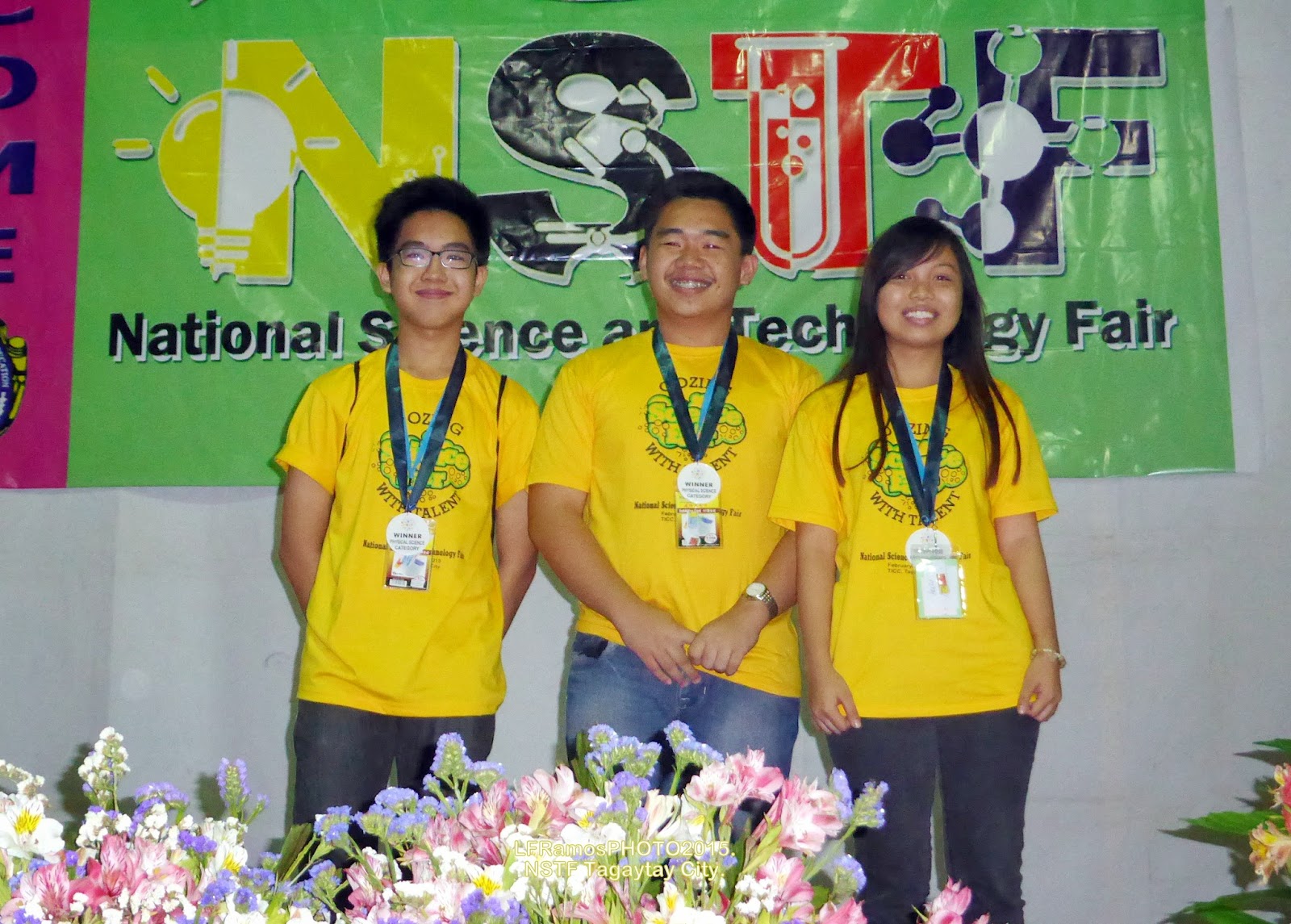
“Oozing with talent,” Jacob described the high school scientists. And that’s exactly what he had printed on the golden yellow T-shirts that the students wore during the fair.  Their talents probed into various areas like nanomaterials, bioremediation, microbiology, software development, environmental management, medicine and health. Some of their explorations utilized materials from the natural terrestrial and marine environment.

He made sure that the spotlight was on them alone: the recipients of special awards from DepEd or from international groups, and the grand prize winners in the individual and team categories in the life and physical sciences. 

Medals for the grand prize winners.
There were all in all six (6) individual and six (6) team grand prize winners: a total of 24, the best among more than 130 science talents in the competition.

Of these grand prize winners, three (3) individuals and two (2) teams were proclaimed candidates for the selection of Team Philippines that will go to the Intel ISEF in Pittsburgh. They will first undergo mentoring, and the final delegation will be announced in March: 

  • Quantification and characterization of proteins from Acanthaster planci skin and spine: its latent role in marine and human pathogens and blood clotting inhibitions (potential management of coral infestation).  Mary Carmelle Antonette Gindap. Iloilo National High School, La Paz, Iloilo City. Region 6.
  • One-step synthesis of biomemetic superhydrophobocity nanofibers copper stearate film electrodes via electrochemical deposition method. Angelo Gabriel Urag. Father Saturnino Urios University, Butuan City. Region 13.
Life Sciences (Individual) grand winners 

  • In ovo anti-angiogenic screening of Gynura nepalensis (Ashitaba) on Anas platyrynchos (Duck) embryo using chrorioallantoic membrane assay.  Rizza Ann Vibar. Las Pinas National HS, Las Pinas, MManila. National Capital Region.
  • Hypoxic-ischemic cerebral cell death and locomotory-cognitive damage mitigation using squid (Thysanoteuthis rhombus) waste integument constituent: Simulated non-arrhythmia inducing mortal stroke evolution disruption. Team of Kenneth Michael Antonio, Marian Cabuntocan & Thea Marie Tinaja. Bayugan National Comprehensive High School. Region 13.
  • Toxicological effect of the bioactive compounds in giant taro (Alocasia macorrhizos) against coconut scale insects (Aspidiotus destructor). Team of Sam Jethro Cudillo, Armie Grace Pepino & Millene Ruth Edradan. Caraga Regional Science HS, Surigao City. Region 13.
Life Sciences (Team) grand winners from Regs. 7 & 13, and PSHS-CLC
 The other grand winners were:  
  • Ficus nota (Blanco) Merr. Moraceae fruit extract for “In vitro” antioxidant and genotoxicity cctivities. John Parlo Rosido. Agoo Kiddie Special School, Agoo, La Union. Region 1.
  • The antimicrobial and cytotoxic activity screening of the ink of sea hare (Dolobella auricularia Lightfoot) or donsol. Team of Sophie Alohilani Iturralde, Mel Michelle Dawn Ramirez & Vanity Temblor. RTPM-Dumaguete SHS. Region 7.

Physical Sciences (Individual) grand winners
  • Luminescent activity of Photobacterium leiognathi isolated from squid ink as its potential as bioindicator for oil contamination. Team of Joseph Neos Cruz, Jailah Mae Valentin & Celine Bueno. PSHS-Central Luzon Campus. Clark, Pampanga.
  • Polyaniline-based fish freshness sensor through digital imaging colorimetry.  Team of Marjorie Gold Maningas, Je-Anne Alodia Presado & Janella Umbina. PSHS-Central Luzon Campus. Clark, Pampanga.

  • Pomelo (Citrus maxima) and Marang (Artocorpus odoratissimus) fruit peelings as potential biosorbent in oil spills. Team of Cresart Ulysses Mata, Annafer Dumalagan & Jerald Nituda. Daniel R. Aguinaldo National High School, Matina,Davao City. Region 11.

    Physical Sciences (Team) grand winners from Regs. 11 & 13, and PSHS-CLC
  • Nanochemical remediation of organochlorine pesticide residues and heavy metals in agricultural soil. Moises Marion Silvestre. Juan R. Liwag Memorial HS, Gapan City. Region 3.

  • Madness Blocker: a cyber eye program for social media and online games. Ashly Katrene Pineda. Nabuslot National HS, Oriental Mindoro. Region 4b.

Angelo Gabriel Urag
Almost all the grand prize winners are in their senior year. Those who will go to Pittsburgh would have received their high school diploma by then and getting ready for college.

Angelo Gabriel Urag though is still in Grade 9 and will go through the K-12 curriculum. He was in the Intel ISEF 2014, and he is now vying for membership in Team Philippines to ISEF 2015. There had been two repeaters in the ISEF. Urag may yet be the third.