Tuesday, September 20, 2016

First learning encounter with sculptor Auguste Rodin

We viewed the special exhibit 'Rodin: Transforming Sculpture' at the Essex Peabody Museum in Salem, Massachusetts the day before we flew to San Francisco simply because we just wanted to see the iconic The Thinker and The Kiss sculptures of Auguste Rodin. We did not know much else about him and his works; hence, this museum visit became Rodin 101 appreciation course for us.

Big white drapes were hang from the ceiling and along the walls of the six exhibition galleries to give the feel of roaming around his studio. There were some 175 pieces on display, big and small, in clay, plaster, marble, patinated plaster, and bronze.

The first gallery had configurations of hands, small statuettes, and up in the wall was The Gates of Hell, the bronze doors that were inspired by Dante's Inferno. We later learned that some of Rodin's major works were originally planned for The Gates, and some figures there were transformed into independent pieces.

One of them is The Three Shades, or the souls of the damned in Dante's Divine Comedy. This trio of nude male in exaggerated twisted pose can also be found at the top of the said The Gates. 


The Three Shades.

In the Christ and Mary Magdalene, which shows a dying man nailed to a rock with a naked mourning woman kneeling in front of him, the Magdalene is said to have been derived from one of the condemned figures in The Gates. 


Christ and Mary Magdalene.

Rodin also called this Prometheus and the Oceanid and The Genius and Pity, thus giving his art piece religious, mythical and secular undertones. On the whole though, we were looking at polished surfaces of naked bodies esp. that of the contorted female against the rough marble on which these are mounted.

While we were looking for the iconic The Kiss, we encountered variations of the kissing theme such as the Eternal Spring. Literature on Rodin's artworks tell us that the latter piece was originally modeled while he was planning The Gates of Hell.

Eternal Spring.

The Kiss.

There were indeed many other naked bodies in this Rodin exhibition like the famous The Thinker both in bronze and patinated plaster; St. John the Baptist in plaster, which we think has resemblance with The Awakening Man in bronze; Adam in bronze and Eve in patinated plaster.

The crooked finger of Adam pointing downward reminded us of Adam's finger in Michaelangelo's mural of the creation in the Sistine Chapel. On the other hand, the brawny contortions in the body of Rodin's Adam contrasts strongly though with the polished structure of Michaelangelo's David. Nevertheless, we found traces of Michaelangelo's influence in the Rodins.


The Thinker.

Adam and Eve.

In contrast to the nudes were the fully robed Monument to Balzac and the three clothed Burghers of Calais, all in bronze.  It was interesting to read that this robed Balzac was controversial, and it took years for Rodin to make several studies before he finally came out with this distillation of the persona of the French novelist and playwright as being alone but with head aloft.

Other Rodin's studies of Honore de Balzac on exhibit were his head in bronze, and his full naked figure in plaster.

Monument to Balzac (top left); bust (top right) and full figure (bottom).

Only three of the six Burghers of Calais were part of the exhibit. These draped figures represent the burghers who chose to sacrifice their lives to save their city during the Hundred Years War,  According to literature on this commissioned work, the figures are arranged in a circle, thus not one of them is the focal point. Rodin created two versions. The Burghers in the memorial in Calais are mounted on a pedestal, and the others at the Musee Rodin in Paris were on the ground so that viewers can go around them.

Three of the six Burghers of Calais. 

The special exhibit was on view from 14 May to 05 September 2016. As expected, the do-not-touch rule was enforced but the organizers provided us slabs of the media (clay, plaster, marble) to feel in lieu of the polished or rough body surfaces of the artworks. We're thankful though that photography was allowed.


Sunday, September 11, 2016

9/11/16: Remembering the Twin Towers

The first thing we had in mind when we got to New York recently was visit the National September 11 Memorial & Museum (9/11 Memorial in short), which opened on the anniversary day five years ago, 

The Memorial consists of twin pools, each about an acre in size, surrounded by bronze parapets where names of the people killed in the attacks of 11 September 2001 and 26 February 1993 are inscribed.  The north and south pools are set within the footprints of the original Twin Towers, which were known then as One and Two World Trade Center (WTC), also as North and South Towers, respectively. 

The Twin Towers and The Sphere at the 9/11 Museum. Photo by the author.

The first item we saw upon entry to the Museum was a blow-up picture of the Twin Towers with the large metallic sculpture called The Sphere in the foreground. And as we gazed at it, memories of more than 30 years ago came flooding in.

In 1982, for six months, we commuted from upper west Manhattan via the A Express subway train to Cortlandt to get to the World Trade Center. We would get into the the express elevator to the 78th floor sky lobby where we'd transfer to the local elevator to get to our cubicle at the 89th floor. We were in training in health physics with Ebasco Services, the largest tenant then of Two WTC (South Tower), occupying 16 floors between the 77th and 93rd. 

Up and down these elevators became quite routine for the lunch breaks either at the ground floor or around the neighborhood, and for the rush to the PATH or to the subway stations nearby for those heading home to New Jersey or elsewhere in New York, respectively,

We were originally facing the windows through which we could see the canyon of buildings on Broadway. One time as we were looking at the view of buildings from our desk, we suddenly realized that the tower was swaying: the vertical frames of the windows were moving vis-a-vis the skyscraper in the distance.  That made us turn the table around, and henceforth, had our back to the windows as we pored through our training materials.

We remembered taking a picture of the Twin Towers before we left New York for a job training in Tennessee. There had also been other pictures that we took at the lobby where the giant tapestry of Joan Miro hang, and those at the top, where, on clear, sunny days, we could see the city and New Jersey as far as our eyes could reach.

The Twin Towers, Oct 1982. Photo by the author.
                                    
Our picture of the towers reminded us that on the day before 9/11, we were at the Austin J. Tobin Plaza, near The Sphere, and we had fun looking at two young Frenchmen trying to get a souvenir photo of themselves with the top of the towers as background. One of them had to lie down with a camera so that he can get the other one framed by the towers as he stood on the parapet around The Sphere. 

This sculptural piece, badly damaged, is installed at the Battery Park, We learned that it would be relocated within the 9/11 Memorial. 

The damaged The Sphere at Battery Park. Photo by the author.

On 9/11, we were preparing to leave our friend's house in Queens for the WTC because we wanted to buy a discounted ticket for a Broadway musical. I think it was The Producer, at a TKTs booth there to avoid the long queues at Times Square. We were having coffee and watching TV. When the first plane struck one of the towers, we thought an accident had just happened. We were all glued to the breaking news still unaware that these were terrorist attacks. When the towers came down, the young man in the house was almost in panic, deeply worried of  his friends who were working within the WTC complex. 

Subway trains to lower Manhattan were suspended that day. Some lines were opened the next day and we could get to the Penn Station on 34th Street. The Amtrak trains were running, and we decided to leave for Boston.

The train was full, and everybody it seemed had a newspaper to read. The headlines were all about the terror that hit the United States on 9/11: the attacks on the towers and the Pentagon, and an aborted one due to the heroic act of the passengers.

Relics from the towers at the 9/11 Museum. Photo by the author.

We felt the terrorist scare when we were approaching Providence, Rhode Island. Suddenly, without explanation, the train stopped on the tracks. The wait for it to resume running became stressful and tense. The mobile phones of passengers calling their friends or families provided the logical answer to our predicament. Our train was stopped because authorities were searching another train on the other track for suspected terrorists.

The parapet around the 9/11 Memorial pools. Photo by the author.

9/11 wrought a drastic change in the airport departure protocols. We were among the first to taste stricter security procedures from Boston to San Francisco on our way home to Manila a week after. We remember that our check-in baggage were selected for inspection in Boston, and we had a good laugh with the inspector regarding the large quantity of chocolate candies we were bringing home. They were very alert for pointed objects.  In San Francisco, a good friend who was on the same flight with us had a micro screw driver in his carry-on. He argued that it's something not easy to find in Manila, hence, as an accommodation, it was wrapped, tagged, and checked in, in a way, with the flight crew.

9/11 reverberates in every airport around the world. One can not even get a bottle of water past security. 


Wednesday, September 7, 2016

Did Jose Rizal leave his heart in San Francisco?

Many Filipinos entering the United States for the first time through San Francisco may be surprised to know that national hero Jose Rizal preceded them here more than a century ago.

From Tokyo, he wrote his parents and siblings that "[o]n the 13th of [April 1888] I leave for America on the steamship Belgic of the Oriental and Occidental Company. I intend to stay in America some weeks and afterward depart for London where I should be toward the end of May."

The steamer sailed from Yokohama, and based on the data from the 'Marine Ships in Port' of 'The Maritime Heritage Project - San Francisco 1846-1899', a voyage of the Belgic in 1890 took 15 days 13 hours and 44 minutes before it dropped anchor at the port in San Francisco.

The Port of San Francisco, 1849. (Source: The Maritime Heritage Project.)

On Saturday, 28 April, Rizal wrote in his diary: "We arrived in the morning at San Francisco, We docked, They say that we shall be quarantined, The little customs launch came to visit us. They have unloaded the silk cargo: Each bale costs about $700. They are not afraid of the silk and of the lunch."

The next day, Sunday, he noted: "The second day of the quarantine, We are bored. I no longer know how to amuse myself."  And he wrote to his parents: "Here we are in sight of America since yesterday without being able to disembark, placed in quarantine on account of the 642 Chinese that we have on board coming from Hong Kong where they say smallpox prevails. But the true reason is that, as America is against Chinese immigration and now they are campaigning for the elections, the government, in order to get the vote of the people, must appear to be strict with the Chinese, and we suffer. On board there is not one sick person."

On the third day: "The quarantine continues. I read in the newspapers a statement of the health inspector against the quarantine."  He wrote to his friend Dr. Ferdinand Blumentritt: "We are anchored in this port under quarantine. We don't know how long it will last, although there are no sick passengers aboard and the ship did not come from a filthy port. The reason for this is that we have 643 Chinese passengers and, as elections are approaching, the government wants to be in the good graces of the people. We protest, but it is useless for, as the Spaniards say, it is like exercising the right to kick."

On 01 May, Rizal said they signed a protest against the quarantine and the Englishmen wrote to their consul. After six days of quarantine, in the afternoon of 4 May, they, the first class passengers finally stepped on American soil.  The Japanese and Chinese remained on board.

At that time, the disembarkation point was not the postcard Port of San Francisco we see today. So where did the Belgic docked?  Gary Kamiya provided the most probable answer in his book Cool Gray City of Love: "The thousands of Chinese immigrants that poured into the city disembarked at the Pacific Mail Steamship pier, near what is now First and Brannan."

Marker on the wall of the Palace at the Montgomery St-
Market St. corner.

From there, Rizal could have taken a coach to the first class Palace Hotel on New Montgomery Street, where he lodged at "$4.00 a day with bath and everything included"  Based on the historical data of 1887, he stayed in a sunny outside room with southern exposure that cost '$4.00 per day and upward.'  It was more expensive by a dollar if he stayed in an outside room 'with facing street.' The cheapest were for outside rooms facing open courts: '$2.50, $3.00 and upward.'

There was not much in his diary from which to deduce how Rizal spent his short time in the city,

He simply wrote: "...Stockton St. 312. I saw the Golden Gate ... (one illegible word). The customs-house. A letter of recommendation. On Sunday the stores are closed. The best street in San Francisco is Market Street. Stroll. -- Stanford, the rich man. -- A street near Chinatown."

We must note that Rizal might have been referring to the Golden Gate Strait, the entrance to San Francisco Bay, because the iconic bridge was built in the 1930s. Or, he could have gone to the Golden Gate Park but he could not have walked to this large public park as it was too far from the hotel. He did not mention taking the streetcar that was already running to this place in 1887.

When he stepped out for a walk, the first thing that he could have noticed were the cable cars that had been running along Market Street since 1883. These cars replaced horse-drawn rails. He might have preferred to walk rather than take the cable car; hence, his remark that Market was the best street of the city.

When he strolled on Market, he could have noted at the corner of Geary and Kearny, a short distance from the hotel, Lotta's Fountain: a cast iron sculpture painted in bronze with lion's heads and other ornaments. Historical accounts say that this fountain was presented to the citizens of San Francisco in 1875 by the famous Lotta Crabtree, who started her career as a vaudeville performer in the city during the Gold Rush days.

The Lotta's Fountain in 1901 when Pres. McKinley visited the Palace Hotel.  (Source: Wikipedia)

The Lotta's Fountain today near the Palace Hotel. Photo by the author.

Except for the other buildings and street scenes, the vintage and recent photographs of Palace Hotel with Lotta's Fountain are quite similar except that the original hotel, where Rizal stayed, was gutted by fire in the aftermath of the 1906 earthquake. The reconstructed one was opened in 1909.

'Stanford, the rich man.'  Rizal was referring to Leland Stanford, one of the 'Big Four Millionaires' from the Gold Rush and was also dubbed a robber baron. His farm spawned the Stanford University. Did Rizal hear about his anti-Chinese attitude when he was governor of California? He lobbied for the restriction of Chinese immigration during his term.

'A street near China town,' he wrote. Did he go there? The scene could have been similar to Binondo of his student days in Manila.

He was in San Francisco for two days and two nights, and left for Oakland in the late afternoon of 06 May 1888 on a ferry boat. From there, he would board the train that eventually took him on a coast-to-coast journey to New York City.

From London, Rizal would relate his overall impression of America to his friend Mariano Ponce in his letter of 27 July 1888: "I visited the largest cities of America with their big buildings, electric lights, and magnificent conceptions. Undoubtedly America is a great country, but it still has many defects. There is no real civil liberty. In some states the Negro cannot marry a white woman, nor a Negress a white man. Because of the hatred of the Chinese, other Asiatics, like the Japanese, being confused with them, are likewise disliked by the ignorant Americans. The customs is excessively strict. However, as they say rightly, America offers a home to the poor who like to work."

He cited his sad experience in San Francisco: "There was moreover much arbitrariness; for example, when we were in quarantine. They placed us under quarantine, in spite of the clearance given by the American consul, of having been at sea for about one month, of not having a single case of illness aboard, and of the telegram of the governor of Hong Kong declaring that port free from epidemic. We were quarantined because there were on board 800 Chinese and, as elections were being held in San Francisco, the government wanted to boast that is was taking strict measures against the Chinese to win votes and the people's sympathy. We were informed of the quarantine verbally, without specifying its duration. However, on the same day of our arrival, they unloaded 700 bales of silk without fumigating them; the ship's doctor went ashore; many customs employees and an American doctor from the hospital for cholera victims ate on board. Thus we were for about thirteen days. Afterwards only the passengers of the first class were allowed to land, the Japanese and Chinese of the 2nd and 3rd classes remaining in quarantine for an indefinite period. It is said that in that way they got rid of about 300 Chinese, letting them gradually die on board. I don't know if this is true."

In November that year, the Americans were going to elect their president. The incumbent was Grover Cleveland (Democrat). In California, they voted for the Republican challenger Benjamin Harrison.

The Chinese issue of Rizal's time resonates in the present debates on immigration policy between the Republican Donald Trump and the Democrat Hillary Clinton. Trump had swiped at illegal immigrants particularly the Mexicans, but he also clawed at people coming from what he deemed terrorist nations, and tagged the Philippines as one of them. "We're dealing with animals," he trumped.


Note:  
Rizal's diary entries and letters were taken from the book Jose Rizal Reminiscences & Travels published by the National Historical Commission of the Philippines in 2011.

Recommended reading on the historical and current views of San Francisco:
Kamiya, Gary. 2013. Cool Gray City of Love: 49 Views of San Francisco. Berryville, VA: Berryville Graphics, Inc,


Wednesday, August 31, 2016

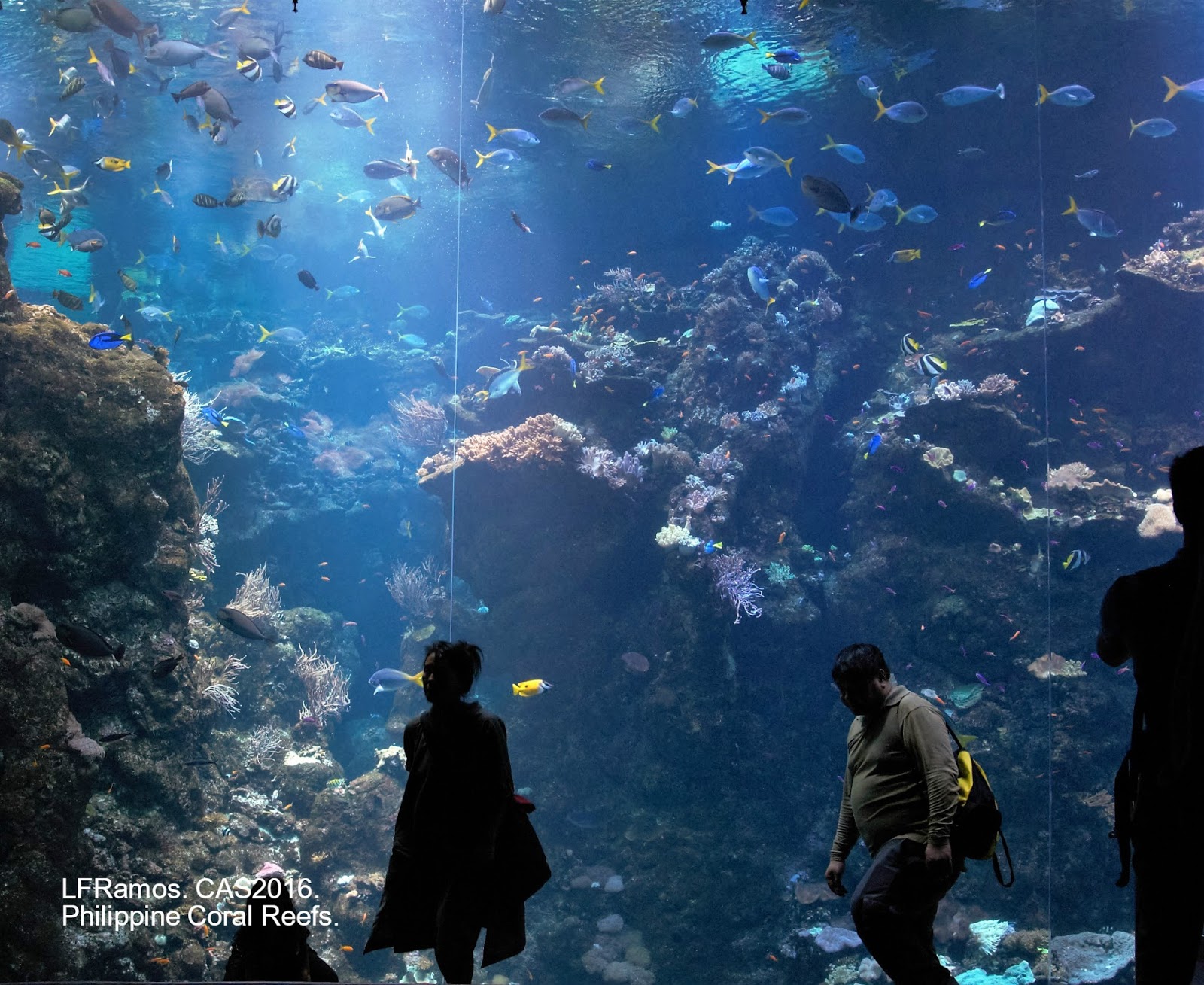
Philippine coral reefs at the California Academy of Sciences

We had to be in San Francisco, CA for a close look at marine life in Philippine coral reefs without donning a diving suit and a breathing apparatus. For the record, we had a camera whose shutter speed and aperture opening we had to adjust to the available light under the Philippine sea in an American setting.

Our 'diving site' was a 212,000-gallon aquarium of the California Academy of Sciences (CAS), which replicates some of the diversity found in our coral reefs.  

The coral reefs, says CAS, 'are among the world's most diverse ecosystems. Home to more than 500 coral species and 3,000 fish species of fish, they support entire ocean ecosystems and the people rely on reefs for food, income, and protection from storms.'

The Academy has been doing research in our country for more than a century, and the latest one was the 2014 Philippine Biodiversity Expedition that focused on marine habitats near the apex of the Coral Triangle. It surveyed the Triangle's 'twilight zone', a habitat 40 to 150 meters deep, where no humans had entered before.

The Triangle refers to the triangular area of the marine waters of Indonesia, Malaysia, Papua New Guinea, Philippines, Solomon Islands and Timor-Leste. The Philippines is near its apex.


Hundreds of species have been discovered through the joint efforts of Academy and Filipino scientists but they estimate that 'fewer than half of all reef species have been identified.'  During the cited expedition, at least 300 new species were discovered' such as the deep-water coral Philippine sea fan (Solenocaulon sp.) and the spiny, globular Philippine pencil urchin (Phyllacanthus imperialis), whose specimens are on display at the CAS.

The Academy noted that pollution, coastal development, global climate change, and non-sustainable fishing practices pose severe threats to Philippine diversity. It has 'developed a practice of rapidly translating data collected in the field into effective marine conservation actions.'


'The 2011 Philippine Expedition,' the Academy reported in its webpage, 'resulted in recommendations for better regulation of existing Marine Protected Areas, as well as the establishment of new MPAs. Today, that work—in conjunction with community-based conversation projects—has recently begun to yield reversed degradation in coral reefs. While the threats still far outweigh any recovery, these comprehensive policies and practices have begun to slow the loss of biodiversity in the Philippines. Here [in California], our work in the Philippines enriches and informs Academy exhibits, where it continues to reach millions of visitors, teachers, and students each year.'


Part of the exhibit is a video presentation of 'Filipino Voices' which shows Filipinos 'who are championing marine sanctuaries, changing fishing practices, protecting precious reefs for future generations.'

In its caption on the Philippine pencil urchin, the Academy cited the villagers living near Batalang Bato, a popular dive spot.  'After decades of unsustainable practices,' CAS said, '[they] established one of the first community-initiated marine sanctuaries. Academy researchers worked closely with the community leaders and after six years of protection, a once depleted reef now teems with life that will repopulate other nearby reefs.'


This community action resonates with the marine turtles conservation project of volunteer fisher folks in our coastal village La Paz in the San Narciso town of Zambales province. For the past four years, they have been operating a hatchery during the nesting season to ensure the survival of the endangered Olive ridley turtles for future generations. They know that these creatures feed on sea grass and in so doing, they maintain the balance in the ecosystems in the reefs, the breeding ground of fishes. Fishing is the primary source of livelihood of these volunteers.


Tuesday, August 23, 2016

Japan Overseas Cooperation Volunteers: 2016 Ramon Magsaysay Awardee

The Ramon Magsaysay Award. (Source: http://rmaward.asia/)

We have not encountered Japanese Overseas Cooperation Volunteers (JOCVs) except through the cinema. In the recent Japanese Film Festival Eiga Sai 2016 in Metro Manila, one of the featured movies was about three young volunteers in the Philippines, two men and a woman: one of the men worked with the tourism department as a photographer and the other as an aquaculture worker in Mayoyao, Ifugao, and the woman as a midwife in a Baguio hospital.  This movie titled "Crossroads"  was released in 2015.

We tried to find out if the movie story line is based on actual experiences of JOCVs in the Philippines. 

There was indeed a volunteer who assisted the municipal agriculturist of Mayoyao in setting up a simpler and organic method of raising loach in 2013. This fish (dojo to the people) is abundant in the rice fields there but it is not an indigenous species; it is also eaten in Japan, Korea and China.

In "Crossroads", the aquaculture volunteer is a young man, The one who stayed in Mayoyao was a young woman. 

Available accounts of JOCV accomplishments in the Philippines do not mention any one involved with tourism, but they do mention those who did public health nursing in some parts of the country other than the Cordilleras.

The JOCV was established as a program of the Japan International Cooperation Agency (JICA) in 1965 to assist developing countries,  Volunteers (aged 20 to 39) are assigned to host countries for two years. The first volunteers were dispatched to the Philippines in 1966. Their website says that 'the Philippines is one of the countries with the largest number of JOCV assignments.'

The fields of specialization of volunteers in the Philippines are listed as follows:
  • Agriculture, forestry, fisheries: animal husbandry, soils and fertilizer, aquatic products processing, animal hygiene, veterinary medicine, rural community development;
  • Manufacturing and maintenance:  ceramics/chinaware, product design, garments
  • Education and information services: science and math, computer technology, Japanese language instruction, youth activities;
  • Public health and medical service: nurse, physical therapy, social worker, nursing for disabled person.
The Ramon Magsaysay Award Foundation says that the "[a]reas of volunteer work span 190 fields of specialization in education, social welfare, health care, environmental sustainability, agriculture, manufacturing, public works, sports, and governance. The work of JOCV volunteers improved lives, induced behavioral change, and transferred knowledge and skills to partners and communities in many countries."

Now on its 51st year, the JOCV has been chosen as one of the six recipients of the Ramon Magsaysay Award for 2016.  This is in recognition of the "idealism and spirit of service in advancing the lives of communities other than their own, demonstrating over five decades that it is indeed when people live, work, and think together that they lay the true foundation for peace and international solidarity.”

The citation capsulizes work done by the volunteers in several countries: "In Laos, Japanese volunteers assisted a provincial handicraft center in the design and marketing of products in a project aimed at reducing the villagers’ reliance on poppy farming. In Ghana, a volunteer who worked with Toyota in Japan helped locals with on-the-job training in automotive repair and a car assembly shop. In Bangladesh, a succession of a hundred volunteers over a ten-year period improved the preventive polio vaccination rate and eradicated polio and filariasis in the country. In the Philippines, volunteers teamed up with local teachers in developing teaching materials and organizing programs to foster interest in science among young Filipinos. These are a few of thousands of examples of the myriad arenas of interaction in which young Japanese men and women voluntarily immersed themselves in other cultures and helped people and communities."

The citation also mentions Hidekazu Kumano, a volunteer in the 1960s who has maintained his friendship with the people of Benguet. When he was assigned there, he worked with the farmers in growing thousands of mulberry trees.

In brief, the Magsaysay Award recognizes the JOCVs for "building a world of genuine solidarity/" 

Source: The Ramon Magsaysay Foundation at http://rmaward.asia/

There are two other organizations who will receive the Award: Dompet Dhuafa (Indonesia) for "expanding the transformative impact of zakat" and Vientiane Rescue (Laos) for "volunteering to save lives at risk".

Three individuals will also be honored with the Award:  Thodur Madabusi Krishna (India) for "ensuring social inclusiveness in culture," Bezwada Wilson (India) for "asserting the inalienable right to a life of human dignity," and Conchita Carpio Morales for "restoring faith in the rule of law."

The 2016 Ramon Magsaysay Award Presentation Ceremonies will be on 31 August 2016 at the Cultural Center of the Philippines. 


Friday, August 19, 2016

Philippine dignitaries in the history of New York's ticker-tape parades

It's not a tourist attraction in New York City: the series of granite plaques inlaid into the sidewalks on both sides of the city's most famous Broadway Avenue. These bear names and dates inscribed in steel, which I later learned to be the honorees of the New York ticker-tape parades through the years from 1886 to the latest in July 2015.


Granite panel commemorating ticker-tape parade for Pres. Carlos P. Garcia.

Coming from the 9/11 National Memorial, this plaque caught my interest on my way to lunch: "June 23, 1958. Carlos P. Garcia, President of the Philippines" (all caps). Later, I found out what this and the others were all about; the plaque on the sidewalk of 1 Broadway says that "These granite panels commemorate the New York tradition of ticker-tape parades up Broadway from the Battery to City Hall. This celebrated route is called the Canyon of Heroes [all caps]."

The commemorative markers were embedded in 2004 in chronological order starting from the southernmost point of the Canyon (across the Bowling Green with the popular Charging Bull sculpture and the Museum of American Indians nearby) up to the Woolworth Building.

The first ticker-tape parade happened on 28 October 1886 when the Statue of Liberty was unveiled. At that time, stock brokers occupied many offices along Broadway. They had ticker-tape machines, and they relayed stock market prices using ticker-tapes. According to accounts, when the celebration parade passed by, they ripped ticker-tapes off and threw them out of the window onto the parade. The ticker-tape parade tradition thus began.

This panel explains the embedded ones on Broadway Ave. sidewalks.

The mayor of New York City  decides who to honor with a ticker tape parade. The list includes important events (landing on the moon, end of World War II, triumphs of hometown sports teams) and dignitaries (royalties, heads of states, athletes, etc.).

So far, there had been only three honorees from the Philippines;  Elpidio Quirino, President of the Philippines. 11 August 1949; Carlos P. Garcia, President of the Philippines. 23 June 1958; and Diosdado Macapagal, President of the Philippines. 08 October 1964.  These were during their state visits to the United States.

Commemorative panel of ticker-tape parade for Pres. Elpidio Quirino.

Commemorative panel of ticker-tape parade for Pres. Diosdado Macapagal.

As an aside, Admiral George Dewey and General Douglas MacArthur, two prominent names in the history of the Philippines as an American imperial territory, were also showered with ticker-tape in the Canyon of Heroes. Dewey's defeat of the Spanish armada in Manila Bay to MacArthur's destructive redemption of his 'I shall return' promise defined the timeline of the Americanization of the Filipino psyche.

New York welcomed him after Pres. Truman dismissed him as commander of the UN forces in Korea.

New York welcomed Dewey upon his return from Manila with a parade on 30 September 1899.   MacArthur's parade did not happen after World War II. Ticker-tape rained on him on 20 April 1951 following his dismissal 'on the grounds of insubordination' as commander of the U.N. forces in Korea by President Harry S. Truman.

The ticker-tape parades remind us of the "yellow confetti" that rained down from the business buildings in Makati after the assassination of Ninoy Aquino in 1983. These were shredded yellow pages of telephone directories thrown out of windows during the protest rallies on Ayala Avenue.

No one was honored in those "yellow confetti" rallies. They were symbols of indignation against strongman Ferdinand Marcos,


Sunday, August 7, 2016

Discovering the Lopez Family of Balayan, Batangas in Boston, MA

The Lopez ancestral house, Balayan, Batangas. Photo taken by the author in 2014.

My fraternity brother based in New Haven, CT and I were on our way to Copley Square of Boston, MA when, out of curiosity, we paused in front of the New England Genealogical Society building and decided to check what can its library be holding. I keyed in 'Manila' to the desktop computer on one of the tables; a list came out including pdf version of the book 'The Story of the Lopez Family, A Page from the History of the War in the Philippines' published in Boston in 1904, and digitized by Google. A copy can be downloaded from Googlebooks. 

The editor Canning Eyot said that the letters of Juliana Lopez formed the backbone of the book, which also included exchanges among her other siblings. These chronicle the friendly-to-hostile turn of events during the Philippine-American war that affected their family, the province of Batangas and the Philippine Republic, all because of their brother Sixto Lopez, a very good friend of Jose Rizal.

The story said the family was from Balayan, Batangas, and this reminded me of visiting an ancestral house there two years ago in July during the annual 'Parada ng mga Litson' (Parade of Roasted Pigs) event there. I reviewed my files and found out that this was the house of the Lopez family which has been converted into a museum. It was full of historical memorabilia like heirloom pieces and pictures on the walls but I was more interested in the architecture and construction of the house, amazed at the envelope of capiz windows around the main floor.

Looking at the picture of the house I took, I noted that there were two large tarpaulin pictures hanging by the windows for passers-by to see. These are the same pictures included in the book:  that of Sixto Lopez and Jose Rial, and that of Clemencia Lopez.


Photo from page 32 of the book.
The first picture was "from a photograph taken in Hong-Kong on Rizal's return from Europe in 1891. ... It is interesting .. because of an incident which occurred when it was being taken. In response to the customary injunction to "look pleasant," Rizal said to Lopez, "Yes, -- imagine that you are just about to be executed by the Spaniards!" These were prophetic of Rizal's tragic death, which occurred five years later."

Before the outbreak of the war, Sixto was in Washington to seek recognition for the new Philippine Republic. He was also advocating for negotiating peace with the United States. 

At the start of the American occupation of Batangas, the Lopez family extended hospitality to the American officers stationed there, keeping their house in Balayan open to them.

Eventually, the US military forces would turn hostile to them even if Cipriano, who was an officer in Aguinaldo's army, surrendered with his men and arms. Mariano resigned from his post in the Malolos Congress to attend to their businesses, which included shipping. 

But Sixto did not want to take the oath of allegiance to the US. He failed to convince General Malvar and other die-hard generals from Batangas to surrender; they persisted in their armed resistance. The Americans considered Sixto still an enemy, and pursued a scorch-earth policy (water and fire methods) in the province just like they imposed in Panay and Samar. 

Photo from the frontispiece of the book.
Part of the narrative on the Lopez saga mentioned Felipe Buencamino, labelled here as evil genius and Judas, who recommended arrest of wealthy non-combatants, and 'extermination of the entire population of Batangas'

The Lopez house in Balayan, their estates and ships were seized by the Americans, and Lorenzo, Cipriano and Manuel arrested and imprisoned in an island on Manila Bay.

Clemencia went to the United States in April 1902 to "seek justice at the hands of the President [Theodore Roosevelt] for her imprisoned brothers" with the help of their friends in Boston but her petition was denied. 

There were other friendly Americans in Manila who vouchsafed for them, sending testimonial letters to civil and military authorities about the integrity of the family.

Eventually, the saga came to a happy ending, the family honor restored and their business losses incurred in their shipping business compensated by the Americans. 

This is not only the story of one family, It tells us how America made us Filipinos bow under the threat of water and fire in their so-called 'pacification campaign'.